
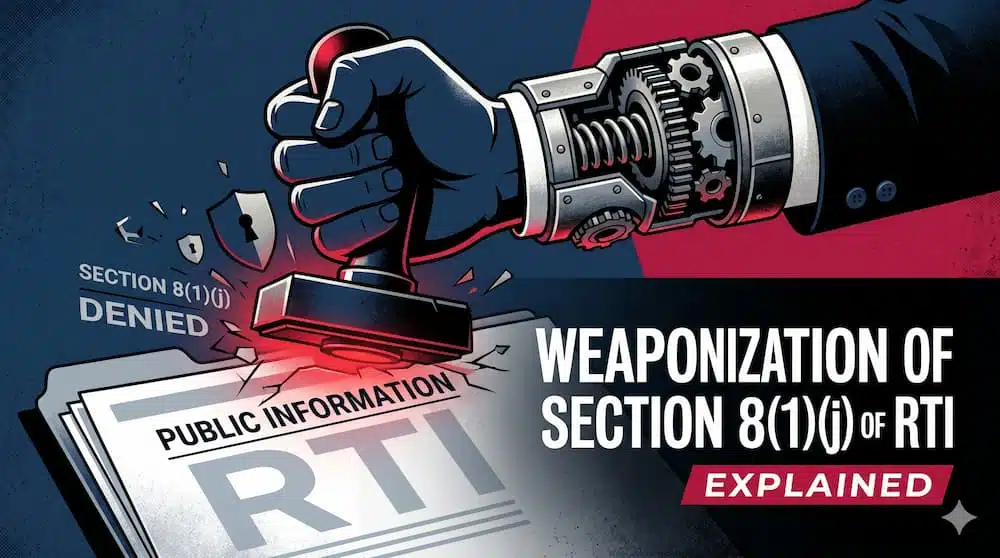
Weaponization of Section 8(1)(j) of RTI is obvious from the fact that an information seeker is requesting details about their own application for Farmer Registration. Given that the government department is actively processing this information, it clearly falls under the definition of public information as stated in the RTI Act. The essence of this legislation is to promote transparency and accountability within governmental operations. If the applicant cannot secure information about their own application from the relevant government department, one must question the validity of the RTI framework itself. This raises serious concerns about accessibility to personal information and undermines the very purpose of the RTI, which is to empower citizens by granting them access to information pertaining to their rights.
Key Takeaways
- The Weaponization of Section 8(1)(j) of RTI undermines transparency as public authorities deny access to an applicant’s own information.
- Public Information Officers (PIOs) misapply Section 8(1)(j), using it as a shield against accountability for administrative failures.
- Information seekers face denials even when seeking tracking data related to their families due to wrongly invoked privacy clauses.
- The RTI Act mandates disclosure of processing logs, yet authorities often conceal this information to evade scrutiny.
- State Information Commissions must enforce transparency and penalise PIOs who misuse the provisions of the RTI Act.
Weaponization of Section 8(1)(j) of RTI: How Public Authorities Hide Administrative Failures
The Right to Information (RTI) Act, 2005, aimed to transform the relationship between the Indian citizen and the state. It sought to replace opaque governance with absolute accountability. However, more than two decades into its implementation, public authorities routinely dodge public scrutiny. Specifically, a rising and deeply concerning trend in bureaucratic evasion is the weaponization of Section 8(1)(j) of RTI to suppress transparency.
A striking case study of this tactical roadblock appears in “Yogimp RTI case No A-20260402727.pdf”. In this matter, the Office of the Deputy Director of Agriculture, Mirzapur, issued a blanket denial of information. By deploying this exemption clause as a routine obstacle, public officials actively shield systemic irregularities from the light of day. Furthermore, they use it to hide deliberate stalling and manual manipulation.
The Legal Facade: The Real Purpose vs. The Exploitation
Section 8(1)(j) of the RTI Act exempts the disclosure of personal information under specific conditions. For instance, it blocks data that has no relationship to any public activity. Additionally, it protects details that would cause an unwarranted invasion of privacy. Therefore, the legislative intent behind this clause is simple: it protects private citizens from having their personal data exposed to malicious third parties.
However, the reality on the ground has shifted toward the systemic weaponization of Section 8(1)(j) of RTI. Instead of applying the privacy law correctly, Public Information Officers (PIOs) issue templated rejections to bury records of administrative stagnation. Consequently, when a citizen asks for the tracking metrics of public welfare schemes, the PIO merely copy-pastes the text of the privacy exemption. They do this because they hope the applicant will abandon the pursuit out of sheer exhaustion.
Core Issue 1: Denying the Applicant’s Own Data
The most egregious example of the weaponization of Section 8(1)(j) of RTI occurs when public authorities refuse to give an applicant information regarding their own files. In the Mirzapur agricultural case, for example, the PIO blocked details for Reference No. 20250119514266. Yet, the file records conclusively show that this specific application belongs directly to the applicant himself, Shri Yogi M. P. Singh (Mahesh Pratap Singh).
Established principles of administrative law clearly state that privacy exemptions cannot apply to the individual who owns the data. Therefore, a public authority cannot statutorily declare an applicant a “third party” to his own life and records. Denying a citizen access to his own file under the guise of privacy is a logical absurdity. Ultimately, it represents a direct violation of natural justice.
Core Issue 2: The Fallacy of the “Third-Party” Shield Among Kin (Weaponization of Section 8(1)(j) of RTI)
Similarly, the second line of bureaucratic defense usually involves applications that immediate family members file. In this matter, the PIO denied tracking data for Reference Nos. 20250119192467 and 20250119512524. These files belong to the applicant’s biological younger brothers, Shri Arun Pratap Singh and Shri Keshav Pratap Singh.
The public authority invoked the privacy shield because they claimed disclosure would invade third-party privacy. However, this defense falls apart on two structural counts:
- Familial and Joint Interest: The individuals are biological brothers who share a joint agricultural interest. As a result, they have actively aligned to track these files, leaving zero room for unsolicited intrusion. PDF+ 1
- Consent Overrides Exemption: Immediate kin explicitly authorized the information seeker to track their files. Because of this authorization, the core prerequisite of an “unwarranted invasion of privacy” completely dissolves.
Core Issue 3: The “Final Stage” Paradox—Why Processing Logs Must Be Disclosed
A critical focal point of this case is the PIO’s assertion that the applications stand “Rejected at the Tehsil level”. If a public authority officially declares that a file has reached its final stage of rejection, they face a legal obligation. They must produce the complete processing trail that led to that final decision.
Indeed, a final administrative outcome cannot exist in a legal vacuum without its processing history. If an application has been rejected, the daily progress records become vital. Similarly, desk movement sheets and internal official notations form the very foundation of that order. Therefore, withholding the journey while declaring the destination violates the transparency mandate.
Furthermore, administrative law dictates that any rejection by a state authority must feature a clear, reasoned file noting. Through the weaponization of Section 8(1)(j) of RTI, the PIO attempts to conceal whether a lawful, reasoned order ever existed in the first place.
Core Issue 4: Exposing Digital Portal Contradictions
The systemic danger of allowing PIOs to hide processing logs becomes clear when we examine digital dashboards. In the case documented in “Yogimp RTI case No A-20260402727.pdf”, the local department manually claimed the applications were rejected. Concurrently, the state government’s official DARSHAN Portal continued to display their status actively as “Vicharadheen” (Under Consideration). (Weaponization of Section 8(1)(j) of RTI)
| Local Department Claim | State DARSHAN Portal Status |
|---|---|
| “Rejected at Tehsil Level” PDF | “Vicharadheen” (Under Consideration) PDF |
This massive data mismatch points directly to why officials withhold the daily progress reports. Citizens require the tracking logs to expose exactly where the transmission failed between the local desk and the public dashboard. Thus, the systematic denial under the guise of privacy is a desperate defensive strategy to escape anti-corruption scrutiny.
The Overriding Commandment: The Proviso to Section 8(1)(j)
Even if an item of information is deemed personal, the law contains an absolute check against bureaucratic stubbornness. The statutory Proviso to Section 8(1)(j) of the RTI Act explicitly states:
“Provided that the information, which cannot be denied to the Parliament or a State Legislature shall not be denied to any person.”
The efficiency or prolonged delay of a government desk handling farmer welfare applications is highly reportable. If a Member of the Legislative Assembly (MLA) can demand a report on why public portals display conflicting data, the state cannot deny that exact same information to a citizen.
Conclusion: The Path Forward Before the Commission
When public authorities use privacy laws to mask administrative failure, the State Information Commission must intervene firmly. In the ongoing proceedings before the Uttar Pradesh Information Commission (Hearing Room S-9, File No. S09/A/0581/2026), the Appellant has placed these exact structural arguments on record. (Weaponization of Section 8(1)(j) of RTI)
To protect the integrity of the RTI Act, Information Commissioners must look past the weaponization of Section 8(1)(j) of RTI. They must reject these evasive point-wise denials. Finally, they should invoke Section 20(1) to penalize PIOs who intentionally misapply the law. True transparency will only arrive when public servants realize that the privacy clause is a lock to protect private citizens, not a shield to hide public accountability.
Based on the official records and communications for your ongoing case before the Uttar Pradesh Information Commission, here are the structured details of the application IDs, contact information, and public authority web links:
🆔 Application & Reference Identifiers (Weaponization of Section 8(1)(j) of RTI)
- RTI Case Registration Number: A-20260402727
- Commission File Number: S09/A/0581/2026
- Commission Diary Number: D-230620260040
- UPIC Welcome ID: UPICR20240000149
- Farmer Registration / Portal Reference IDs:
- 20250119514266 (Mahesh Pratap Singh)
- 20250119192467 (Arun Pratap Singh)
- 20250119512524 (Keshav Pratap Singh)
📧 Email Addresses & Contact Numbers (Weaponization of Section 8(1)(j) of RTI)
- The Appellant (Yogi M. P. Singh):
- Email:
yogimpsingh@gmail.com - Mobile Number: 7379105911
- Email:
- The Public Information Officer (Vikesh Kumar, DDA Mirzapur):
- Official Email:
ddamzp2012@gmail.com
- Official Email:
- The State Information Commission (Hearing Room S-9):
- Bench Email:
hearingcourts9.upic@up.gov.in
- Bench Email:
🌐 Official Web Links & Portals (Weaponization of Section 8(1)(j) of RTI)
- Commission Web Portal: UPIC Virtual Hearing Link[cite: 1]
- State Agriculture Dashboard: Uttar Pradesh DARSHAN Portal
- State Welfare Tracking Dashboard:DARSHAN Portal: The official Uttar Pradesh agricultural tracking platform used to verify the Vicharadheen (Under Consideration) status of farmer welfare metrics.


Facing a similar challenge? Share the details in the box below, and our team of experts will do their best to help.