
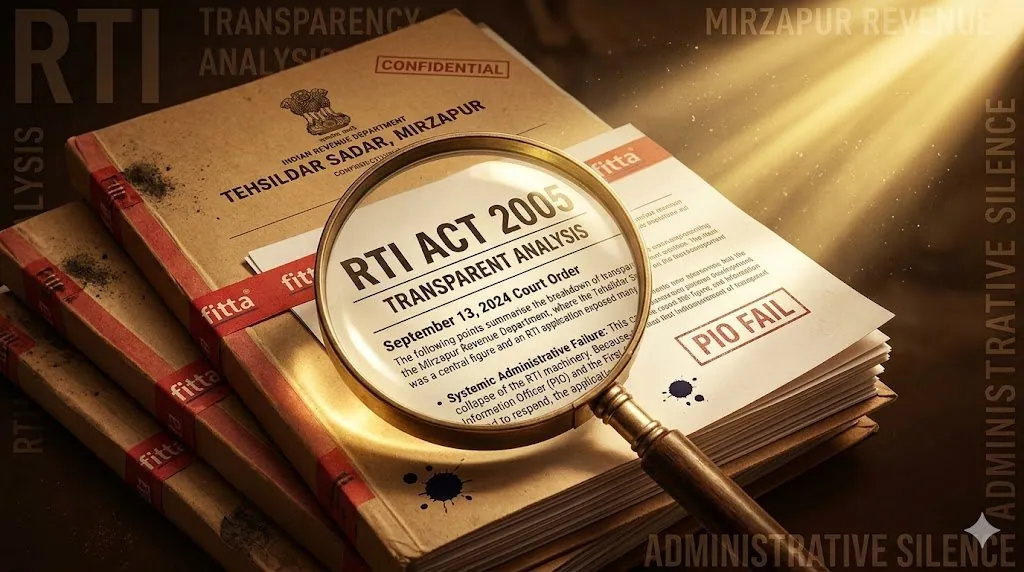
The key takeaway from this post is that the Tehsil Sadar Revenue Department in Mirzapur is experiencing a systemic collapse of accountability regarding the RTI Act 2005. This issue specifically concerns the Tehsildar Sadar & RTI Application process and the challenges faced by applicants.
By failing to respond to an application concerning a September 2024 court order, both the Public Information Officer (PIO) and the First Appellate Authority (FAA) have effectively used “administrative silence” as a shield to protect subordinate staff (the local Lekhpal) from judicial oversight.
Other critical points include:
- Legal Defiance: The department ignored mandatory 30-day and 45-day statutory timelines, which the appellant characterizes as “administrative anarchy.”
- Demand for Reform: The dispute centers not just on specific facts, but on a demand for transparency regarding the “specific mechanisms” the government uses to punish official delays and corruption.
- Impending Penalties: Due to these failures, the officials now face potential monetary penalties (up to ₹25,000) and disciplinary action as the matter moves to the State Information Commission.
Tehsildar Sadar & RTI Application: The RTI Dispute in Mirzapur
The following points summarise the breakdown of transparency in the Mirzapur Revenue Department, where the Tehsildar Sadar was a central figure and an RTI application exposed many issues.
- Systemic Administrative Failure: This case reveals a total collapse of the RTI machinery. Because both the Public Information Officer (PIO) and the First Appellate Authority (FAA) failed to respond, the applications remain stuck in a perpetual state of “Received.
- Obstruction of Judicial Orders: Furthermore, a central theme involves the non-compliance of a court order dated September 13, 2024. The RTI served as a tool to uncover why a local Lekhpal (revenue officer) failed to submit a report for five months. Consequently, this suggests that officials use silence to shield subordinate staff from accountability, particularly with respect to Tehsildar Sadar and the RTI application process in Mirzapur.
- Breach of Statutory Timelines: The department ignored the legal timelines established by the RTI Act 2005:
- The PIO missed the mandatory 30-day window.
- In addition, the FAA failed to adjudicate the appeal within the 45-day limit.
- Demand for Structural Transparency: The appellant is not just seeking facts; rather, he is demanding access to government circulars intended to curb corruption. In fact, these demands often arise specifically from incidents involving Tehsildar Sadar and related RTI applications.
- Potential Legal Consequences: Under Section 20 of the RTI Act, the respondents now face monetary penalties, disciplinary action, and formal admonishment.
Silence as a Shield: The Erosion of RTI Accountability
In a vibrant democracy, the RTI Act is the “sunlight” that disinfects the dark corners of bureaucracy. However, when officials choose total silence, that sunlight vanishes. The case of Yogi M. P. Singh vs. Revenue Department serves as a stark reminder of how institutional “insolence” undermines the rule of law. On a related note, the role of Tehsildar Sadar during the RTI application process has become emblematic of this silence.
1. The Genesis: A Quest for Compliance
The journey began on February 25, 2025, when Mr. Singh filed an RTI application. He did not file this out of idle curiosity; instead, he demanded accountability regarding a court order. Specifically, he sought the timeline of compliance and the mechanisms available to punish officials for undue delays, especially relevant in cases like those involving Tehsildar Sadar and RTI applications.
2. The Breakdown of the Statutory Timeline
The RTI Act relies on strict timelines. Under Section 7(1), a PIO must provide information within 30 days. Nevertheless, Tehsildar Hemant Kumar provided no response. Consequently, the appellant filed a First Appeal on April 19, 2025. Although the FAA should have adjudicated this within 45 days, a total vacuum followed. Quite often, such breakdowns in response are tied to issues with Tehsildar Sadar and RTI application handling.
3. The Core Issue: “Administrative Anarchy”
The appellant’s second appeal uses a powerful word: Anarchy. When a public authority ignores the law they swore to uphold, they create a state of lawlessness. By withholding information about the Lekhpal’s actions, the Tehsil office effectively shields its staff from scrutiny. A key point in many appeals is that the involvement of Tehsildar Sadar and issues with RTI applications have become synonymous with administrative failure.
4. Legal Ramifications
The Second Appeal now brings the matter before the Chief Information Commissioner. As a result, the respondents face significant risks: In particular, the case sets a precedent for accountability whenever Tehsildar Sadar is named in an RTI application dispute.
- Section 20(1) Penalties: The Commission can impose a penalty of ₹25,000 on the PIO.
- Disciplinary Action: The Commission may recommend departmental proceedings.
- Admonishment: The FAA faces strictures for failing to perform quasi-judicial duties.
5. Significance for Governance
This represents a systemic threat. If a citizen cannot find out why a court order is being ignored, the judiciary loses its power. Therefore, this case stands as a test of the Commission’s resolve. A healthy democracy cannot survive the silence of its officials, particularly with regard to authorities like Tehsildar Sadar and the RTI application process.
Directory of Authorities & Resources (Tehsildar Sadar & RTI Application)
| Role | Name & Designation | Mobile Number | Email Address |
| PIO | Hemant Kumar (Tehsildar Sadar) | 9454416823 | teh-sadar.mi@up.gov.in |
| FAA | Asha Ram Verma (SDM Sadar) | 9454416810 | sdm-sadar.mi@up.gov.in |
| Nodal | Ajai Kumar Singh (ADM F&R) | 9454417638 | admfr.mi-up@gov.in |
Important Links for Tracking (Tehsildar Sadar & RTI Application)
Would you like me to draft that rejoinder to the PIO’s potential defence so you are fully prepared for the Commission hearing? The rejoinder can highlight specific gaps related to Tehsildar Sadar and RTI application processing.


Facing a similar challenge? Share the details in the box below, and our team of experts will do their best to help.