
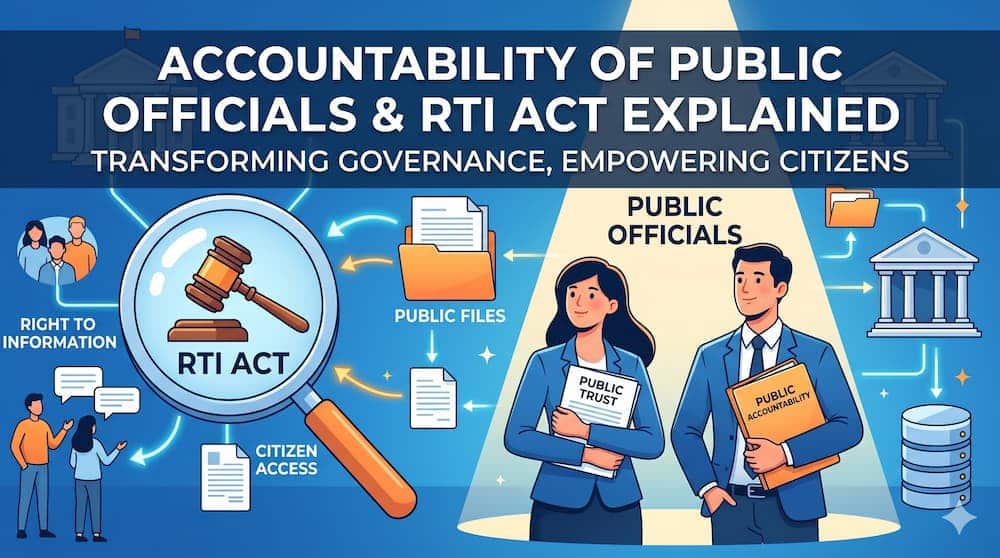
Accountability of Public Officials and the Right to Information Act: A Comprehensive Framework for Ensuring Transparency and Responsibility in Governance. This framework is essential for fostering an environment where public officials are held accountable for their actions and decisions. The RTI Act empowers citizens to seek information, thereby promoting transparency and enabling informed participation in governance. Understanding the Accountability of Public Officials & RTI Act is crucial to recognise how these principles work together. By intertwining the principles of accountability and the provisions of the RTI Act, we can create a robust mechanism that not only enhances oversight but also strengthens the trust between the government and the citizens it serves, ultimately leading to better public service delivery.
Key Takeaways
- The accountability of public officials & the RTI Act framework promote transparency and enable citizens to seek information.
- Administrative inertia often results in ‘deemed refusals’, complicating the appeal process for citizens.
- Citizens can escalate issues through the RTI Act against unresponsive public information officers (PIOs).
- Interim orders from the State Information Commission enforce accountability among public officials under the RTI Act.
- Historical audits of public appointments allow citizens to investigate recruitment processes and demand transparency.
Accountability of Public Officials & RTI Act: A Case Study of Prayagraj Nagar Nigam
When a citizen files a Request for Information under the Right to Information (RTI) Act, 2005, it is not merely a request—it is a statutory mandate backed by the law of the land. However, administrative inertia often leads to “deemed refusals”, forcing citizens to navigate a multi-layered appeal process to demand accountability. The interplay between the RTI Act and the accountability of public officials is vital in ensuring transparent governance.
This blog post explores the core procedural issues, structural timelines, and legal frameworks involved in ensuring public authorities remain transparent, using recent tracking records from the Uttar Pradesh Information Commission and highlighting how the Accountability of Public Officials & RTI Act enhances oversight.
1. The Core Dispute: Grievance Handling and Personnel Integrity
At the heart of administrative transparency is the tracking of public grievances and the internal conduct of public servants. In the initial phase of this case tracking, an application was filed seeking highly sensitive administrative records. The core issues centred around the relationship between public officials, accountability, and the RTI Act.
- Transparency in Grievance Redressal: Tracking the exact names and designations of personnel responsible for processing and monitoring specific complaints on the Public Grievance Portal.
- Public Service Integrity: Investigating leaves of absence granted to public servants facing serious criminal charges.
- The Legal Conflict Over Personal Information: Public authorities often attempt to shield document copies (like leave applications) under the guise of “Personal Information” via Section 8(1)(j). However, when public servants face criminal proceedings, their administrative actions cross into public interest, overriding standard exemptions. +1
2. Escalation Pathways: From PIO Silence to the State Information Commission
The RTI Act provides a strict statutory ladder to counter departmental non-responsiveness. When a Public Information Officer (PIO) fails to act, the law empowers the citizen to escalate the matter. Through these escalation pathways, the Accountability of Public Officials & RTI Act come together to empower ordinary people in pursuit of information.
| Stage | Authority involved | Statutory Timeline | Status in This Case |
|---|---|---|---|
| Original Application | Public Information Officer (PIO) | 30 Days | Filed on 10/11/2025; met with complete silence (“Deemed Refusal”). |
| First Appeal | First Appellate Authority (FAA) | 30–45 Days | Filed on 13/01/2026; no response or relief provided. |
| Second Appeal | State Information Commission | 90 Days | Filed on 04/03/2026; assigned to Hearing Room S-10. |
Export to Sheets
3. The Power of Interim Orders and Commission Enforcement
When a matter reaches the State Information Commission, the power dynamic shifts heavily back to the citizen. In this instance, the Honourable State Information Commissioner passed a strict interim order on 08/05/2026. Notably, the enforcement of interim orders directly supports the accountability of public officials through the RTI Act in such proceedings.
Under these enforcement notices, the Commission demands a formal Action Taken Report (ATR) or written statement from the PIO, which must be submitted via scanned PDF to the Commission portal or email at least two days prior to the final hearing. Failure to comply with these orders strips the public authority of its procedural leverage and opens the door for penalties under Section 20(1) and disciplinary recommendations under Section 20(2) of the RTI Act. +1
4. Historical Recruitment Audits: Shifting Focus to Public Appointments
A separate, critical dimension of RTI tracking involves historical audits of public appointments. When systemic irregularities are suspected in old recruitment drives, citizens have the right to inspect foundational administrative records. The accountability of public officials & the RTI Act are central to this audit process, providing citizen oversight.
A companion tracking application filed against the local body’s directorate demonstrates how citizens dig into structural data regarding public appointments. The critical touchpoints for a historical recruitment audit include:
- Public Advertisements: Verifying if vacancies were openly advertised in newspapers to give all eligible citizens an equal opportunity.
- Selection Committee Minutes: Accessing the signed “Minutes of the Meeting” and official selection criteria under regional service rules to verify the fairness of candidate evaluations.
- Reservation Roster Compliance: Demanding categorised breakdowns (OBC, SC, ST, and Unreserved) to ensure that statutory reservation rosters were not manipulated during final selections.
5. Demanding the “Reason for Rejection”: A New Tool for Accountability
What happens when a public authority completely ignores or fails to properly entertain an online application? The latest strategy adopted in this tracking cycle involves filing a direct query regarding the administrative and legal reasons for non-disposal. By leveraging both the accountability of public officials and provisions of the RTI Act, citizens can gain clarity and drive reforms.
Under the RTI framework, citizens can demand:
- File Notings: The internal remarks written by clerks and dealing assistants tracking the movement (or stagnation) of the file.
- Accountability of Personnel: The names and designations of the specific desk officials who kept the statutory application pending.
- Daily Progress Reports: A system-generated audit log proving whether the public authority actively processed the file or wilfully neglected it.
By shifting the focus onto why the application was not entertained, the citizen effectively builds an undeniable evidentiary paper trail of systemic non-responsiveness, which can be presented at the next Commission hearing to demand immediate penalty proceedings against the erring PIO. Evidently, the Accountability of Public Officials & RTI Act together form an essential backbone for transparent and responsible public service.
Here is the structured directory of all application IDs, email addresses, mobile numbers, and web links extracted from the tracking documents across your cases:
1. Application and Reference IDs (Accountability of Public Officials & RTI Act)
- Original RTI Registration Number (Grievances): DIRLB/R/2025/60405 +4
- First Appeal Registration Number: DIRLB/A/2026/60010 +3
- Second Appeal Case Number: S10/A/0540/2026 +1
- Commission Notice Number: 202605S10N200448 +1
- Commission Appellant Registration Number: A-20260300227
- Commission Portal Diary Number: D-180520260013
- RTI Application Number (Recruitment): DIRLB/R/2026/60148
- RTI Application Number (Non-Disposal): DIRLB/R/2026/60304
- RTI Online Payment Reference Number: CPAGSNLXV7
- Historical Case Reference: S10/A/1469/2024
2. Official Email Addresses (Accountability of Public Officials & RTI Act)
- UP Information Commission Registry (S-10): hearing courts 10. upic@up.gov.in +2
- Prayagraj Nagar Nigam (PIO/FAA Office): osnagarnigam@rediffmail.com +4
- Nodal Officer (Local Bodies Directorate): diruplb@nic.in
- Appellant (Indradev Yadav): yadavindramzp9118@gmail.com +3
3. Official Mobile and Phone Numbers (Accountability of Public Officials & RTI Act)
- Public Information Officer (Musir Ahmad): 8303701004 +1
- First Appellate Authority (Ravi Ranjan): 8303701320 +2
- Nodal Officer (Alok Goel): 8858555551
- UP Information Commission Representative (Sonu Kumar Sen): 7991C3D281EC75A180C591D49360E51F
- Prayagraj Nagar Nigam Office Landline: 0532-2427221
- Appellant (Indradev Yadav): +91-9118208936 +2
4. Web Portal Links (Accountability of Public Officials & RTI Act)
- Uttar Pradesh Information Commission Portal: https://upsic.up.gov.in/
- Uttar Pradesh RTI Online Filing Gateway: https://rtionline.up.gov.in/


Facing a similar challenge? Share the details in the box below, and our team of experts will do their best to help.