
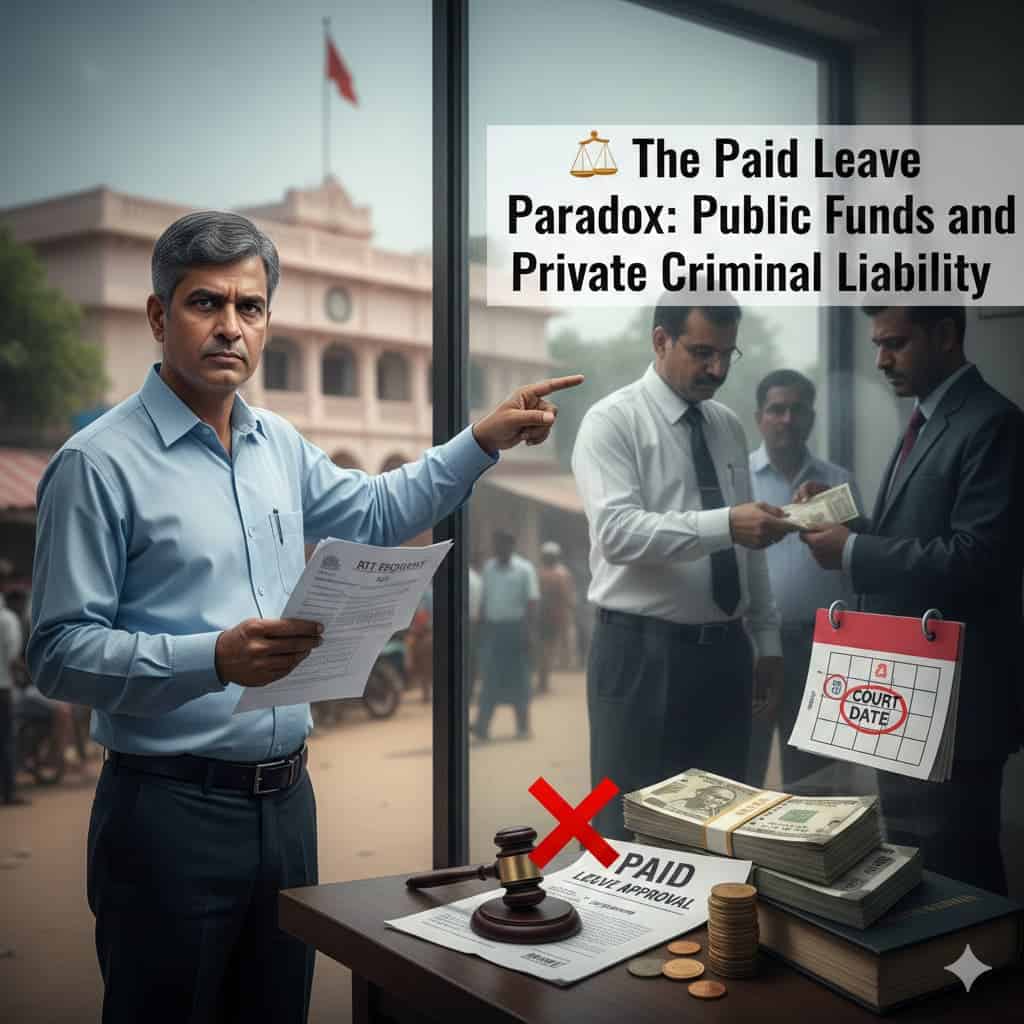
⚖️ The Paid Leave Paradox: Public Funds and Private Criminal Liability
The recent Right to Information (RTI) request filed by Indradev Yadav has spotlighted a contentious issue within public service: the practice of granting paid leave to government employees who are facing criminal charges, specifically when that leave is used to attend court proceedings. Yadav’s grievance, encapsulated in his formal plea, centers on the perceived injustice of using public funds—taxpayer money—to financially support individuals while they fulfill their personal criminal liabilities.
This situation presents a complex intersection of employee rights, public ethics, and the principle of presumed innocence versus the accountability of public servants.
🧐 The Core Grievance: A Matter of Principle
Indradev Yadav’s argument is rooted in a straightforward ethical concern: why should the government, and by extension the public exchequer, bear the cost for an employee’s time off when that time is necessitated by the employee’s alleged criminal activities?
The request explicitly targets the leave applications of two individuals, Umesh Kumar Yadav and Mukesh Kumar Yadav, filed for the purpose of “obtaining bail in two criminal cases.” The implication is clear: these individuals are using their status as government employees to secure paid time off, which essentially translates to a subsidy for their legal defense and court appearances.
Yadav advocates for the withholding of paid leave encashment for these “offenders.” While an accused person is, by law, presumed innocent until proven guilty, the principle being contested here is not the guilt or innocence itself, but the use of public resources to facilitate an individual’s management of a private criminal matter. It is a challenge to the idea that a public institution should financially support an employee’s obligation to address their own criminal accountability.
🏛️ The Legal Framework: Leave Rules vs. Public Perception
Government service in India operates under a comprehensive set of rules governing leave, conduct, and disciplinary action. Generally, employees are entitled to various types of leave, including casual leave (CL), earned leave (EL), and half-pay leave (HPL).
The Mechanics of Paid Leave
Paid leave—such as Earned Leave (EL)—is a legitimate entitlement earned through service. When an employee applies for leave to attend court proceedings, the request is typically processed based on the available leave balance, without necessarily probing the nature of the court case.
- Attendance in Court: An employee who is an accused person must attend court to comply with summons, secure bail, or participate in trials. Using existing leave entitlement (CL or EL) is a standard, administrative mechanism for this.
- The ‘Administrative‘ vs. ‘Criminal’ Divide: From a purely administrative standpoint, the employee is applying for leave, and if they have a balance, it is often granted. The department’s focus is on staffing and operational continuity, not the criminal charges.
The Status of Suspension
The most common recourse for a public authority in such situations is suspension. Suspension is not a penalty but a means to prevent an employee from misusing their position while an inquiry or legal proceeding is underway.
- Suspension Clause: Service rules often stipulate that an employee detained in custody for more than 48 hours is deemed to be suspended. This is crucial because a suspended employee is paid only a subsistence allowance, not their full salary, effectively addressing a part of Yadav’s financial grievance.
- The Gap: However, an employee who is not detained and is merely facing charges or attending proceedings may not be automatically suspended. They continue to perform their duties and remain entitled to their full leave benefits, creating the loophole Yadav is highlighting.
📜 The RTI Application: Seeking Accountability
Yadav’s RTI request is a strategic move to leverage transparency and hold the public authority accountable for its handling of the issue. By filing under the Right to Information Act, 2005, he is demanding specific, verifiable facts, not just a policy review.
Key Information Sought:
- Grievance Processing Details: He is asking for the name and designation of the staff both processing and monitoring his two registered grievances (GOVUP/E/2025/0091377 and GOVUP/E/2025/0087878). This targets the human element responsible for decision-making, ensuring that the process is not left in a bureaucratic void.
- Copies of Leave Applications: Most importantly, he seeks copies of the leave applications submitted by Umesh Kumar Yadav and Mukesh Kumar Yadav specifically for “obtaining bail.” This will confirm the purpose of the leave and serve as evidence for his larger argument.
The Strategy
This RTI is not just about getting information; it’s about forcing the concerned Public Authority, the Local Bodies Directorate (through the Municipal Corporation, Prayagraj), to formalize its position and reveal the steps taken to address a public ethics concern. By identifying the officers responsible for handling his complaint, Yadav ensures that someone’s professional reputation is tied to the outcome, thereby increasing the pressure for a decisive and principled action.
💡 The Call for Policy Review and Ethical Reform
The grievance raises a critical question for public administration: Should there be a distinct, non-paid leave category for public servants dealing with personal criminal matters?
While withholding an employee’s accrued leave outright may be legally contentious, especially before conviction, the current practice clearly fuels public distrust. The spirit of public service demands that public funds are utilized judiciously.
Proposed Solutions:
- Special Leave Without Pay (LWP): The government could consider mandating a “Special Leave Without Pay” (SLWP) category for employees who must attend court as an accused in a criminal case. This respects the legal obligation to attend court without burdening the public exchequer.
- Mandatory Half-Pay Leave (HPL): An intermediate step could be to mandate the use of Half-Pay Leave (HPL), which is an accrued but less financially onerous form of leave for the government.
- Expedited Departmental Inquiry (DI): The authority must also expedite the departmental inquiry (DI) parallel to the criminal proceedings. A swift DI, which can be concluded on a ‘preponderance of probability’ standard (lower than the criminal ‘beyond a reasonable doubt’ standard), could lead to the formal suspension or dismissal of the employee, thereby legally stopping the payment of full salary and leave encashment.
✅ Conclusion: Transparency as a Catalyst
Indradev Yadav’s grievance is more than a localized complaint; it is a test of the commitment of the public authority to ethical governance and the accountable use of public funds. The successful resolution of his RTI request, providing the names of the officers and the copies of the controversial leave applications, will not only bring transparency to this specific case but could also be a catalyst for a much-needed review of government leave policies concerning employees facing serious criminal liabilities. The government’s response will determine whether the principle of public accountability takes precedence over administrative convenience.
I can check if there are any official guidelines or circulars from the Uttar Pradesh government regarding the grant of leave to employees facing criminal charges, which might shed light on the legality of the current practice. Would you like me to look for that information?


Facing a similar challenge? Share the details in the box below, and our team of experts will do their best to help.