
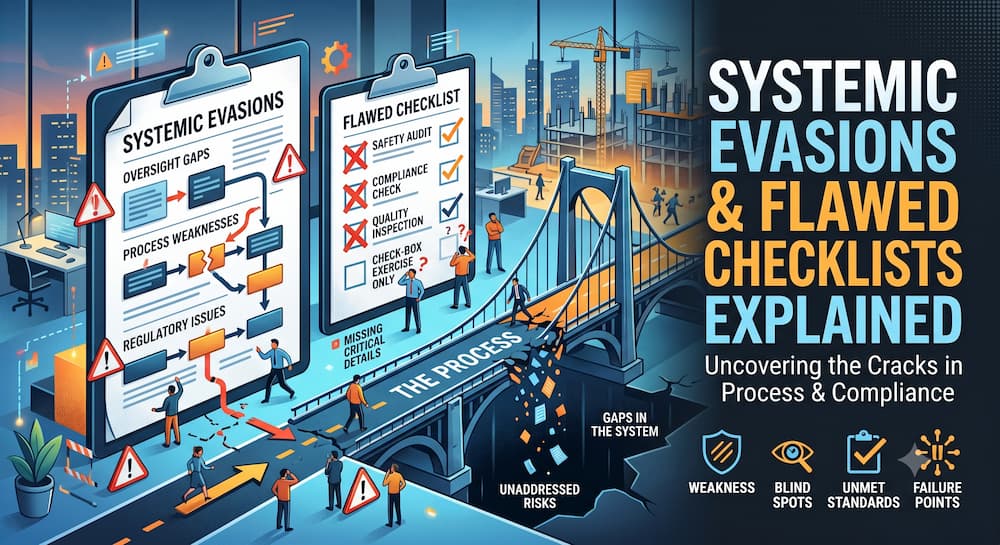
Systemic evasions and flawed checklists highlight critical issues in organisational processes where deficiencies in oversight and accountability lead to significant consequences. These systemic failures often stem from reliance on incomplete or outdated checklists that fail to capture the complexity of modern challenges. As organisations navigate intricate operational landscapes, they must recognise the limitations of simplistic approaches. Adopting a more dynamic framework that incorporates continuous feedback and adaptive strategies is essential. By prioritising thorough analysis and fostering a culture of vigilance and improvement, organisations can mitigate risks associated with systemic evasions and enhance their operational effectiveness, ensuring a more resilient future.
Key Takeaways
- Systemic evasions and flawed checklists hinder transparency and accountability within organisations.
- Recent trends reveal bureaucratic roadblocks undermining the Right to Information (RTI) Act of 2005.
- A case involving the Uttar Pradesh Information Commission illustrates how administrative errors stall justice.
- Solutions include fixing screening portals, applying real penalties for evasion, and ensuring delivery of hearing notices.
- Organisations must hold staff accountable to prevent systemic failures and uphold the intent of the RTI Act.
Systemic Evasions and Flawed Checklists: How Bureaucratic Roadblocks Hurt the RTI Act
The Right to Information (RTI) Act of 2005 gave power to ordinary citizens. It allowed them to hold public authorities accountable. However, recent trends show a disturbing shift. State mechanisms are creating bureaucratic roadblocks. These blocks quickly destroy the true intent of the law.
When institutions choke a citizen’s right to know, accountability collapses. A clear example is unfolding right now before the Uttar Pradesh Information Commission (UPIC). The case involves the second appeal number A-20260402111 (File No.). It perfectly shows how administrative errors, evasive actions by public information officers (PIOs), and weak oversight form a dangerous trap. Two main issues drive this failure: systemic evasions and flawed checklists.
1. How a Flawed Checklist Blocks Justice
The first barrier to transparency usually appears during initial file screening. In this case, an applicant filed an appeal on December 28, 2025. On January 30, 2026, a commission research officer suddenly flagged the file as “deficient”. The officer claimed the appellant failed to file a first appeal after a case transfer occurred.
The actual tracking data tells a completely different story. The appellant filed his mandatory first appeal on November 10, 2025. The proper authority even decided and closed it by December 3, 2025. Despite this clear digital footprint, the research officer manually marked “No” on the compliance checklist.
This is not a minor office mistake. It proves a deeper breakdown in the screening system. A factually wrong deficiency note creates an artificial wall. It stalls legal progress completely. It forces the citizen to waste precious time simply proving that their paperwork was correct from day one
2. How PIOs Use Systemic Evasions to Avoid Answers
The applicant noticed the system was holding his file in limbo. He used the RTI Act to find out why, submitting a new request on February 18, 2026. He asked for basic operational records: the certified Deficiency Note, the live File Movement Register, and the names of the handling officers
The response from State Public Information Officer (SPIO) Mumtaz Ahmad reveals a common institutional tactic. Instead of extracting the specific logs, the SPIO shared an old internal order from November 13, 2025. That order merely discussed a general Customer Relations Management (CRM) helpline cell. For nearly every critical point regarding file tracking, the SPIO just wrote, “As per Point No. 1″.
This behaviour violates Section 7(1) of the RTI Act. A general policy document about a helpline cannot replace a dynamic file movement register. It cannot hide the names of officials who manage public files. By using an unrelated order as a shield, the SPIO relied on systemic evasion. He turned a simple query into a confusing bureaucratic chase.
3. The Breakdown of Higher Appellate Review
The RTI law includes a two-tiered appeal system to fix errors made by lower officials. Unfortunately, the First Appellate Authority (FAA) often acts as an echo chamber for the SPIO. They rarely provide an independent, critical review.
In this matter, FAA Tejaskar Pandey dismissed the challenge on March 6, 2026. He mechanically ruled that the SPIO gave a “complete” answer. He ignored the fact that the SPIO provided no actual logs or names. When higher authorities rubber-stamp bad responses, they reward systemic evasions. They tell subordinate officers that hiding data carries no real penalty. They validate the use of flawed checklists to kill valid appeals.
4. The Heavy Cost Borne by the Citizen
When tracking systems break down, the entire burden shifts to the citizen. In this case, the appellant had to monitor his files online constantly. He had to decode conflicting entries on his own. Moreover, he proactively sent a written statement to Hearing Court 11 (Bench S-11) for his May 21, 2026, hearing. He did all this because the Commission failed to send a formal hearing notice.
This situation exposes three massive flaws in current RTI enforcement:
- Checklist Vulnerability: Manual errors during the screening phase can ruin a perfect appeal before a commissioner ever sees it. PDF+1
- Policy Orders as Shields: SPIOs use general internal guidelines to mask delays and operational failures. PDF
- The Missing Notice Issue: Failing to send formal notices hurts a citizen’s ability to argue their case. This breaks the basic rules of a fair hearing.
5. Easy Steps to Fix the System
To protect the RTI Act, we must remove systemic evasions and flawed checklists through clear reforms:
Fix the screening portals.
Research officers must check internal digital databases before declaring an appeal deficient. If a checklist shows a missing lower order, the portal should auto-verify the case number against digital archives. This eliminates manual entry mistakes.
Apply Real Penalties Under Section 20(1)
The Commission must stop merely telling offices to release data. When an SPIO intentionally shares an unrelated order to hide real tracking logs, the commission must fine them under Section 20(1). Evasion will only stop when it carries a personal financial cost.
Track and Prove Notice Delivery (Systemic Evasions and Flawed Checklists)
Every court listing must require verified proof that the appellant received their hearing notice. Conducting a hearing without giving the citizen a fair chance to prepare ruins the credibility of the commission.
Conclusion (Systemic Evasions and Flawed Checklists)
The struggle to get basic administrative details shows that public offices still resist transparency. The RTI Act exists to open public doors, not to help agencies hide behind internal rules. As this case sits before Hearing Court 11, the commission faces a clear choice. It can allow systemic evasions and flawed checklists to win, or it can hold its own staff accountable to the law.
Based on the official documents and your latest verification data, here is the complete directory of application IDs, emails, mobile numbers, and web links for all public authorities concerned with your case:
1. Case Tracking & Application IDs (Systemic Evasions and Flawed Checklists)
- Current Second Appeal Registration Number:
A-20260402111 - Current Second Appeal File Number:
S11/A/0818/2026 - Current Commission Diary Number:
D-200520260036(Logged on 20/05/2026) - RTI Information Request Registration Number:
UPICM/R/2026/60103 - Original / Blocked Second Appeal Number:
A-20251202449 - Original First Appeal Number (CM Office Section-3):
DOCMO/A/2025/60213
2. Contact Details of the Public Authorities (Systemic Evasions and Flawed Checklists)
Authority A: Uttar Pradesh Information Commission (UPIC)
This is the commission currently hearing your case in hearing room S-11.
- Hearing Court 11 Direct Email:
hearingcourts11.upic@up.gov.in - State Public Information Officer (SPIO): * Name: Mumtaz Ahmad (Administrative Officer)
- Mobile Number:
9151804317 - Official Email:
jansu-section.upic@up.gov.in
- Mobile Number:
- First Appellate Authority (FAA): * Name: Tejaskar Pandey (Deputy Secretary)
- Mobile Number:
9415021746 - Official Email:
deputysecretary-upic@up.gov.in
- Mobile Number:
- Commission CRM Helpline Cell:
- Helpline Phone:
0522-2724930 - Helpline Email:
crm.upic@mail.in
- Helpline Phone:
- Commission Main Office Landline:
0522-2724945
Authority B: Chief Minister’s Office (Section 3), Uttar Pradesh (Systemic Evasions and Flawed Checklists)
This is the original department where your primary RTI dispute began.
- State Public Information Officer (SPIO): (Systemic Evasions and Flawed Checklists)
- Name: Vinod Sharma (Section Officer)
- Mobile Number:
9454412736 - Email:
vsls32165@gmail.com
- First Appellate Authority (FAA): (Systemic Evasions and Flawed Checklists)
- Name: Anjna Tripathi (Under Secretary)
- Mobile Number:
9454411282 - Email:
anjna.11282@gov.in
3. Important Web Links for Your Reference (Systemic Evasions and Flawed Checklists)
- RTI Portal Tracking & Digital Portal Link: You can access your updates and log straight into online hearings via the commission’s operational site engine (extracted from your active electronic logging footprint).
- Official UP Information Commission Web Portal: Orders, status reports, and CRM portal notices can be accessed via the state domain at [URL] or directly managed through the dynamic portal framework where your profile
UPICR20240009954is registered.


Facing a similar challenge? Share the details in the box below, and our team of experts will do their best to help.