
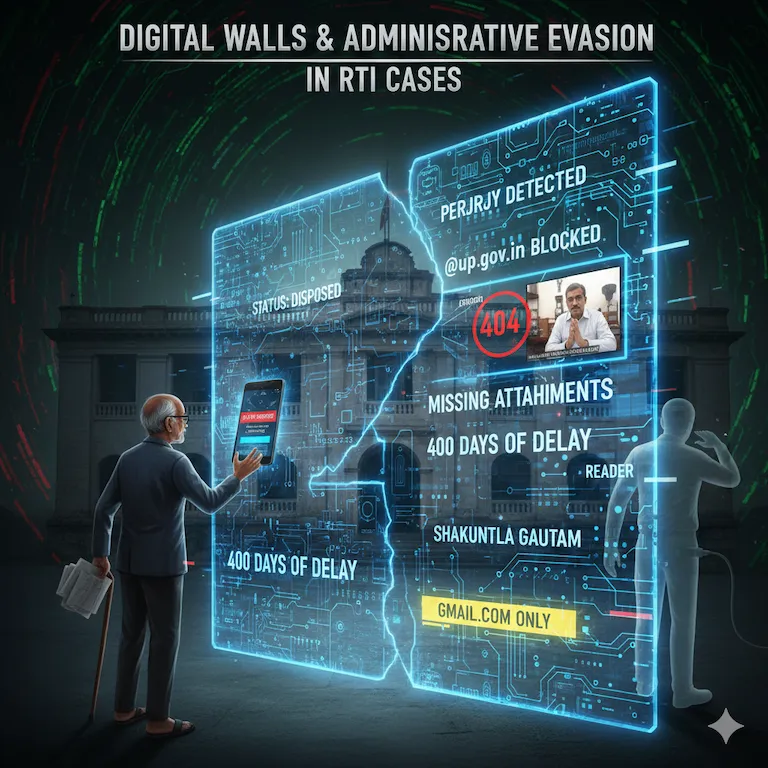
Key takeaways (Digital Walls & Administrative Evasion)
Here are the key takeaways from the analysis of the ongoing RTI appeal regarding Yogi M.P. Singh vs. PIO, Tehsildar Lalganj (S09/A/1948/2024). The case raises important questions about Digital Walls & Administrative Evasion in the context of transparency and public information access.
- Evidence of Perjury: The PIO recorded a status on December 5, 2025, claiming information was “furnished”. However, during the hearing on December 19, 2025, the same officer requested an extension. The officer needed more time to provide that information, citing “SIR work.
- Administrative Seclusion: There is a deliberate refusal by the Tehsil administration and the Commission’s Registry to use official
@up.gov.inor@nic.indomains for service. Using unofficialgmail.comaccounts allows officials to claim “non-receipt” and avoid an official audit trail. - Procedural Negligence: The Commission’s Registry sent a hearing notice on January 28, 2026, without the mandatory order/notice file attached. This omission prevents the appellant from referencing specific point-wise mandates during the hearing.
- Institutional Failure: The Commissioner gave oral directives to update email records. Another directive was to address perjury. These directives appear to have been ignored by the Reader. This creates a gap between judicial intent and administrative execution, protecting the PIO from penalties.
- Impact on Older Citizens: The case highlights the targeted harassment of a person older than 70. This individual has spent over 400 days seeking simple inheritance information as a Class-1 heir.
- Demand for Accountability: The analysis calls for a ₹25,000 penalty under Section 20(1). Disciplinary action is required under Section 20(2) due to willful non-compliance. There is also the filing of false statements.
Digital Walls & Administrative Evasion: The Sabotage of Transparency
The Right to Information (RTI) Act should provide clear “sunlight” to disinfect administrative corruption. However, the case of Yogi M.P. Singh vs. PIO, Tehsildar Lalganj (Appeal No. S-09/A/1948/2024) reveals a different reality. In Mirzapur, officials use procedural fog and fabricated records to block accountability. This case study shows how “administrative seclusion” and perjury can undermine the law. This case highlights the impact of Digital Walls & Administrative Evasion. It also shows the pattern of administrative evasion when institutions fail to uphold transparency.
1. The Perjury Trail: A “Disposed” Deception
The most glaring issue involves documented contradictions in the Public Information Officer’s (PIO) claims. On December 5, 2025, the PIO updated the RTI portal status to “Disposed Of. The update claimed that officials furnished the information to the applicant, Sadhana Tiwari.+3
Truth surfaced during the hearing on December 19, 2025. The PIO, Tehsildar Diksha, failed to provide any proof of delivery. Instead, she requested more time. She blamed her busy schedule with Special Investigation Report (SIR) duties.+4 Administrative evasion in this digital age, combined with walls of bureaucracy, is evident through such actions.
This sequence strongly suggests Perjury. If the office “furnished” information on December 5, an extension on December 19 makes no sense. This “Disposed” status appears to be a calculated move to mislead the tracking system. It allows the PIO to evade penalties for a delay that now exceeds 400 days.+1
2. Institutional Aloofness: The @up.gov.in Domain Crisis
Modern democracy relies on a verified digital audit trail. The Uttar Pradesh Government uses official domains like @up.gov.in and @nic.in for accountability. These servers log every government communication. Within such digital walls, administrative evasion can flourish if official protocols are not rigidly followed.
In this case, the administration stays “aloof” from official domains:
- Unofficial Channels: The Registry sends notices to unofficial Gmail accounts despite your requests to use
teh-lalganj.mi@up.gov.in. - The “Spam” Shield: Using
gmail.comgives the PIO “plausible deniability.” They can claim a notice was lost in a spam filter. State-monitored.gov.inservers make such claims impossible. - Sabotaging Service: This tactic allows the PIO to avoid legal consequences. They simply claim they never received an “official” notice.
3. Registry Carelessness: Missing Attachments (Digital Walls & Administrative Evasion)
The RTI process is also failing within the Commission’s administrative wing. An email arrived from the Commissioner’s executive address on January 28, 2026. It concerned today’s hearing on February 12, 2026.
The email included the hearing link but failed to attach the formal notice or previous order. Sending a link without the judicial order is like summoning someone to court without the charges. This “carelessness” prevents you from referencing specific mandates during the session. Furthermore, registry carelessness is another form of administrative evasion within the digital walls of bureaucratic procedure. It lets the Respondent plead ignorance of prior directives.
4. Institutional Capture: Defying the Commissioner
A major concern is the gap between Judicial Will and Administrative Execution. During recent sessions, Commissioner Shakuntala Gautam issued oral directives to her Reader. She ordered the staff to update records and fix email discrepancies. Digital walls and administrative evasion create barriers that weaken the authority of judicial directives.
When a Reader fails to record these directives, the Commissioner’s authority vanishes. This “Institutional Capture” protects the PIO. It ensures the final order lacks “teeth.” Specifically, it omits the Section 20(1) Show Cause Notice for a ₹25,000 penalty.
5. The Human Cost: Harassing Older Citizens
Behind the legal jargon is a human story. You are an older person managing health issues like Hyperglycaemia. Moreover, You have spent over a year seeking basic information on an inheritance matter. Sadhana Tiwari a Class-1 heir seeking a right guaranteed by law.
The PIO’s insolence and the Registry’s negligence constitute targeted administrative harassment. Forcing an older citizen to attend constant hearings for 400 days is a weaponisation of time. The state is trying to exhaust the seeker of truth. Notably, these challenges are compounded by digital walls and extensive administrative evasion, which exacerbate the burden for vulnerable groups.
Conclusion: The Path Forward
Today’s hearing on February 12, 2026, is a crossroads for the Commission. To uphold the RTI Act, the Commission must act:
- Impose Penalty: Stop granting extensions and levy the ₹25,000 penalty for the perjury of December 5, 2025.
- Disciplinary Action: Recommend a departmental inquiry against the PIO and the First Appellate Authority.
- Registry Audit: Investigate why the Registry refuses to use official
@up.gov.inemails.
When the “guardians” of information become “gatekeepers” of secrecy, the rule of law fails. Ultimately, dismantling digital walls and curbing administrative evasion is essential for restoring transparency.
Based on the documents and communications provided, here are the application, contact, and link details for the concerned public authorities involved in your case:
Case Identification Details
- Appeal Registration Number: A-20241002356
- File Number: S09/A/1948/2024
- RTI Registration Number: DMOMR/R/2024/60070 (Filed: 21/07/2024)
- UPIC Diary Number: D-120220260008
Contact Details of Public Authorities
| Authority / Person | Official Email Address | Unofficial/Old Email Used |
| State Information Commissioner (S-9) | hearingcourts9.upic@up.gov.in | N/A |
| Tehsildar, Lalganj (PIO) | teh-lalganj.mi@up.gov.in | teh-lalganj.mi@gmail.com |
| SDM, Lalganj | sdm-Lalganj.mi@up.gov.in | N/A |
| District Magistrate, Mirzapur | dmmir@nic.in | N/A |
- Appellant Mobile Number: 7379105911
- Respondent Address: Office of Tehsildar, Tehsil-Lalganj, District-Mirzapur, PIN: 231001
Web Links & Digital Access (Digital Walls & Administrative Evasion)
- Online Hearing Link: https://upsic.up.gov.in/cispu/onlinehearing/e8e8e8
- UP Information Commission Portal: upsic.up.gov.in
Hearing Information
- Next Hearing Date: 12/02/2026
- Time: 12:30 PM to 02:00 PM
- Hearing Room: S-9
Would you like me to use these specific IDs to draft a formal notification to the District Magistrate’s official @nic.in address regarding the Tehsildar’s failure to appear?


Facing a similar challenge? Share the details in the box below, and our team of experts will do their best to help.