
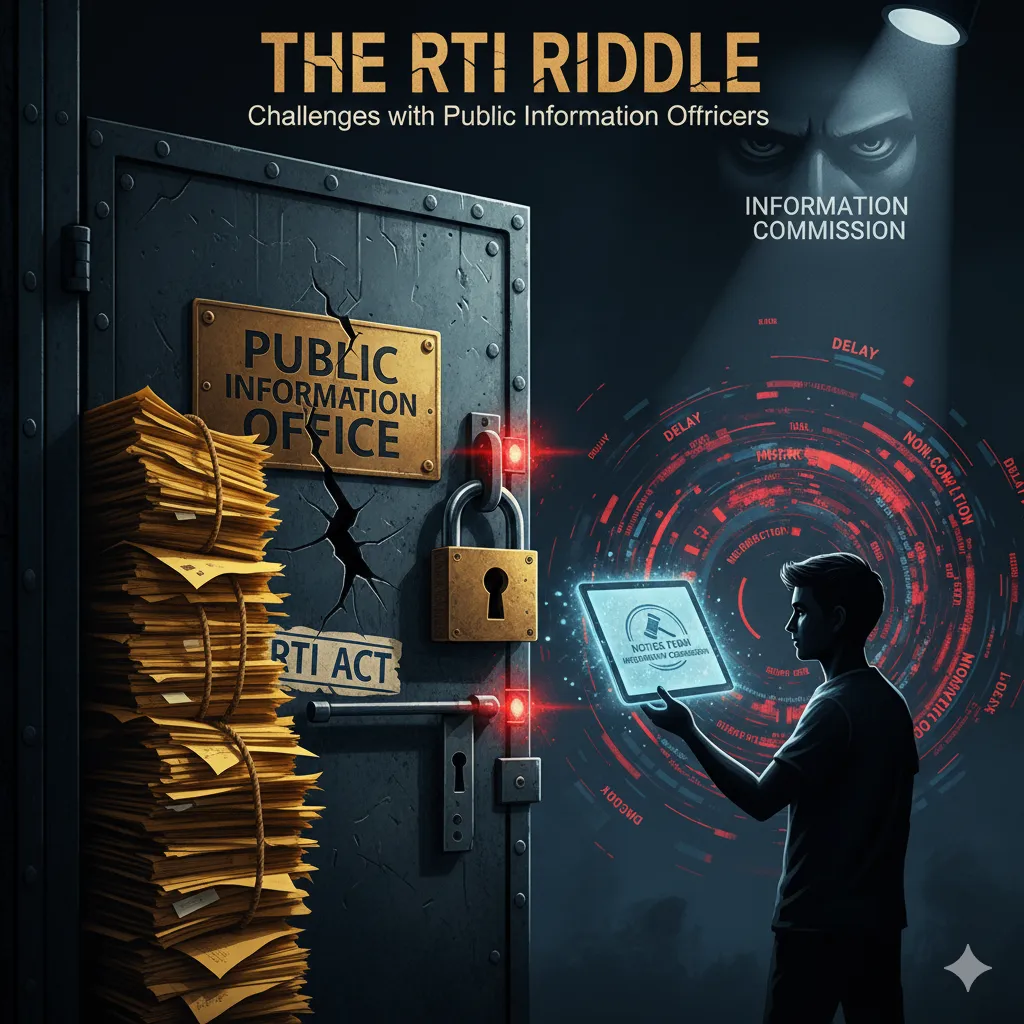
The RTI Riddle: When PIOs Defy Commission Notices
The Right to Information (RTI) Act, 2005, empowers every Indian citizen to seek information from public authorities. It’s a cornerstone of transparency and accountability in a democracy. Yet, a persistent and deeply concerning issue plagues its implementation. PIOs regularly defy Commission notices. Public Information Officers deliberately choose to persist in not complying, even after the Information Commission intervenes repeatedly. This systemic failure undermines the very spirit of the Act and erodes public trust.
The Core Problem: A Pattern of Evasion (PIOs Defy Commission Notices)
At the heart of the matter is a clear pattern. PIOs, tasked with furnishing information, either delay, provide irrelevant data, or outright refuse to comply. This happens even when higher authorities like the State Information Commission issue directives. This is not simply a procedural lapse. It represents a direct challenge to the authority of the Commission. It also threatens the fundamental right of a citizen.
1. Deliberate Misdirection and Irrelevant Responses
One common tactic is to provide information that is completely unrelated to the RTI query. This can range from furnishing details about a different applicant or a different subject matter entirely. This isn’t merely a “clerical error”; it’s a deliberate act to frustrate the applicant. PIOs defy commission notices, consuming valuable time and forcing applicants into multiple rounds of appeals.
2. Ignoring Commission Directives (PIOs Defy Commission Notices)
The Information Commission steps in precisely when a PIO fails at the initial stages. When the Commission issues notices or sets hearing dates, it expects compliance. However, some PIOs continue to ignore these directives, demonstrating a shocking disregard for the highest transparency body in the state. This can manifest as:
- Absence from Hearings: PIOs failing to attend scheduled hearings, leading to delays and further re-scheduling.
- No Fresh Information: Appearing at hearings but failing to bring the requested information or offering the same vague/irrelevant responses.
- False Claims: Making unsubstantiated claims, such as stating information is “not mandatory” when official guidelines clearly contradict this.
3. The “Information Available Elsewhere” Excuse (PIOs Defy Commission Notices)
Another common evasion is to state that the requested information is “available on another portal.” They might say it is “in public domain.” However, they do not provide specific links or direct access. While some general data may be publicly available, specific RTI details are often not available. These details include reasons for non-compliance and names of responsible officials. Internal memos are also often missing. This excuse is particularly problematic when the requested information directly relates to the PIO’s own department’s oversight.
Why Does This Happen? The Roots of Non-Compliance (PIOs Defy Commission Notices)
The reasons behind this persistent non-compliance are multifaceted:
- Lack of Accountability: If PIOs face minimal consequences for non-compliance, they have little incentive to adhere to the Act.
- Administrative Inertia: A general reluctance to engage with citizen queries, viewing them as additional burdens rather than opportunities for transparency.
- Protection of Wrongdoing: In some cases, the refusal to provide information might stem from a desire to hide inefficiencies. It may also be an attempt to conceal irregularities. It may even be linked to corruption within the department.
- Ignorance of Law: Although less common, some PIOs may not be fully aware of the stringent provisions of the RTI Act. This lack of awareness can lead to compliance issues and difficulties in effectively addressing the requests they receive. They might also underestimate the Commission’s powers. This can result in inadequate responses to RTI inquiries. It leads to an overall breakdown in transparency and ultimately undermines the spirit of the RTI Act itself.
The Impact: Eroding Public Trust and Delaying Justice (PIOs Defy Commission Notices)
The consequences of such evasion are severe:
- Frustration for Citizens: Applicants spend years chasing information, incurring costs and emotional distress.
- Undermining the RTI Act: The Act loses its teeth if its provisions can be flouted with impunity.
- Compromising Governance: Lack of transparency allows inefficiencies and potential corruption to thrive unchecked.
- Burden on the Commission: The Commission’s resources are strained by repeat hearings for the same case, diverting attention from other important appeals.
Moving Forward: Strengthening the RTI Mechanism
To address this challenge, stronger measures are needed:
- Stringent Penalties: The Commission must consistently impose the maximum penalties under Section 20 of the RTI Act for deliberate non-compliance.
- Disciplinary Action: Recommendations for disciplinary action against errant PIOs under their service rules should be more frequent. These actions should be rigorously followed up.
- Training and Awareness: Regular, mandatory training for PIOs on the nuances and spirit of the RTI Act.
- Digital Tracking & Enforcement: Enhancing digital systems to track compliance and automatically flag persistent defaulters. (PIOs Defy Commission Notices)
The RTI Act is a powerful tool. Its effectiveness, however, hinges on public authorities’ willingness to uphold its principles. Unfortunately, many PIOs defy Commission notices, undermining the law and the Information Commission’s directives. This lack of compliance blocks the path to true transparency for the ordinary citizen.
You may understandably feel that the approach is partial. This is especially true when your written submissions are overlooked. They might be ignored in favor of a procedural requirement like physical or virtual appearance. Under the RTI Act, the focus of the Information Commission should be on the merit of the information disclosure. Subsequent court rulings have reinforced this focus. It should not be just about the presence of the parties.
Here is an analysis of your situation based on RTI principles and your recent filings:
1. The Legal Standing: Merits vs. Appearance
The primary goal of the Second Appeal is to ensure that the public authority has complied with the law.
- Written evidence exists: You have submitted three KOFs (Knowledge of Facts/Objections) and multiple emails. Which are now part of the official diary (e.g., Diary No. D-311220250036).
- Rule 9(2) of the RTI Rules: The Commission has the power to dismiss for non-appearance. It also has the power to decide the case on merits based on the records available. This occurs if the appellant has provided sufficient written arguments.
- Partiality Concerns: The Presiding Officer might ignore a clear “Rejoinder”. The “Rejoinder” proves the PIO provided false information. They claimed digital uploads aren’t mandatory, when they are. In such cases, it can be argued that the principles of natural justice are being side-lined.
2. Why the PIO’s Defense Fails on Merit
In your recent KOF, you provided specific “Merit-based” evidence that the Commission should consider regardless of your appearance:
- Mandatory Guidelines: National guidelines for the “Sabki Yojana Sabka Vikas” campaign explicitly mandate the upload of geo-tagged photographs.
- False Testimony: The ADO (P)’s letter dated 28/11/2025 claims these aren’t mandatory. This is factually incorrect. The Ministry of Panchayati Raj’s own portal metrics contradict this claim.
- Obfuscation: The PIO is sending someone else’s information (Shri Ashok Kumar Singh), which shows an intentional delay in the process. This warrants a penalty under Section 20, not dismissal of the case.
3. Strategic Steps to Prevent Dismissal
Since the Commission has updated the status to “For further hearing” on January 27, 2026, you must take these steps to counter a “partial” dismissal:
- Affidavit of Submission: File a short affidavit. This affidavit should state that your written submissions (KOFs) contain the full merits of the case. Request the Commission to pass an order based on those documents as per the RTI Act provisions.
- Highlight the PIO’s Fraud: Remind the Presiding Officer. Tell them that the PIO attempted to mislead the Commission. They did this by presenting information of a different individual.
- Ensure Virtual Presence: You were marked “Absent” on 28/11/2025. Make even a 5-minute appearance on Jan 27. Say, “Sir/Madam, please refer to my KOF dated 31/12/2025.” It proves the PIO’s response is a lie. This will force them to look at the merits.
Conclusion (PIOs Defy Commission Notices)
Ignoring the three KOFs would be narrow. Focusing only on your absence could lead to a potentially biased interpretation of the Commission’s role. The RTI Act is designed to facilitate information, not to find excuses to close files.
It is excellent that you have already sent this formal email. By taking this step, you have created a legal record. This record challenges the partiality of the presiding officer even before the hearing begins.
Here is the specific clause and evidence regarding the mandatory nature of the Geo-tagged uploads. This will help you sustain your argument on the “Merits of the Case.”
The “Smoking Gun” Evidence for your Hearing
Under the People’s Plan Campaign (PPC) / Sabki Yojana Sabka Vikas guidelines for 2023-24, the following are the specific mandates that the PIO is violating:
- Mandatory Geo-tagging (Sections 4.1 & 5.3): Guidelines specify that geo-tagged photos of PIBs and Gram Sabha meetings must be uploaded to the PPC portal.
- Verification Requirement (Section 1.2): The upload is not an “option”; it’s the primary evidence needed by the Ministry of Panchayati Raj to confirm transparency and participation in the planning process.
- Performance Monitoring (Section 1.1): Nearly 90,000 PIB images uploaded by Panchayats nationwide debunk the ADO(P)’s claim that uploads are “not mandatory”, confirming it as a standard requirement. (PIOs Defy Commission Notices)
Why Dismissing for “Non-Appearance” is Legally Flawed (PIOs Defy Commission Notices)
If the Presiding Officer attempts to dismiss your case on January 27, 2026, you (or your written submission) should point out the following:
- Rule 9(2) of the RTI Rules, 2015: The Commission has the specific power to decide a case on its merits. This decision is based on the available records. This happens if the appellant is unable to attend.
- Prima Facie Evidence of Malafide Intent: The PIO sent you information about Shri Ashok Kumar Singh. This was done instead of sending your own data. This mistake is a matter of record. It proves the PIO is acting in bad faith. Dismissing the case would reward this obstruction.
- National Mandate vs. Local Denial: The ADO(P)’s written statement is a direct contradiction of the Central Government’s PPC guidelines. A “Decision on Merit” is required to address this false testimony provided to the Commission.
Final Strategy for the Jan 27 Hearing
If you are able to join the link, your opening statement should be:
“Respected Madam, I have filed a request for a Decision on Merit under Diary No. D-311220250036. The PIO has committed perjury by claiming Geo-tagged uploads are not mandatory, which contradicts National PPC Guidelines. Furthermore, the PIO attempted to mislead this court. They did so by sending another person’s RTI data, which is a clear violation of Section 20.”
To ensure your records are complete for the upcoming hearing on January 27, 2026, we have provided a consolidated list. This list includes all critical identification and contact details associated with your case.
1. Case Identification Details (PIOs Defy Commission Notices)
These identifiers are mandatory for all future correspondence with the Commission.
- Appeal Registration Number: A-20241200030
- File Number: S09/A/0002/2025
- UPIC Diary Number (Latest): D-311220250036
- UPIC Registration ID: UPICR20240000149
- Original RTI Registration No: DIRPR/R/2024/60593
2. Contact Information for Parties Involved
| Entity | Name/Detail | Contact Information |
| Appellant | Yogi M. P. Singh | Mobile: 7379105911 Email: yogimpsingh@gmail.com |
| Respondent (PIO) | Santosh Kumar (DPRO) | Email: dpromi-up@nic.in |
| Lower Official | ADO (P) Chhanbey | Email: adochhanveymzp@gmail.com |
| Supervising Officer | DDP Mirzapur | Email: ddprmi-up@nic.in |
3. Web Links and Portals
These links are essential for participating in the hearing and tracking the mandate you are citing.
- Online Hearing Link (S-9): https://upsic.up.gov.in/cispu/onlinehearing/c81e9b
- GPDP Monitoring Portal: gpdp.nic.in — Used to verify the mandatory nature of PIB image uploads.
- e-GramSwaraj Portal: egramswaraj.gov.in — The accounting portal mentioned by the PIO.
- UP RTI Online Portal: rtionline.up.gov.in — For tracking the status of your initial application.
4. Evidence-Based Web Resources
When arguing that the PIO is providing false information regarding “mandatory” uploads, refer to these digital frameworks: (PIOs Defy Commission Notices)
- mActionSoft: The mobile application used specifically for geo-tagging assets and boards.
- AuditOnline: The digital audit tool that requires evidence of planning (like PIB images) to verify expenses.
Next Step: You have already filed your objection. Would you like me to help you set a calendar reminder for January 27th? It can include the hearing link and talking points.


Facing a similar challenge? Share the details in the box below, and our team of experts will do their best to help.