
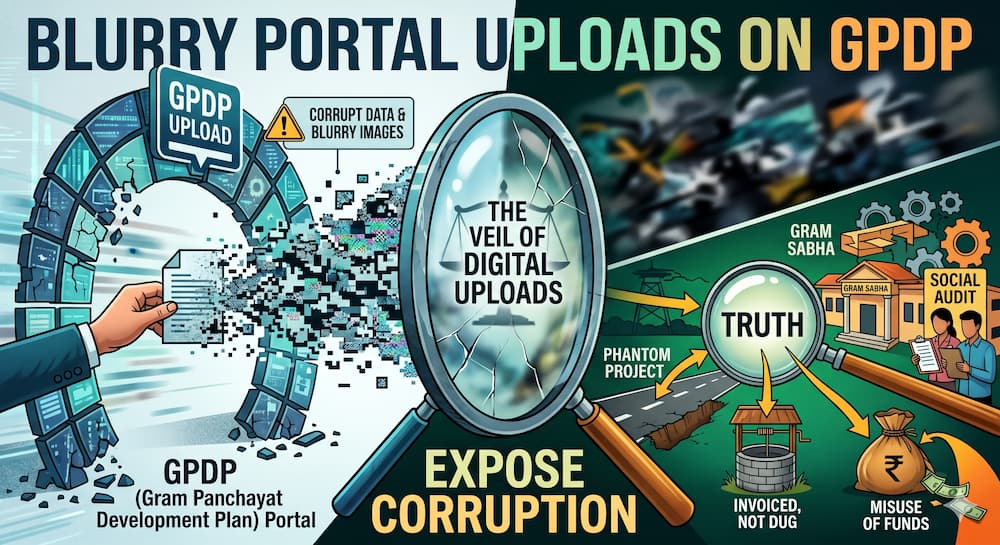
Blurry Portal Uploads on GPDP can significantly hinder user experience and compromise the clarity of important images. This issue can arise due to several factors, such as poor internet connection, incorrect file formats, or improperly sized images. Users often find themselves frustrated when attempting to upload images that appear clear on their devices but become distorted on the platform. To enhance image quality, it’s essential to follow best practices like ensuring high-resolution images, optimizing file formats, and checking upload settings. By addressing these aspects, users can improve the overall effectiveness of their uploads and convey messages more clearly through visuals.
Key Takeaways
- Blurry Portal Uploads on GPDP affect user experience and lead to distorted images due to various factors like poor connections and incorrect formats.
- An RTI request revealed local officials’ data manipulation in Mirzapur, using low-quality images to obscure spending discrepancies.
- The financial audits showed a missing ₹34 Lakhs in FY 2022–2023 and nearly ₹10 Lakhs in FY 2023–2024, demonstrating systemic deceit.
- Local authorities provided vague summaries instead of clear images, which concealed the truth about public funding allocations.
- This situation prompted escalation to the Uttar Pradesh State Information Commission, highlighting the importance of transparency in digital governance.
Blurry Portal Uploads on GPDP: How Blurry Portal Uploads Hide Village Development Funds in Mirzapur
In the era of Digital India, transparency is often marketed as a guaranteed byproduct of governance. We are told that by moving public ledgers, project approvals, and expenditure sheets online, we have effectively locked the door on institutional corruption. But what happens when the digital gateway itself is weaponized to obscure the truth?
A remarkable Right to Information (RTI) battle unfolding in the Mirzapur district of Uttar Pradesh exposes a sophisticated bureaucratic shell game. It reveals how local officials use a mix of technological manipulation and selective data sanitization to disconnect national reporting from local reality. At the heart of this dispute lies a simple mathematical trap: a multi-million rupee mismatch that local authorities tried to hide behind a blurry smartphone camera lens.
The Genesis: A Tale of Two Financial Years (Blurry Portal Uploads on GPDP)
The conflict centers on Gram Panchayat Lohandi Kala, located within the City Development Block of Mirzapur. A localized anti-corruption activist, seeking to audit the utilization of rural development funds, filed an RTI request demanding a clear, legible look at the public disclosure mechanisms of the village. Specifically, the request sought high-resolution copies of the Public Information Boards (PIBs) painted on the village walls and digitally photographed for portal compliance. +4
Under guidelines issued by the Ministry of Panchayati Raj, every Gram Panchayat must paint a physical signboard in a public area that details each project, its approved budget, and the specific scheme funding it. The board must then be photographed and uploaded to the central e-Gram Swaraj Portal (egramswaraj.gov.in) as structural proof of accountability.
Lohandi Kala executed these mandatory uploads across two consecutive cycles.
- January 6, 2023: Uploaded by contractual Panchayat Assistant Rajesh Saini for FY 2022–23. +1
- January 26, 2024: Uploaded by state-employed Assistant Development Officer (Panchayat) Anup Dube for FY 2023–24. +2
When the applicant went online to review these boards, they discovered a glaring issue: the uploaded images appeared completely blurred, low-resolution, and entirely illegible to the human eye. The text remained unreadable. When they filed a formal RTI to demand clean, high-resolution copies of those exact upload files, the block office did not send the images. Instead, they typed out a short, clean spreadsheet on a blank piece of paper and claimed it fully represented the portal data.
That typed piece of paper was a critical mistake. It set a mathematical trap.
Financial Year 2022–2023: The Missing ₹34 Lakhs (Blurry Portal Uploads on GPDP)
When we examine the official macro-budget datasets extracted from the central government’s financial gateway for FY 2022–2023, the absolute ceiling allocations for Gram Panchayat Lohandi Kala are clearly recorded:
- Total National Account Expenditure Logged: ₹40,75,620.00
- Total Approved Fund Allocation: ₹34,94,110.00
Now, let us look at the certified text summary that the local Public Information Officer (PIO) handed over to satisfy the RTI request. The typed paper lists a brief, 7-point ledger consisting of minor handpump repairs, a toilet caretaker’s stipend, and a single localized drain project. (Blurry Portal Uploads on GPDP)
When you calculate the total value of the projects they officially acknowledged on that paper, the sum is just ₹4,60,611.00. Even if we look at the portal’s raw system extract which contains an 8th point, the total only reaches ₹6,60,611.00. +1
The Core Discrepancy
National Portal Expenditure (₹40,75,620.00)−PIO Provided Accounts (₹6,60,611.00)=Unaccounted Deficit (₹34,15,009.00)
The math exposes a massive gap. The central portal registers that ₹40.75 Lakhs was spent in the village. Yet, the local authorities provided a paper tracking sheet that only accounts for ₹6.60 Lakhs. Over ₹34 Lakhs in public funding completely vanished from the local descriptive report. Furthermore, while the national dashboard outlines a budgeted allocation of ₹7,30,200.00 under “Own Funds,” the local PIO’s sheet features ₹0.00 entries under this scheme. +3
Financial Year 2023–2024: Expanding the Deception
The identical pattern of data manipulation carried over into the next fiscal cycle, demonstrating that this was a systemic practice rather than a one-time oversight.
For FY 2023–2024, the official portal reports the following baseline data for Lohandi Kala:
- Total National Account Expenditure Logged: ₹15,77,155.00
- Total Overall Fund Allocation: ₹61,91,600.00
When the local office provided their physical certified summary for this year under RTI, they presented an 8-point sheet outlining modest interlocking tile paving and road patches. The total value of these recorded works comes out to exactly ₹5,84,388.00. +4
The Core Discrepancy
National Portal Expenditure (₹15,77,155.00)−PIO Provided Accounts (₹5,84,388.00)=Unaccounted Deficit (₹9,92,767.00) (Blurry Portal Uploads on GPDP)
Once again, officials have completely deleted nearly ₹10 Lakhs in spent public funds from the itemized records provided to the citizen.
The manipulation becomes even more obvious when analyzing the specific funding streams. The national budgetary allocation chart shows a massive ₹19,80,000.00 assigned to “Own Funds” and another ₹9,00,000.00 routed through the “Swachh Bharat Mission”. Yet, the physical list given to the applicant contains not a single project or rupee tied to either of these major fund pools. +4
The 14-Point Disconnect: Decoding the Strategy
Why would an administration willingly hand over certified lists that conflict so aggressively with national databases? The answer is tied directly to the number of points featured on the physical village signboards. (Blurry Portal Uploads on GPDP)
The original, physical Public Information Boards painted on the village walls of Lohandi Kala contained exactly 14 distinct items of public information. These 14 entries itemized the deployment of the entire multi-million rupee development budget, tracking every allocation from the 15th Finance Commission down to the hidden “Own Funds” and “Swachh Bharat” projects. +4
This reveals the underlying strategy: (Blurry Portal Uploads on GPDP)
- The Visual Cover-up: Local authorities paint a detailed 14-point board in the village to maintain compliance on the ground. However, they intentionally upload a blurry, out-of-focus photograph of this board to the central portal. This satisfies the system’s upload requirement while ensuring no online auditor can read the lines. +3
- The Text Substitution: When a citizen uses the RTI Act to demand a clear version of that image, the PIO intercepts the request and substitutes a short, cleanly typed 7 or 8-point summary. They hope the applicant will accept the clean text sheet and drop the matter. +2
But mathematically, a 7-point or 8-point text list can never equal a 14-point physical registry. The missing lines hold the tracking data for more than ₹44 Lakhs of cumulative development expenditures hidden across both fiscal years. Providing a clear image would immediately expose the discrepancy between the projects displayed to the villagers and the financial records logged behind closed doors. +2
Escalation to the State Information Commission
Faced with this clear evasion, we escalated the matter to the Uttar Pradesh State Information Commission in Lucknow as a second appeal under File No: S-09/A/0602/2025. The District Panchayat Raj Officer (DPRO) of Mirzapur has already issued a stern warning to the block’s ADO (Panchayat), threatening immediate disciplinary actions if the underlying records he did not produce. (Blurry Portal Uploads on GPDP)
This case sets a vital precedent for transparency advocates across India. It proves that digital portals are only as reliable as the raw verification data uploaded to them. When public officials substitute clean text summaries for the actual visual records requested under RTI, it often signals an attempt to hide structural data manipulation. True accountability cannot be manufactured on a clean spreadsheet; it requires a transparent, unedited look at the primary records.
Based on the verified official case files and portal extracts submitted for your second appeal, here is the organized directory of all application IDs, registration numbers, contact emails, mobile numbers, and web portal details associated with the public authorities involved in this case:
🆔 Application & Case Reference IDs (Blurry Portal Uploads on GPDP)
- State Information Commission Appeal File No:
S-09/A/0602/2025+1 - Commission Notice Number:
202510S09N300482+1 - Commission Registration/Diary Number:
A-20250300946+1 - Online RTI Request Registration Number:
DIRPR/R/2024/60814 - Initial Jan Sunwai Public Grievance Reference Number:
60000240207022 - Escalated Public Grievance Registration Number:
GOVUP/E/2024/0077848 - Mirzapur DPRO Office Dispatch File Number:
3336/पं0-7/ जनसूचना-II/2025-26+1 - City Block ADO Office Complaint File Number:
365/शिकायत-जनसुनवाई/2024-25
📧 Official Email Addresses & Contact Channels (Blurry Portal Uploads on GPDP)
- Uttar Pradesh State Information Commission (UPSIC) Gateways:
- Court Room S-09 (Hon’ble Commissioner Smt. Shakuntala Gautam):
hearingcourts9.upic@up.gov.in(Also recorded in block dispatches ashearingcourts9.up.gov.in) +1 - Chief Information Commissioner Court Room Registry:
hearingcourts1.upic@up.gov.in
- Court Room S-09 (Hon’ble Commissioner Smt. Shakuntala Gautam):
- RTI Applicant Contact Details:
- Name Registered: Yogi M.P. Singh (Mahesh Pratap Singh) +1
- Email Registered:
yogimpsingh@gmail.com+1 - Mobile Number Registered:
+91-7379105911
🏢 Concerned Public Authorities & Monitoring Staff (Blurry Portal Uploads on GPDP)
- Shri Santosh Kumar (or Santosh Kumar Srivastava)
- Designation: District Panchayat Raj Officer (DPRO), Mirzapur +1
- Role: District-level monitoring and compliance authority over portal data.
- Shri Anup Kumar Dubey
- Designation: Assistant Development Officer (Panchayat) [ADO-P], Development Block-City, Mirzapur
- Role: Respondent Public Information Officer (PIO) and state-employed uploader for the 2023–24 portal files. +3
- Rajesh Saini
- Designation: Panchayat Assistant (Contractual Employee), Gram Panchayat Lohandi Kala, Mirzapur +1
- Role: Primary operator responsible for uploading the 2022–23 GPDP data packets. +1
🌐 Official Web Portal Links (Blurry Portal Uploads on GPDP)
- Uttar Pradesh State Judicial RTI Filing & Tracking Dashboard:
- Link: https://upsic.up.gov.in/
- Purpose: For scanning, uploading, and checking the status of active written statements before the Information Commissioners.
- Uttar Pradesh Panchayati Raj Financial Management Gateway:
- Link: https://prdfinance.up.gov.in/
- Purpose: The state-sanctioned unblocked server portal used to access integrated work-accounting dashboards safely without security timeouts.
- National e-Gram Swaraj Central Portal:
- Link: [suspicious link removed]
- Purpose: To verify real-time, scheme-wise budgetary outlays, fund distributions, and expenditure reports logged for specific village panchayats.


Facing a similar challenge? Share the details in the box below, and our team of experts will do their best to help.