
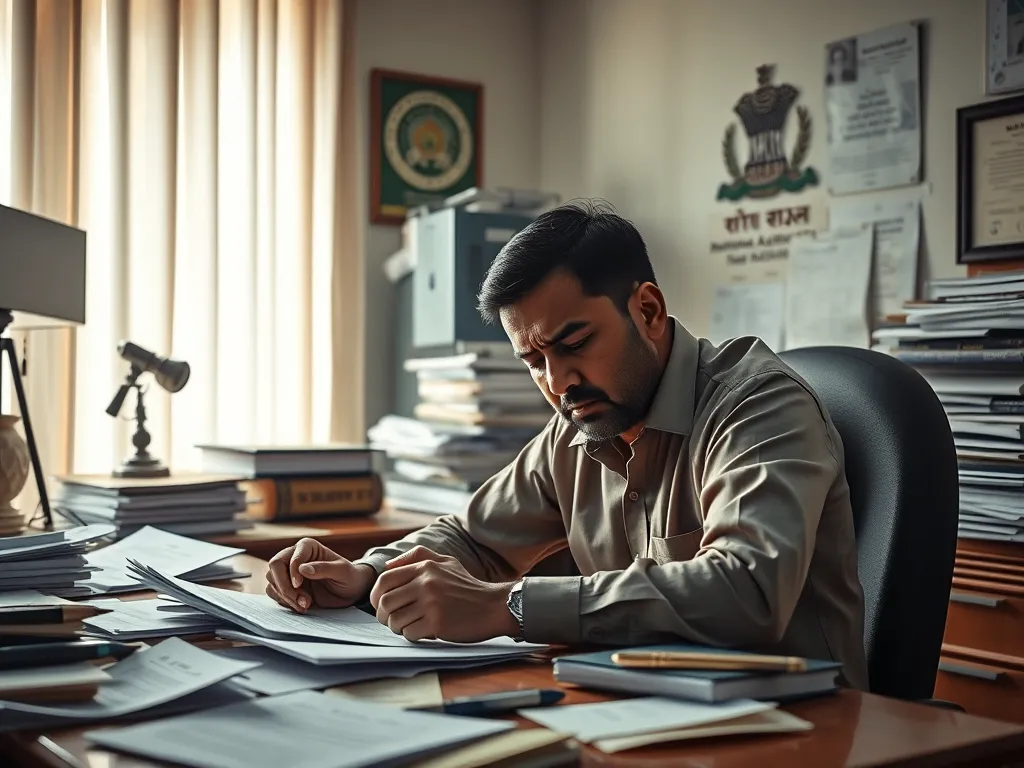
Here are the key takeaways from the analysis of your RTI regarding the Lucknow Development Authority’s (LDA) delayed enquiry:
1. The “Ghost Committee” Phenomenon
A committee was officially established in August 2021 to investigate serious irregularities in plot allotments and registries. Despite nearly four years passing (now 2025), no report has been made public, and no action has been taken against the officers involved.
2. Strategic Avoidance of Accountability
The LDA staff is accused of “running away” from providing details. This is often a bureaucratic tactic to shield internal networks. By keeping the committee members’ names and progress reports secret, the authority prevents the fixing of individual responsibility for the original corruption.
3. The “Document Loop” Tactic
The LDA has been “seeking documents” from allottees for over five years. The blog highlights that this is a classic stalling mechanism; by keeping the matter “under inquiry” indefinitely, they avoid having to deliver a final verdict or penalize guilty staff.
4. Specific Evidence Ignored
A critical 20-page document submitted by whistleblower Dinesh Pratap Singh (related to grievance GOVUP/E/2023/0081676) has seemingly vanished into the system. One of the core takeaways is the demand to know if this evidence ever actually reached the committee.
5. Violation of the “Right to Reason”
The Supreme Court of India has mandated that administrative bodies must provide reasons for their actions. The LDA’s failure to conclude an inquiry for four years is characterized as an arbitrary exercise of power and a violation of the constitutional spirit of transparency.
6. The Role of the RTI as a Tool for Justice
The filing of RTI LKDPA/R/2025/60280 serves as a formal challenge to the PIO (Atul Krishna). It forces the authority to either admit the committee has failed or produce the names and records of those responsible for the delay.
The Great Stall: Transparency vs. Bureaucracy at the Lucknow Development Authority (LDA)
The Lucknow Development Authority (LDA) is tasked with the organized growth of Uttar Pradesh’s capital. However, for many citizens, the authority has become synonymous with a different kind of “growth”—the expansion of bureaucratic red tape and a persistent lack of accountability. A recent RTI application filed by activist Yogi M.P. Singh (Registration No: LKDPA/R/2025/60280) has pulled back the curtain on a troubling pattern: the formation of “ghost committees” that serve more to bury controversies than to resolve them.
The Core Issue: A Committee Without a Conclusion
In August 2021, the LDA acknowledged serious irregularities regarding plot allotments and land registries. To address these concerns, a committee was officially constituted to investigate the matter. The logic was sound: a dedicated body would scrutinize the documents, identify the officials responsible for illegal registries, and recommend disciplinary action.
Fast forward to 2025. Nearly four years have elapsed, and the “inquiry” remains in a state of perpetual limbo. The RTI filed by Mr. Singh highlights a fundamental breakdown in administrative justice. When a committee takes half a decade to investigate internal corruption, the delay itself becomes a form of corruption.
The Anatomy of the RTI Request
The information sought from the Public Information Officer (PIO), Mr. Atul Krishna, is surgical in its precision. The applicant is not just asking for a status update; he is demanding the “Who, What, and Why” of the delay:
- Personnel Identification: Names and designations of the officers who formed the committee and those who sit on it.
- Timeframes: The specific deadline given to the committee to submit its report.
- Accountability: Why, despite five years of “seeking documents” from allottees, has no concrete action been taken?
- Specific Evidence: Whether documented evidence submitted by whistleblowers (like the 20-page document from Dinesh Pratap Singh) even reached the committee’s hands.
Why is the LDA “Running Away” from Transparency?
The primary question posed by the applicant is why the LDA staff seems to be avoiding the disclosure of committee details. In the world of Indian bureaucracy, silence is often a defensive maneuver. There are several systemic reasons why an authority might stonewall an RTI request of this nature:
1. The Protection of Internal Networks
Corruption in land allotment rarely involves a single individual. It often requires a chain of signatures from junior clerks up to senior secretaries. Disclosing the names of the committee members and their progress (or lack thereof) creates a paper trail. If the committee is found to have done nothing, the members themselves could be held liable for “dereliction of duty.”
2. The “Document Loop” Tactic
The RTI highlights that the LDA has been “seeking documents” from allottees for five years. This is a classic stall tactic. By constantly requesting more information, the authority can claim the matter is still “under process,” thereby exempting them from providing a final conclusion or taking punitive action against erring staff.
3. Legal Complications and Title Suits
The mention of a specific title suit involving “Anuradha Singh” (Case related to Writ Petition 135 HC Year 2006) suggests that the LDA might be hiding behind sub-judice excuses. However, as the RTI points out, if a court has already decided on a matter, the failure of the LDA to update its records and fix accountability is a violation of the High Court’s spirit.
The “Right to Reason”: A Constitutional Mandate
The RTI application correctly cites that the “Right to Reason” is an indispensable part of a sound administrative system. This principle, upheld by the Supreme Court of India, dictates that any administrative body must provide a rational basis for its actions—or inactions.
When the LDA fails to provide a report for four years, it isn’t just a delay; it is an arbitrary exercise of power. Citizens have a right to know:
- If the committee met.
- If minutes were recorded.
- Why the 2021 mandate has not been fulfilled by 2025.
The Role of the PIO and Nodal Officer
The responsibility now rests on the shoulders of:
- PIO: Atul Krishna (Deputy Secretary)
- Nodal Officer: Rekha Doharey
Under the RTI Act 2005, a PIO cannot simply ignore a request because the information is “sensitive” or “unpleasant.” If the committee has failed to do its job, the PIO must state that fact clearly. Failure to provide information within the 30-day window can lead to penalties under Section 20 of the RTI Act.
Conclusion: The Path Forward
The case of Yogi M.P. Singh vs. Lucknow Development Authority is a litmus test for the Uttar Pradesh government’s “Zero Tolerance” policy toward corruption. If an inquiry into land scams can be buried for four years under the guise of “committee proceedings,” then the very mechanism of internal audits is broken.
Transparency is the only cure for the rot in urban development authorities. The LDA must realize that in the age of digital tracking and online RTI portals, “running away” from the truth is no longer a viable long-term strategy. The citizens of Lucknow deserve to know who is sitting on these committees and why the wheels of justice are turning so slowly.
Based on the official records and your specific RTI filing, here are the structured contact details for the Lucknow Development Authority (LDA) and the officers currently handling your case.
🏛️ Public Authority Details
- Public Authority Name: Lucknow Development Authority (LDA)
- Department: Housing and Urban Planning Department, Government of Uttar Pradesh.
- Head Office Address: Pradhikaran Bhawan, Vipin Khand, Gomti Nagar, Lucknow, Uttar Pradesh, Pin Code: 226010.
- Official Websites: * https://ldalucknow.in
- General Helpline: 1800-1800-5000 / 0522-2307868
- General Email: ldavc@rediffmail.com / contact@ldalucknow.in
📞 Concerned Officer Details (RTI Case: LKDPA/R/2025/60280)
| Role | Name & Designation | Mobile / Phone | Email Address |
| Current PIO | Atul Krishna (Deputy Secretary) | 9918001893 | raz.9125@gmail.com |
| Nodal Officer | Rekha Doharey | 7081100326 | ldartionline@gmail.com |
| First Appellate Authority | Gyanendra Verma (Addl. Secretary) | 9918001927 | ldartionline@gmail.com |
| Alternative PIO | Hemchandra Tiwari (Chakbandi Adhikari) | 9918005512 | hemtiwari071@gmail.com |
📑 RTI Tracking Information
- RTI Registration Number:
LKDPA/R/2025/60280 - Filing Date: 28/04/2025
- Status: Request Received / Under Process (as of last update)
- RTI Online Portal (UP): https://rtionline.up.gov.in
⚖️ Higher Authorities (For Escalation)
If the PIO fails to provide the information regarding the 2021 committee report within the statutory 30-day period, you may escalate to:
- U.P. Information Commission (UPIC): * Address: 7/7A, RTI Bhawan, Vibhuti Khand, Gomti Nagar, Lucknow, UP – 226010.
- Portal: https://upsic.up.gov.in
- Vice Chairman (LDA): * Phone: 0522-2307868
- Email: ldavc@rediffmail.com
Would you like me to draft a formal reminder letter addressed to the PIO (Atul Krishna) to press for the committee report before the 30-day deadline expires?
L.D.A. set up committee to look into matter of corruption on complaint of Dinesh Pratap Singh but its outcome is zero due to procrastination


Facing a similar challenge? Share the details in the box below, and our team of experts will do their best to help.