
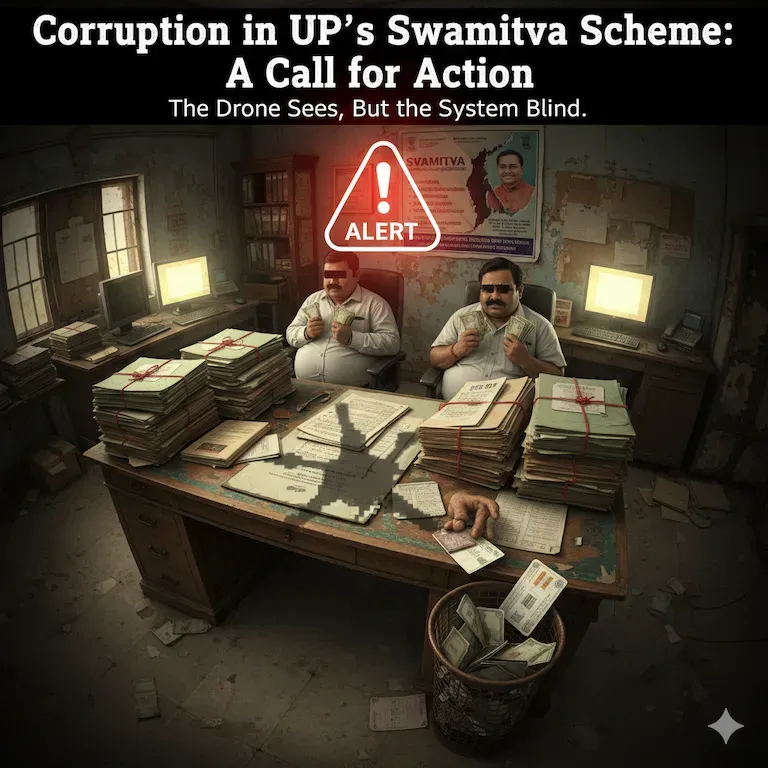
Corruption in UP’s Swamitva Scheme has become a significant concern, undermining the project’s objectives intended for empowering rural populations. Initially launched to provide property rights through innovative mapping technologies, the scheme has faced numerous allegations of mismanagement and fraudulent practices. Reports indicate that officials colluded with landowners to manipulate property data, resulting in the unjust distribution of land titles. This not only violates the scheme’s fundamental principles but also erodes public trust in government initiatives. Addressing these corruption issues is essential for the scheme’s success, ensuring that it truly benefits the rural communities it aims to serve and promotes equitable development.
Key takeaways from the blog post
Here are the key takeaways from the analysis of the grievance regarding Tehsil Lalganj:
- Systemic Corruption in SVAMITVA Implementation: Despite the use of objective drone technology to map rural properties, local Tehsil staff in Lalganj, Mirzapur, are allegedly manipulating the final “Gharauni” (property card) lists, leading to the exclusion of rightful owners, such as the family of Ram Dulari Devi.
- Jurisdictional Mismanagement: A critical procedural flaw exists, forwarded to the Police Department (Circle Officer) for investigation. This effectively shields revenue officials from accountability, as police lack the authority to audit land records.
- Lack of Administrative Transparency: The grievance highlights a “selective” distribution process. Complainants argue that staff are rendering houses visible to drones “invisible” in official records due to their “arbitrariness and tyranny.”
- Ineffective Redressal Mechanism: The current grievance system appears to be a “paper exercise.” Subordinate officers are filing reports without conducting on-the-ground investigations, while senior officials are manually converting negative citizen feedback into “Satisfactory” ratings without addressing the core issue.
- Economic Stagnation: By withholding property cards, the local bureaucracy is denying the rural poor access to financial benefits, such as bank loans and legal protection against property disputes, which are the primary goals of the SVAMITVA scheme.
- Reputational Risk to Government: Persistent irregularities and a perceived lack of accountability are damaging the government’s image among rural voters in Uttar Pradesh.
The SVAMITVA Scheme Mirage: Corruption and Procedural Lapses in Tehsil Lalganj
The SVAMITVA Scheme (Survey of Villages and Mapping with Improvised Technology in Village Areas) launched as a beacon of hope for rural India. By utilising cutting-edge drone technology, the government aimed to provide “Gharauni” (property cards) to rural residents, granting them legal ownership of their homes. However, in Tehsil Lalganj, District Mirzapur, the transition from aerial mapping to ground-level implementation has hit a wall of alleged corruption and bureaucratic apathy.
The case of Shivam Gupta (Grievance No: GOVUP/E/2025/0061269) sheds light on a systemic failure where technology meets human interference.Local revenue officials are allegedly syphoning off or blocking the benefits of the digital survey, leaving the rightful heirs of properties, such as the family of the late Ram Dulari Devi, in legal limbo.
The Core Issue: Selective Benefits and the “Invisible” Houses
The primary objective of SVAMITVA is transparency. Drones do not have biases; they map what they see. Yet, the grievance filed by Mr. Gupta raises a haunting question: How can a house visible to a drone become invisible to the Tehsil staff? (Corruption in UP’s Swamitva Scheme)
The complainant highlights that the property details of Ram Dulari Devi (now inherited by her daughter Anarkali Devi) are missing from the distributed lists. This is not presented as a technical glitch but as a deliberate act of “arbitrariness and tyranny” by the Tehsil staff. The allegation is clear: the list of beneficiaries in Lalganj is selective and incomplete, manipulated by corrupt officials who are reportedly using the scheme to “fill their pockets” rather than empower people in need.
Jurisdictional Jugglery: Why is the Police Reporting on Revenue Matters?
Perhaps the most glaring irregularity in this case is the procedural “pass-the-parcel” played by the administration. (Corruption in UP’s Swamitva Scheme)
- The Grievance: Concerns corruption in the Revenue Department (Tehsil Lalganj) regarding the issuance of Gharauni.
- The Action: The matter was forwarded to the Circle Officer (Police) Lalganj.
The complainant rightly questions the logic of this transfer. The SVAMITVA scheme and the issuance of Gharauni fall squarely under the jurisdiction of the Sub-Divisional Magistrate (SDM) and the Revenue Department. By forwarding a complaint about revenue corruption to the police, the administration has effectively ensured that no accountability can be fixed. A police officer cannot audit revenue records or investigate the technical mapping errors of a drone survey. This “arbitrary forwarding” is viewed as a tactic to shield the SDM’s office from a direct enquiry.
The Paper Trail of Disregard (Corruption in UP’s Swamitva Scheme)
The timeline of the grievance reveals a disappointing pattern of “disposal” without “resolution”:
- April 2025: Initial complaints, they filed regarding the scheme’s failure to reach people in need.
- May 2024-2025: The District Magistrate transferred the matter to the Assistant Commissioner of Police.
- The Result: The police reported that they disposed of the case, even though the complainant strongly disagreed.
Even more concerning is the feedback mechanism. When the complainant flagged that the police filed the report without a real investigation, senior police officials manually marked the status as “Converted to Satisfactory.” This administrative gaslighting ignores the factual position on the ground: the property card still hasn’t reached the rightful owner.
Direct vs. Circumstantial Evidence of Corruption
Mr Gupta asserts that he can prove corruption in Lalganj through two lenses:
- Direct Evidence: The selective exclusion of names from the official list despite clear physical occupancy.
- Circumstantial Evidence: The deliberate misrouting of grievances to the wrong department to prevent a professional audit of the Tehsil’s working. (Corruption in UP’s Swamitva Scheme)
When the staff of a Tehsil ignores drone-verified data to exclude specific individuals, it points toward a system of “pay-to-play” where only those who comply with the corrupt demands of the staff receive their legal documents.
The Impact: Maligned Government Image and Financial Exclusion
The SVAMITVA scheme is not just about a piece of paper; it is a tool for financial liberation. A Gharauni allows a villager to: (Corruption in UP’s Swamitva Scheme)
- Secure bank loans against their property.
- Reduce long-standing land disputes.
- Establish a legal identity for their household.
By allowing corruption to fester in Lalganj, the local administration is not just failing one family; they are undermining a flagship national project. As noted in the grievance, this “rampant corruption” is maligning the image of the Uttar Pradesh government among the masses, turning a celebrated reform into a symbol of local tyranny.
Conclusion: A Call for Accountability
The demand is simple: An independent enquiry into the working of Tehsil Lalganj. Shri Arvind Mohan, Joint Secretary at the Chief Minister’s Secretariat, has received the grievance. For justice to reach the needy, the state must hold the Revenue Department accountable and look beyond the “satisfactory” reports filed by the police. If the “Double Engine” growth is to reach every corner of Mirzapur, the authorities must clear the “clogged pipes” of the Lalganj Tehsil.
The residents of Mirzapur are watching. Will the drone-mapped truth prevail, or will a corrupt bureaucracy bury it under its files?
To help you visualise the gap between the government’s vision and the ground reality in Lalganj, here is a comparison of the intended workflow versus the reported hurdles.
SVAMITVA Scheme: Intent vs. Reality in Tehsil Lalganj
| Process Stage | Standard/Intended Procedure | Reported Hurdle in Lalganj |
| Data Collection | Drones map all residential structures (Abadi areas) impartially. | Selective inclusion; some houses (like Ram Dulari Devi’s) are “omitted.” |
| Verification (Corruption in UP’s Swamitva Scheme) | Revenue officials (Lekhpal/SDM) verify ownership based on records and drone data. | Allegations of “tyranny” and “arbitrariness” where staff manipulate the list for personal gain. |
| Grievance Redressal | SDM or DM investigates complaints regarding mapping or staff corruption. | Jurisdictional Error: Grievances are forwarded to Police (Circle Officer) instead of Revenue officials. |
| Outcome | Homeowner receives a “Gharauni” (Legal Property Card). | “Gharauni” is withheld from the needy, preventing them from accessing loans or legal safety. |
The Grievance Redressal Paradox
As highlighted in the blog, the main barrier to justice is the “Administrative Loop” shown below: (Corruption in UP’s Swamitva Scheme)
- Citizen Complaint: “The Tehsil staff is corrupt and ignored my house.
- Administrative Action: The complaint is sent to the Police, who have no jurisdiction over land records.
- The Result: The Police submit a “Technical Disposal” report, and the senior officers mark the case as “Satisfactory” despite the citizen’s disagreement.
Based on your grievance documents and official state records, here are the structured contact details for the relevant authorities.
1. State Level: Chief Minister’s Secretariat (Lucknow) (Corruption in UP’s Swamitva Scheme)
These officials are currently handling your grievance at the top level of the state administration.
- Concerned Officer: Shri Arvind Mohan
- Designation: Joint Secretary, Chief Minister Office
- Office Address: Room No. 321, 3rd Floor, Lok Bhawan (U.P. Secretariat), Lucknow, U.P.
- Contact Number: 0522-2226350 / 0522-2226354
- Email Address: arvind.12574@gov.in
- CMO Main Email: cmup@nic.in
2. District Level: Mirzapur Administration (Corruption in UP’s Swamitva Scheme)
Since the grievance originated in Mirzapur, the District Magistrate (DM) has supervisory authority over the Tehsil staff you are concerned about.
- Public Authority: District Magistrate, Mirzapur
- Current Officer: Shri Pawan Kumar Gangwar (IAS)
- Mobile (CUG): 9454417567
- Office Phone: 05442-252480 / 05442-257400
- Email Address: dmmir@nic.in or dmmir@up.nic.in
- Web Link: https://mirzapur.nic.in
3. Department Specific: Revenue & Tehsil Lalganj (Corruption in UP’s Swamitva Scheme)
The core of your complaint lies here. You can contact the Tehsildar directly to demand a manual verification of the SVAMITVA survey.
- Tehsil Lalganj (Mirzapur) Office: 05440-285360
- Tehsildar (Lalganj) CUG Number: 9454417951 (Note: Based on standard departmental CUG mapping for Lalganj unit)
- Board of Revenue (UP): https://bor.up.nic.in
4. Portal & Digital Redressal (Corruption in UP’s Swamitva Scheme)
Use these for tracking your specific application IDs: GOVUP/E/2025/0061269 and GOVUP/E/2025/0042472.
- Portal Name: IGRS Jansunwai (Samadhan)
- Web Link: https://jansunwai.up.nic.in
- CM Helpline Number: 1076 (Toll-Free)
- Technical Support Email: jansunwai-up@gov.in (For technical portal issues only)
Next Steps for Your Grievance (Corruption in UP’s Swamitva Scheme)
Given that your previous feedback was “Converted to Satisfactory” by the police without a resolution, you should:
- Send an Email to Shri Arvind Mohan: Attach your grievance PDF and explicitly state that the Police (Circle Officer) report is legally invalid because the matter is a Revenue Dispute involving drone surveys.
- File a Formal Remonstrance: Log into the Jansunwai portal and use the “Send Reminder” or “Feedback” option again, citing the specific jurisdictional error.
Would you like me to draft a formal email specifically for the Joint Secretary (Shri Arvind Mohan) that argues why the police report is legally inapplicable to this revenue matter?


Facing a similar challenge? Share the details in the box below, and our team of experts will do their best to help.