
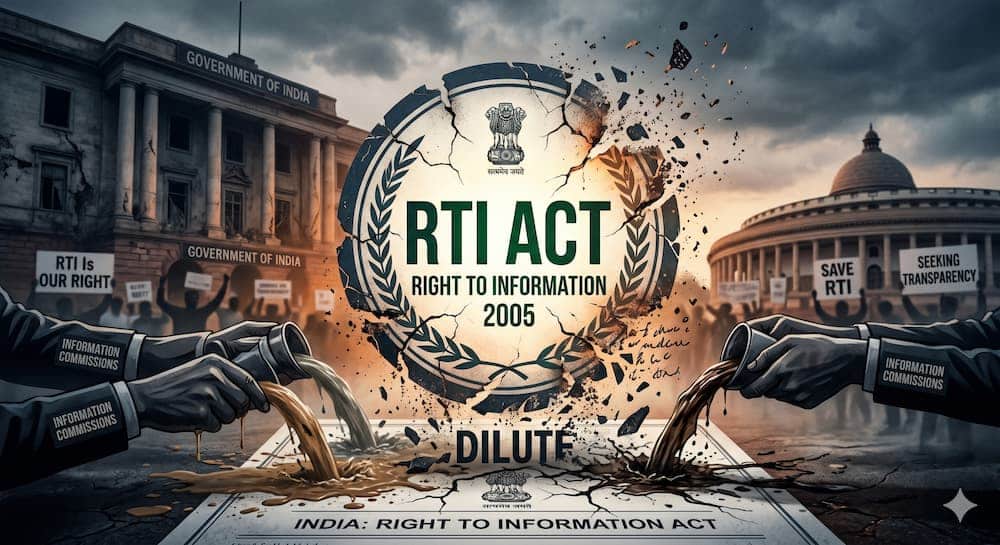
Information Commissions Dilute RTI Act in India
In recent years, various information commissions have scrutinised the effectiveness of the Right to Information (RTI) Act in India. These bodies, established to ensure transparency and accountability in governance, have increasingly diluted the provisions of the RTI Act. They often impose arbitrary decisions and hefty fines and deny information requests based on vague interpretations of the law. This trend undermines the fundamental purpose of the RTI Act and raises concerns about the erosion of democratic principles and citizen empowerment in the country.
Key Takeaways
- Information Commissions in India weaken the RTI Act through inconsistent decisions and fines, undermining transparency and accountability.
- Once a revolutionary tool, the RTI Act now faces challenges with bureaucratic inertia and police misconduct going unchecked.
- RTI applicants often encounter evasive responses and inadequate information, revealing how authorities evade scrutiny.
- Systemic issues arise when information commissions fail to impose penalties on public information officers who obstruct information requests.
- To restore transparency, information commissions must actively enforce the law and impose penalties as mandated by the RTI Act.
Information Commissions Dilute RTI Act in India: The Accountability Void
When the Parliament of India passed the Right to Information (RTI) Act in 2005, it was hailed as a revolutionary tool to give citizens a “right to question. Fast forward to today, and citizens often find themselves trapped in a bureaucratic labyrinth. In this web, law enforcement suppresses critical evidence, and regulatory bodies fail to step in. A growing body of evidence suggests that, instead of acting as strict enforcers of transparency, regional information commissions dilute the RTI Act in India. They do this by functioning as toothless, passive facilitators.
A glaring case study unfolding right now in Uttar Pradesh exposes exactly how accountability is systematically dismantled. This happens when oversight bodies refuse to exercise their statutory powers. +2
1. The Genesis: When Human Rights Orders Meet Police Inertia (Information Commissions Dilute RTI Act)
The breakdown of transparency frequently begins when an independent statutory body exposes police misconduct or mandates compliance. In this specific case, the Uttar Pradesh State Human Rights Commission (UPSHRC) issued a clear directive on December 29, 2025 (Case No. 28286/24/55/2025) regarding a serious grievance.
When an ordinary citizen sought to verify whether the Office of the Superintendent of Police (SP) in Mirzapur actually complied with the human rights mandate, they were met with institutional stone-walling. To unearth the truth, an online RTI application was filed on January 28, 2026.
2. The Core Issues: What Law Enforcement Hides from the Public
When an RTI applicant asks targeted, uncomfortable questions, public authorities frequently deploy tactics of diversion. They are confident that a lack of enforcement means they will face no consequences. A close look at the requested information reveals exactly what police administrations try to keep hidden:
A. The Myth of the “Action Taken Report” (ATR)
- The Request: A certified copy of the actual correspondence or compliance report dispatched by the SP Mirzapur to the UPSHRC.
- The Evasive Reality: Instead of providing the specific dispatch document, the public information officer (PIO) merely hands over generic internal summaries or unrelated inquiry reports. +1
B. The Erasure of Procedural Accountability (NastiNoting Sheets)
- The Request: Certified copies of the day-to-day progress file notation showing exactly how the file moved within the police department after receiving the human rights order. +1
- The Evasive Reality: File notings are the absolute DNA of administrative accountability—they reveal which officer delayed the file and what internal opinions were recorded. The PIO completely withheld these records, flagrantly violating Section 2(j) of the RTI Act. +4
C. The Suppression of Critical Electronic Evidence (CCTV DVR)
- The Request: Definite information on whether a crucial piece of evidence—the CCTV Digital Video Recorder (DVR) mentioned in the original human rights complaint—was formally seized under a legal seizure memo.
- The Evasive Reality: Total, calculated silence. Failing to disclose the seizure status of electronic evidence points directly to potential tampering or a deliberate cover-up of police high-handedness. +2
3. How Passive Information Commissions Dilute RTI Act in India
The RTI Act was built with strong internal safeguards: if a PIO lies or stonewalls, the First Appellate Authority (FAA) and the State Information Commission are legally mandated to penalise them. In practice, however, this chain is fundamentally broken. This is because modern appellate authorities choose to act as facilitators rather than judges. +1
The Rubber-Stamping Appellate Authority
When a First Appeal was preferred against the PIO’s evasive reply, the FAA (the SP Mirzapur) completely bypassed its judicial duty. On April 3, 2026, the FAA mechanically upheld the PIO’s deficient reply. This forced a citizen into prolonged litigation before the State Commission. +4
A Commission “Without Nails and Teeth”
The final tier of hope rests with the State Information Commission. However, this case highlights a broader systemic failure: +2
- The Statutory Mandate: Section 20(1) explicitly states the Commission shall impose a daily financial penalty on a PIO who wilfully obstructs information.
- The Grim Reality: Rather than enforcing financial penalties or pulling up the administrative “chair” currently held by the PIO, commissions frequently issue gentle warnings, grant endless adjournments, and accept incomplete compliance. This institutional passivity is precisely how information commissions dilute the RTI Act in India, transforming a powerful transparency tool into an administrative formality. +2
4. The Final Word: Reclaiming the Spirit of Transparency
The ongoing legal battle under File No. S08/A/0774/2026 is not just about one citizen’s quest for justice in Mirzapur. Instead, it reflects a systemic crisis across the nation. +2
When public authorities ignore state human rights orders, bury file movements, refuse to account for critical CCTV evidence, and escape the Information Commission without consequences, they subvert transparency. (Information Commissions Dilute RTI Act)
To fix this accountability void, information commissions must transition out of their self-imposed role as polite facilitators. They must start using the legal teeth given to them by Parliament: impose personal penalties under Section 20(1), name the defaulting officers, and mandate immediate, time-bound public disclosures. Until then, the burden of maintaining democracy falls entirely on the relentless endurance of the citizen appellant. +2
Based on the official documents and transparency portal records provided, here is the complete directory of application IDs, transactions, emails, mobile numbers, and digital web links for all the public authorities involved in this case:
1. Application IDs & Tracking Reference Numbers (Information Commissions Dilute RTI Act)
- RTI Registration Number (Section 6(1)):
SPMZR/R/2026/60047+2 - RTI Online Transaction ID:
SPMZRR20260000000059 - First Appeal Reference Number: Processed via Section 19(1) under the primary application chain on 07-03-2026.
- Second Appeal Registration Number:
A-20260401256+1 - State Information Commission File Number:
S08/A/0774/2026+1 - UP Information Commission Diary Number:
D-190520260006 - UPIC Registry Welcome ID:
UPICR20260002329
2. Public Information Officer (PIO) Details (Information Commissions Dilute RTI Act)
- Concerned Authority: Office of the Superintendent of Police, Mirzapur, Uttar Pradesh – 231001. +1
- Designated Active Officers: * Shri Manish Kumar Mishra, ASP +1
- Shri Raj Kumar Meena, ASP (Current handling officer cited in recent correspondences)
- Official Mobile Number:
+91-9454401105 - Official Email Address:
asp-op.mi@up.gov.in
3. First Appellate Authority (FAA) Details (Information Commissions Dilute RTI Act)
- Concerned Officer: Smt Aparna Rajat Kaushik, SP
- Office Location: Office of the Superintendent of Police, Mirzapur, Uttar Pradesh – 231001.
- Official Mobile Number:
+91-9473567333 - Official Email Address:
spmzr-up@nic.in
4. Additional Local Police Contacts (Information Commissions Dilute RTI Act)
- Circle Officer (City of Mirzapur): Involved in the administrative tracking loop.
- Official Email Address:
co-city.mi@up.gov.in
5. Second Appellate Authority & Digital Web Links (Information Commissions Dilute RTI Act)
- Adjudicating Body: Uttar Pradesh Information Commission (Hearing Court Room S-8), Lucknow. +1
- Court Registry Email:
- Technical/Portal Webmaster Email:
webmaster-upic@up.gov.in - RTI Portal Context Links:
6. Appellant Credentials (For Verification Matching) (Information Commissions Dilute RTI Act)
- Name: Smt Archana Dubey +1
- Registered Address: Ghode Shahid Ghurahu Patti (Ramai Patti), Thana Kotwali City, Mirzapur, Uttar Pradesh – 231001. +1
- Registered Mobile Number:
+91-8840098979 - Primary Account Email:
myogimpsingh@gmail.com - Appellate Communication Email:
archanadubeymzp1995@gmail.com


Facing a similar challenge? Share the details in the box below, and our team of experts will do their best to help.