
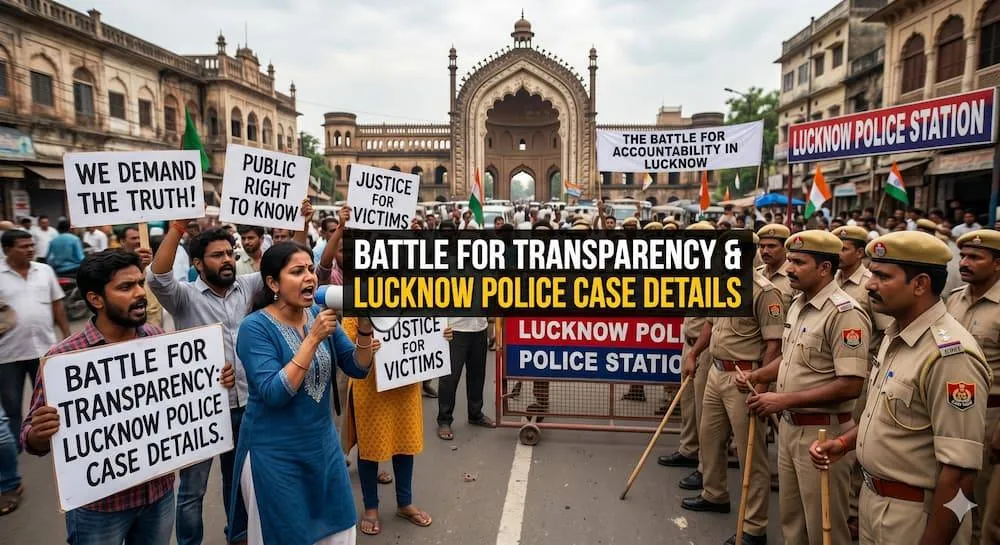
Battle for Transparency & Lucknow Police: In recent times, the Lucknow Police have faced increasing scrutiny regarding their accountability and transparency practices. Community leaders and activists have called for reforms aimed at fostering greater trust between law enforcement and the citizens they serve. This battle for transparency includes demands for improved communication strategies, the establishment of oversight committees, and the implementation of technology that can ensure police actions are recorded and monitored. Additionally, there is a push for the police to engage more actively with local communities, creating open forums where concerns can be discussed and addressed in a constructive manner.
Key Takeaways
- Lucknow Police face scrutiny over transparency and accountability amid calls for reform from community leaders.
- Kiran Singh’s RTI case highlights systemic barriers to accessing information and accountability in police conduct.
- The police have used evasive tactics, reclassifying inquiries about conduct into land disputes, undermining public trust.
- The Uttar Pradesh Information Commission criticized police responses as incomplete, urging better compliance with RTI obligations.
- Kiran Singh’s struggle represents a broader fight for the Right to Information, testing the effectiveness of the RTI Act in ensuring accountability.
Battle for Transparency & Lucknow Police: A Case Study of RTI Non-Compliance in Uttar Pradesh
The Right to Information (RTI) Act of 2005 aimed to empower citizens and strengthen accountability in governance. However, Kiran Singh’s ongoing legal battle with the Lucknow Police Commissionerate (File No. S05/A/0106/2025) shows how systemic hurdles still block the Act’s promise. In this case, the fight goes beyond a personal land dispute. Instead, it exposes how public authorities use red herrings and misleading reports to avoid scrutiny.
Battle for Transparency & Lucknow Police is more than a headline. It shows how RTI applicants face delays, evasive replies, and procedural roadblocks when they ask for point-wise answers about police action. In this post, I walk through the key dates, orders, and contradictions in the Kiran Singh v. Lucknow Police Commissionerate matter. More importantly, I explain what the record signals about accountability in Uttar Pradesh.
The Core Conflict: Land Rights vs Police Conduct
This dispute involves a 16-foot path and a plot of 2,615 square feet in Ali Nagar Sunahla. The police have repeatedly framed it as a “revenue matter” that land records should settle. However, the appellant, Kiran Singh, has pushed the focus to a more urgent issue: police accountability. In this Battle for Transparency & Lucknow Police, one question drives everything. Will the public authority give clear, point-wise RTI disclosures about police conduct?
The appellant’s RTI queries seek specific information that the police have repeatedly evaded:
- The Legal Basis for Road Classification: On what investigative grounds did the police conclude that a specific path is a “common road?
- Justification for Detention: What legal provision allowed for the detention and confinement of the appellant’s family members at the Krishnanagar Police Station?
- Conflict of Interest: What are the posting details of specific personnel (Kamla Dayal and Manoj Kumar Solanki) who may be influencing the investigation?
The Commission’s Intervention: “Incomplete and Misleading”
The Uttar Pradesh Information Commission recognised these omissions early. Therefore, in an order dated September 11, 2025, the Hon’ble State Information Commissioner, Shri Padum Narayan Dwivedi, called the police response “incomplete and misleading.” This order marked a turning point in the broader Battle for Transparency & Lucknow Police.
Next, the Commission directed the SHO of Krishna Nagar and the Tehsildar of Sarojini Nagar to provide the requested information within two weeks. It also warned that it could start penal proceedings under Sections 20(1) and 20(2) of the RTI Act if officials failed to comply. However, the police still sent defensive and repetitive reports.
Tactics of Evasion: The “Revenue Matter” Red Herring
On December 1, 2025, Sub-Inspector Ashish Kumar submitted a report that the appellant calls a “mockery of the law.” Instead of answering the RTI points, the report focused on the appellant’s failure to provide land documents. It then concluded that the police should take no action because the issue was “revenue-related.”
This tactic shows classic administrative buck-passing. For example, the Public Information Officer (PIO) reframed a query about police conduct as a dispute about land ownership. As a result, the response sidestepped questions about illegal detention and investigative bias. Meanwhile, the appellant clarified a simple point in her representation. The RTI asked about police actions, not land titles. This pattern sits at the core of the Battle for Transparency & Lucknow Police. It demands that authorities answer what they did, under which legal power, and on what record.
Contradictions in the Courtroom
The hearing on February 11, 2026 exposed a gap between what the police claimed and what they actually shared. Although the appellant was absent, Inspector Vijay Kumar stated that the police had provided all information on November 14, 2025. However, the record of point-wise disclosure remains contested.
Since then, the appellant has filed a detailed rebuttal. She categorically denies receiving the specific, point-wise information that the Commission ordered. Consequently, this stage highlights a common RTI frustration. Many authorities show “compliance on paper,” but they still block real transparency.
The Path Forward: Fixing Accountability
As of May 1, 2026, the case has taken a complex turn. The Commission’s portal lists it as “Disposed” as of April 29, 2026. However, the final “Reasoned Order” is still not available to the public. Therefore, the appellant has taken two strategic steps to restore accountability:
- Restoration of Appeal: A representation (Diary No. D-010520260033) has been filed to reopen the appeal due to continued non-compliance and the submission of misleading facts by the PIO.
- Fresh RTI for Administrative Transparency: A new RTI application (Registration No. UPICM/R/2026/60247) has been filed against the Commission itself to identify who is responsible for the delay in uploading the final order and to demand a physical inspection of the file under Section 2(j)(i).
Conclusion: Why This Case Matters
Kiran Singh’s case reflects a wider struggle for the “Right to Know” in India. It shows how public authorities use technicalities to shield themselves from misconduct allegations. When a police department refuses to explain the legal basis for detentions or investigative conclusions, it weakens the rule of law. Therefore, this Battle for Transparency & Lucknow Police matters beyond one dispute. It tests whether RTI can force real answers about state power.
The Uttar Pradesh Information Commission’s eventual “Reasoned Order” will test how well the RTI Act works in practice. Will the Commission penalise the PIO under Section 20. Or will officials use the “revenue matter” defence to bury legitimate questions about police conduct? For now, citizens have one practical tool. They can keep scrutinising the record.
Key Takeaways from the Battle for Transparency & Lucknow Police (For RTI Applicants)
- Identify Red Herrings: If a PIO changes the subject of your query (e.g., from “police conduct” to “land records”), immediately point this out in your appeal.
- Request Reasoned Orders: Every citizen has the right to a detailed explanation for the disposal of their case.
- Use Section 2(j): If you suspect a signed order is being withheld or doesn’t exist, use your right to inspect the physical file.
Based on the provided documents and your recent filings, here are the essential identification and contact details for the public authorities involved in your case:
1. Appeal & Filing Identifiers (Battle for Transparency & Lucknow Police)
- Appeal Number: S05/A/0106/2025
- Registration Number: A-20250200031
- New Representation Diary Number: D-010520260033 (Filed 01-05-2026)
- RTI Registration (Commission): UPICM/R/2026/60247
- RTI Registration (Police): PCLKO/R/2026/60799
2. Uttar Pradesh Information Commission (UPIC) (Battle for Transparency & Lucknow Police)
- Web Link: upic.up.nic.in
- Email for Hearing Court 5: hearingcourts5.upic@up.gov.in
- PIO Email: jansu-section.upic@up.gov.in
- Nodal Officer Telephone: 9415021746
- PIO (Administrative Officer): Mumtaz Ahmad
- PIO Phone: 9151804317
- Address: 7/7A, RTI Bhawan, Vibhuti Khand, Gomti Nagar, Lucknow – 226010
3. Police Commissionerate Lucknow (Battle for Transparency & Lucknow Police)
- Web Link: lucknow.upsdc.gov.in
- Primary RTI Email: jansuchanalko@gmail.com
- Commissioner of Police Emails: * cp-pol.lu@up.gov.in
- jcp-pollo.lu@up.gov.in
- jcp-polhq.lu@up.gov.in
- DCP HQ Office Email: dcphqoffice@gmail.com
- Nodal Officer/PIO Phone: 9140770107
- PIO (ADC): Naveen Kumar Singh
- Address: Office of the Commissioner of Police, Lucknow, PIN: 226001
4. Local Police Details (Krishnanagar) (Battle for Transparency & Lucknow Police)
- Sub-Inspector: Ashish Kumar
- Inspector: Vijay Kumar
- Station: Police Station Krishnanagar, Lucknow
Related reading: ACP Manoj Kumar Singh: Service Details Revealed


Facing a similar challenge? Share the details in the box below, and our team of experts will do their best to help.