
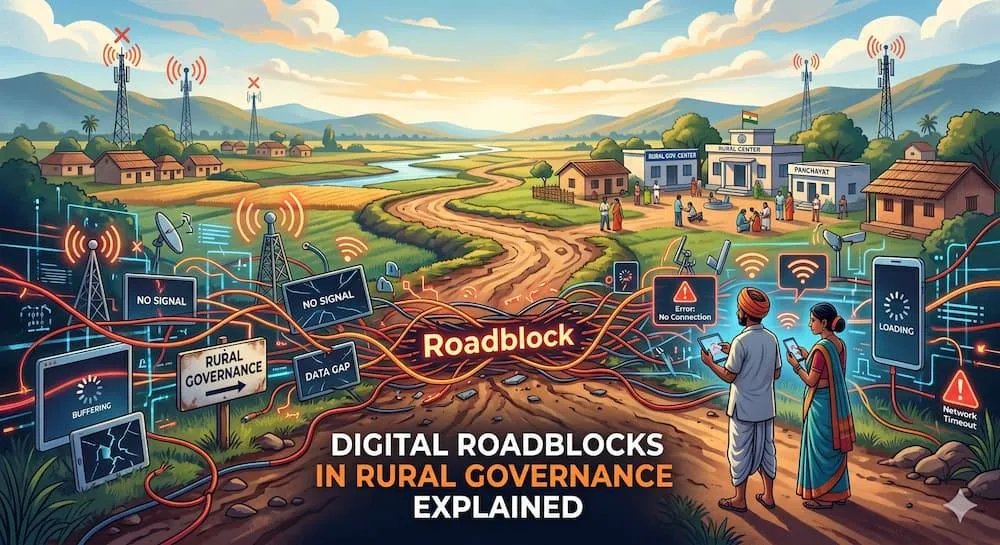
Digital roadblocks in rural governance pose significant challenges to effective administration and service delivery. Limited internet access, inadequate digital infrastructure, and a lack of technological literacy among citizens hinder the implementation of e-governance initiatives. Additionally, these obstacles create disparities in information access, leading to reduced citizen engagement and participation in decision-making processes. Furthermore, the digital divide exacerbates existing social inequalities, as marginalised communities often struggle to leverage technology for their needs. It is crucial for policymakers to address these issues by targeting investments in infrastructure and training programs to ensure equitable access to digital resources and to enhance governance in rural areas.
Key Takeaways
- Digital roadblocks in rural governance hinder effective administration, reducing access and participation for citizens.
- A case study in Mirzapur highlights how these roadblocks delay PM-KISAN benefits due to bureaucratic inefficiencies.
- Existing digital systems conflict with local document requirements, slowing down service delivery and exacerbating frustrations.
- RTI responses often evade accountability, shielding delays and hiding the identities of responsible officials from scrutiny.
- To improve governance, officials must enhance transparency, adhere to timelines, and eliminate redundant requirements related to digital records.
Digital Roadblocks in Rural Governance: Farmer Rights and PM-KISAN Delays in Mirzapur
Summary: This case study from Mirzapur, Uttar Pradesh shows how Digital Roadblocks in Rural Governance delay PM-KISAN-linked farmer benefits. It also shows how portal status mismatches, redundant paperwork, and opaque RTI replies weaken accountability.
“Digital India” promises transparency and speed. It also aims to reduce dependence on middlemen. However, Digital Roadblocks in Rural Governance appear when district processes drift away from central platforms. In agriculture, the DARSHAN Portal (Digital Agriculture Realtime Services, Hassel-free Assistance, and New Initiative) and the PM-KISAN scheme should deliver benefits directly to farmers.
A recent legal battle in Mirzapur, Uttar Pradesh involves Yogi M P Singh and his family. It shows how officials can stall legitimate benefits for months. They do it through negligence, cryptic data entry, and broad legal exemptions. Meanwhile, the public portal can still appear to show “progress.”
1. The “Vicharadheen” Paradox: A Digital Roadblock in Rural Governance
This issue centers on three farmer registrations (Reference Nos: 20250119514266, 20250119512524, and 20250119192467). Farmers submitted them through the DARSHAN portal. However, for over ten months, the portal kept these applications in “Vicharadheen” status. The word means “Under Consideration.”
At first glance, the public portal suggests active review. However, internal documents tell a different story. In an RTI response, the Deputy Director of Agriculture (DDA) Mirzapur, Vikesh Kumar, stated that officials marked Keshav Pratap Singh’s application as “Rejected at Tehsil login”. They did so “for authenticating the land record.” As a result, the system creates a kind of digital limbo. The farmer sees “pending” online, but the backend has already discarded the file without notice.
2. The Redundancy of Physical Documents in a DBT Era
The DDA Mirzapur cited another hurdle. Officials require farmers to submit a physical certified Khatauni (land record) and a bank passbook.
Officials justify this demand by citing older circulars. They often point to G.O. No. 20/2020/462-A dated April 25, 2020. However, this local demand conflicts with newer central mandates:
- Aadhaar Payment Bridge System (APBS): PM-KISAN now routes payments through Aadhaar-seeded accounts. Here, Aadhaar acts as the financial address.
- The Information Technology Act, 2000: This law gives legal status to digital records. Therefore, data on the Bhulekh UP portal can carry the same legal weight as a certified physical copy.
- Central Mandate (Nov 19, 2025): Recent reforms push a seamless DBT process. They rely on Aadhaar-based e-KYC and digital land records as the main pillars of transparency.
When local offices insist on paperwork the digital system should replace, they slow everything down. As a result, they create friction and widen discretion. These are classic Digital Roadblocks in Rural Governance. They also defeat the purpose of DBT reform.
3. The Misuse of RTI Section 8(1)(j): Shielding Accountability
The appellant then sought clarity under the Right to Information (RTI) Act. In response, the DDA Mirzapur used Section 8(1)(j) to deny key details. This section protects “personal information” unrelated to public activity.
Specifically, the PIO refused to share:
- Daily Progress Reports: Detailed logs of how the applications were handled between January and December 2025.
- Names of Responsible Officials: The identity of the Lekhpals, Technical Assistants, or Clerks with whom the applications were pending.
- Rejection Remarks: The specific internal comments or digital portal remarks that led to the “Vicharadheen” status.
As a result, the farmer cannot identify who caused the ten-month delay. That makes it harder to hold specific public servants accountable for inaction.
4. The “No Knowledge” Defence: A Lack of Proactive Disclosure
Next, Section 4(1)(b) of the RTI Act requires every department to publish its norms and timelines. It also requires a Citizen Charter that sets service delivery standards. (Digital Roadblocks in Rural Governance)
However, the PIO claimed that “no such Government Order or Citizen Charter is within knowledge” on the maximum time limit for approving a new farmer registration. This response signals a transparency gap in the Mirzapur District Agriculture Office. Moreover, without a defined timeline, officials can keep an application “pending” indefinitely. Nothing automatically triggers an administrative red flag.
5. Contradictions in Grievance Redressal
Section 5 also shows a breakdown in communication across central, state, and district authorities. (Digital Roadblocks in Rural Governance)
- Central Directive: A directive from the Central Government Grievance (DOAAC/E/2025/0045542) dated December 10, 2025, was sent regarding these issues.
- Local Response: The DDA Mirzapur claimed they were unaware of this directive and had taken no action on it.
Because authorities did not sync their actions, escalation did not help. Even after the farmer raised the complaint at the national level, the local office stayed unresponsive. Instead, it cited “lack of information.”
6. The Path to Justice: The Second Appeal
After months of misleading updates and stonewalling, the appellant escalated the matter to the Uttar Pradesh Information Commission (Appeal Registration No: A-20260402727).
In this appeal, the appellant asks for three specific remedies:
- Direct Disclosure: Direct the PIO to provide the Daily Progress Report. Also require the names and designations of officials who held the files for ten months.
- Harmonisation of Records: Require the department to explain why the portal status (“Vicharadheen”) conflicts with the PIO’s internal claim of “Rejection.”
- Strict Penalties: Invoke Section 20(1) of the RTI Act and penalize the PIO for wilfully providing misleading and incomplete information.
Conclusion: Reclaiming the Digital Promise
The DARSHAN portal uses the motto “Kisan ka Adhikar, Kisan ke Dwar” (The Farmer’s Right at the Farmer’s Door). However, this case shows a different reality. Bureaucratic red tape and weak digital adoption often lock that door. (Digital Roadblocks in Rural Governance)
For PM-KISAN to succeed, the DDA Mirzapur must stop relying on “cryptic feedings” and redundant document demands. In addition, the office must publish clear timelines and follow them. Transparency also requires more than a website. It requires the right to know who holds a file and why officials delay it. Finally, the upcoming hearing at the State Information Commission can test farmer rights and administrative accountability in Uttar Pradesh.
If we want digital welfare systems to work at scale, we must shift from “portal presence” to enforceable service standards. Otherwise, Digital Roadblocks in Rural Governance will keep blocking citizens in real life.
Based on the provided documents and the recently filed Second Appeal, here are the specific details regarding application IDs and the contact information for the public authorities involved.
1. Farmer Registration Application IDs (Digital Roadblocks in Rural Governance)
The registrations submitted via the DARSHAN Portal for the members of your family are as follows:
- 20250119514266
- 20250119512524
- 20250119192467 (Note: Referenced as 20250119193467 in some internal responses ).
2. Public Authority Contact Details (Digital Roadblocks in Rural Governance)
| Authority | Name/Designation | Mobile Number | Email Address |
| Public Information Officer (PIO) | Vikesh Kumar, DDA Mirzapur | 7839882478 | ddamzp2012@gmail.com |
| First Appellate Authority (FAA) | Joint Director of Agriculture (JDA), Vindhyachal | 7668571373 | jdavindhyachal@gmail.com |
| Nodal Officer (Agriculture) | Additional Director of Agriculture | 8081560096 | dirag@up.nic.in |
3. Web Links and Digital Portals (Digital Roadblocks in Rural Governance)
- UP Agriculture Registration Portal: agriculture.up.gov.in/registration/
- RTI Online Uttar Pradesh: rtionline.up.gov.in/request/regdetails.php
- UP Information Commission Appeal Link: Reference Registration Number A-20260402727 for the appeal filed on 30/04/2026.
4. Central Grievance Reference (Digital Roadblocks in Rural Governance)
- Grievance Number: DOAAC/E/2025/0045542.
- Date: 10/12/2025.
Summary of Concern: Despite these digital links and active contact details, your applications remain in “Vicharadheen“ (Under Consideration) status according to the portal , while the PIO has internally claimed they are rejected at the Tehsil level.


Facing a similar challenge? Share the details in the box below, and our team of experts will do their best to help.