
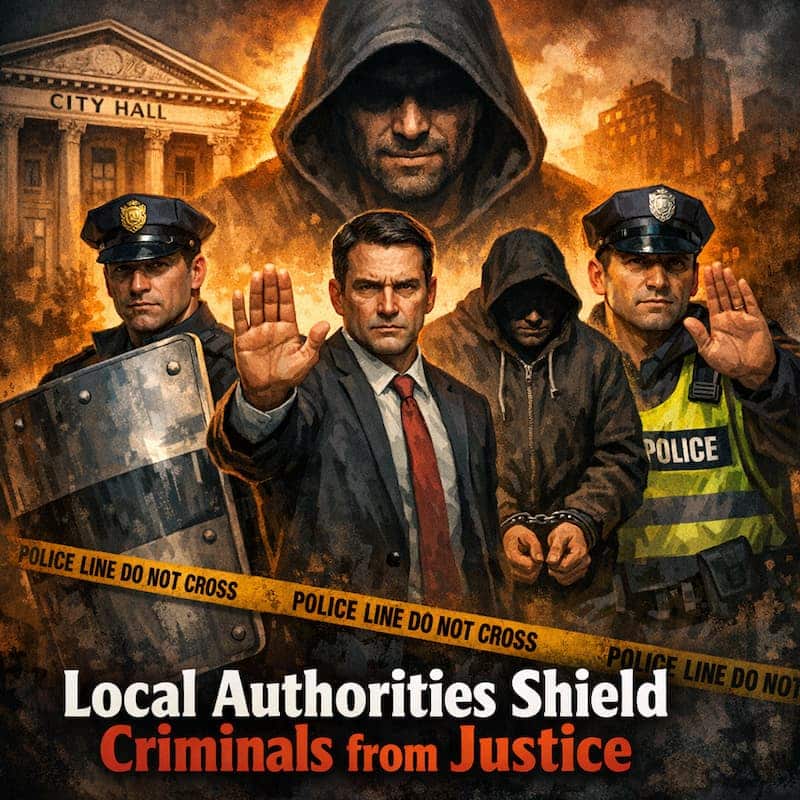
Local Authorities Shield Criminals from Justice. This disturbing trend has raised significant concerns among communities, as the very institutions meant to protect citizens appear to prioritize the interests of offenders over public safety. Many residents feel a growing sense of betrayal, witnessing a lack of accountability for criminal actions. Instances of leniency toward offenders, purportedly for rehabilitation purposes, often result in repeat offenses and increased fear among law-abiding citizens. Furthermore, this phenomenon undermines the trust that is essential for effective policing and community safety, prompting calls for reform and a reevaluation of policies that enable such shielding practices.
Key Takeaways
- Local authorities are prioritising the interests of offenders over public safety, causing community unrest.
- They misclassify criminal offences, labelling them as ‘civil disputes,’ which undermines justice and accountability.
- A specific case in Mirzapur illustrates this trend, where police ignored clear evidence of robbery to protect influential perpetrators.
- Despite multiple grievances, the local administrative system defied higher authority directives, blocking justice.
- Judicial intervention is now necessary to restore accountability and enforce the Rule of Law.
How Local Authorities Shield Criminals by Using “Civil Dispute” Labels
When a citizen turns to the police for help, they expect the law to protect them. However, a very worrying trend is growing in local government departments. Specifically, officers are choosing to label clear criminal acts as simple “civil family disputes” to ensure that Local Authorities Shield Criminals. A clear example of this broken system is now happening in Mirzapur, Uttar Pradesh. There, the state’s online grievance portal (IGRS / Jansunwai) has become a tool for endless paperwork instead of a path to real justice.
The case of Smt. Archana Dubey shows exactly how local police can manipulate small gaps in the system. Furthermore, it reveals how they openly ignore groups like the National Human Rights Commission (NHRC). Most importantly, they do this by turning a blind eye to solid physical evidence. Consequently, these actions demonstrate exactly how Local Authorities Shield Criminals and protect well-connected offenders from jail.
The Crime: A Daylight Robbery Disguised as a Property Fight
The trouble began on October 24, 2025, when a planned daylight robbery and house trespass took place at the victim’s home in Ghode Shahid, Ghurahu Patti. This happened under the City Kotwali Police Station in Mirzapur. First, while the family was away, a group of relatives broke the physical locks of the rooms. Next, they stole gold jewelry worth about ₹8 Lakh. In addition, they cleared out vital household items like a washing machine, a fridge, and a television.
Immediately after the theft, the attackers replaced the victim’s locks with their own. Therefore, they took illegal control of the legally shared part of the family house. This violent act did not just cause a major financial loss. Rather, it also started a painful human crisis. Because of the eviction, the complainant—who was seven months pregnant at the time—was left completely homeless along with her nine-year-old daughter. As a result, they had to move into a tiny rented room while facing constant safety threats because Local Authorities Shield Criminals by refusing to step in.
The “Civil Dispute” Lie: A Shield for Serious Crimes
Under the new criminal law (Bharatiya Nyaya Sanhita / BNS), house-breaking, robbery, and forced eviction are serious criminal acts. Therefore, the police must log a First Information Report (FIR) and take quick action. This rule was made clear by the Supreme Court in the well-known Lalita Kumari case.
However, instead of doing their job, the local police chose a different path. Following a biased report by the Circle Officer (CO) City, they labeled the whole event a “civil property dispute.” The police argue that because the people involved are relatives fighting over an ancestral house, the event falls outside criminal law.
But this argument is a dangerous lie. Even if a property fight is moving through the courts, a family tie does not give anyone the right to break locks and rob a home. By treating this as a civil matter, the police are acting like a court. In short, they are helping criminals keep a house without any official order from a real judge. This dynamic shows the exact methods by which Local Authorities Shield Criminals from the consequences of statutory law.
Solid Proof: The Electricity Bill and Security Cameras
The local police keep claiming that there is “no evidence” to prove the complainant lived in the house or that a theft took place. Yet, this claim is completely ruined by official, state-backed utility papers.
The strongest piece of proof is the official electricity bill from Purvanchal Vidyut Vitran Nigam Ltd. (PUVNL) for Connection Number 1493926000. This account stands strictly in the name of the victim’s husband, Shri Amit Kumar Dubey. Today, the bill shows an unpaid balance of ₹13,411 and a clear threat of disconnection.
PDF+ 2
This creates a major legal trap for the police for two reasons:
- Proof of Living There: The active bill proves that the husband’s family was the true occupant and user of that specific living space. PDF
- Theft of Power: Since the family was driven out on October 24, 2025, the criminals have been living in those rooms. Thus, they are using power under the husband’s account. They are running up high bills in his name, which counts as ongoing financial theft. PDF+ 2
Additionally, the home has a private security camera network with repair bills in the husband’s name. This further proves who owned the space. Therefore, the police’s refusal to seize the central video box (DVR) held by the accused is a clear attempt to hide vital proof so that Local Authorities Shield Criminals.
The Portal Loop: Closed Files and Broken Rules
Faced with local delays, the complainant turned to the Chief Minister’s IGRS online portal. She filed five separate complaints, including numbers GOVUP/E/2026/0051084 and GOVUP/E/2026/0032000. However, the response shows a deeply broken system. Lower-level officers closed every single file with the exact same copy-pasted line: “महोदय जांच आख्या संलग्न व रिपोर्ट सादर सेवा में प्रेषित है”.
Instead of looking at the new facts or helping the pregnant victim, local officers just reused the old, biased report from the CO City. Then, to stop the victim from fighting back, the online portal was changed to say “Can Appeal: No.” This step effectively blocked her right to take the matter higher because Local Authorities Shield Criminals by cutting off their path to appeal.
Even direct orders from the National Human Rights Commission (NHRC)—which attached the matter to Case No. 28286/24/55/2025—were completely ignored. The local police simply closed the tracking files without registering an FIR, showing that they do not care about higher authorities.
Signs of Local Police Corruption
It is very hard to find a paper trail of a bribe in local police cases. Nonetheless, our laws state that when officers systematically ignore their basic duties, it serves as strong proof of corruption.
When officers ignore active power bills, refuse to take a camera DVR, and disobey the NHRC, the truth is obvious. The local police are working with the accused. By running away from the hard facts, the local authorities have stopped protecting the public. Instead, we see a clear system where Local Authorities Shield Criminals to protect their own interests.
The Next Step: Moving to the Courts
The standstill in Mirzapur proves that when a local police station is compromised, public online portals stop working. Because of this, a new push was started on June 17, 2026. The entire text and evidence package was split into four new, connected IGRS files (0078025, 0078030, 0078033, 0078037) and sent straight to the Chief Minister’s office.
Consequently, the final battle must now move to a real court. By using the PUVNL power bill, the camera receipts, and the records of the closed files, the victim’s lawyer has a rock-solid base. They can now file an application under Section 175(3) of the BNSS before a local judge. Only a direct judicial order can break this wall of police collusion, bypass the ways Local Authorities Shield Criminals, force them to take the evidence, and bring justice to a suffering family.
Here is the structured directory of the application IDs, official contact emails, mobile numbers, and web link details related to the ongoing grievances of Smt. Archana Dubey.
1. IGRS Grievance Application IDs & Tracking Links (Local Authorities Shield Criminals)
These are the reference numbers logged on the integrated grievance portal of the Government of Uttar Pradesh:
- Active Escalation IDs (Filed 17/06/2026):
GOVUP/E/2026/0078025(Evidentiary/Electricity Bill Focus)GOVUP/E/2026/0078030(Narrative Part 1)GOVUP/E/2026/0078033(Narrative Part 2)GOVUP/E/2026/0078037(Final Prayer for Relief)
- Previously Closed Reference IDs:
GOVUP/E/2026/0051084GOVUP/E/2026/0037912GOVUP/E/2026/0032023GOVUP/E/2026/0032000GOVUP/E/2026/0028594
- Official Tracking Portal: UP Jansunwai / IGRS Portal
2. National & State Human Rights Commission Tracking (Local Authorities Shield Criminals)
- NHRC Case/File Number:
28286/24/55/2025 - NHRC Diary Number:
1841/IN/2026 - Official Tracking Portal: NHRC Case Status Link
3. Concerned Public Authorities Contact Details (Local Authorities Shield Criminals)
A. Nodal Appellate Officer (IGRS/CM Secretariat) (Local Authorities Shield Criminals)
- Officer Name: Shri Arvind Mohan (Joint Secretary)
- Organization: Government of Uttar Pradesh (Chief Minister Secretariat)
- Office Address: Room No. 321, U.P. Secretariat, Lucknow, Pincode: 226001
- Official Email:
arvind.12574@gov.in - Landline Contact: 0522-2226350
B. District Police Administration (Mirzapur) (Local Authorities Shield Criminals)
- Authority: Superintendent of Police (SP), Mirzapur
- Office Address: SP Office, Civil Lines, Mirzapur, Uttar Pradesh, Pincode: 231001
- Official Email:
spmz-up@nic.in - CUG Mobile Number: 9454400299
- Web Portal: Mirzapur District Police Directory
C. Local Police Jurisdiction (City Kotwali & Chowki) (Local Authorities Shield Criminals)
- Station House Officer (SHO): P.S. City Kotwali, Mirzapur
- CUG Mobile Number: 9454403964
- Chowki In-Charge: Fataha Police Chowki, Mirzapur
- Contact Protocol: Accessible via City Kotwali control desk at 05442-252222
4. Utility Account & Billing Link (Local Authorities Shield Criminals) (Local Authorities Shield Criminals)
- Discom: Purvanchal Vidyut Vitran Nigam Ltd. (PUVNL)[cite: 1]
- Account Number: 1493926000 (Registered to Amit Kumar Dubey)[cite: 1]
- Direct Bill Download & Payment Link: rtxp.in/UPPCLT/KIjxPD[cite: 1]
- UPPCL Consumer Portal: UPPCL Online Bill Pay
5. Complainant Communication Credentials (Local Authorities Shield Criminals)
- Complainant: Smt. Archana Dubey (W/o Shri Amit Kumar Dubey)
- Primary Contact Mobile: 8840098979


Facing a similar challenge? Share the details in the box below, and our team of experts will do their best to help.