
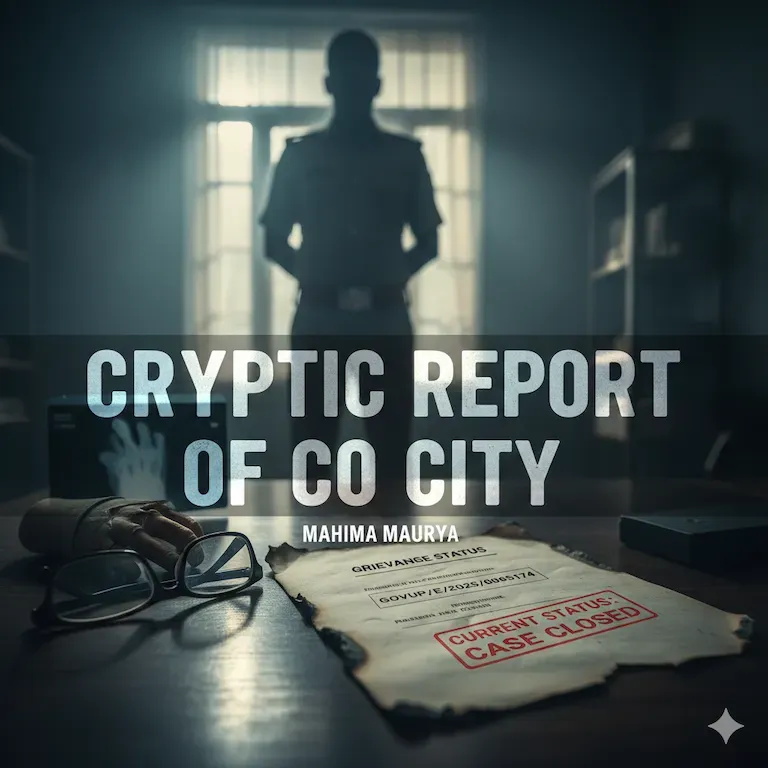
The case of Mahima Maurya highlights a critical breakdown in police accountability and the handling of criminal evidence. One crucial element in the situation was the cryptic report of CO. This report significantly influenced how events unfolded. Here are the key takeaways from the situation:
1. The “Lost” Evidence Mystery & Cryptic report of CO
The central conflict involves the disappearance of original medical records (X-rays and prescriptions) from the Tej Bahadur Sapru Hospital. Two police officers, SI Jaishankar Roy and SI Raghavendra Ray, provide conflicting accounts. They disagree about who currently possesses these vital documents.
2. Evidence of Grievous Hurt
The medical records are not just paperwork; they are substantial evidence of a bone fracture (the thumb) and a head injury requiring three stitches. Legally, proving a fracture is crucial. It upgrades a case from simple “hurt” to “grievous hurt.” Grievous hurt carries much stiffer legal penalties.
3. Procedural Irregularities
There are significant concerns regarding the transparency of the investigation:
- Initial Documentation: The police communicated the case and section numbers as “Nil.” They later manually corrected this. This raises a red flag for administrative inconsistency.
- Intimidation Allegations: The victim reports receiving “irritating calls” from police personnel. They are pressuring her not to pursue the matter with higher authorities.
4. Administrative Failure results in Cryptic report of CO (The “Right to Reason”)
The victim submitted scanned copies and audio evidence that show the officers’ conflicting claims. Despite this evidence, the authorities marked the grievance as “Case Closed.” They overlooked the missing documents. This violates the legal principle that requires administrative actions to have clear, logical reasoning.
5. The Scanned vs. Original Dilemma
The police create a challenge by refusing to return the original documents. They also refuse to acknowledge them, which forces the victim to rely on scanned copies. These copies are legally admissible under certain conditions, but they require complex forensic verification (metadata and pixel analysis). This situation could not reach if someone had maintained the chain of custody.
Cryptic report of CO: The Missing Medical Records of Mahima Maurya
The pursuit of justice in India often hinges on the integrity of the “chain of custody.” This is the chronological documentation or paper trail that records the sequence of custody, control, and transfer of evidence. Sometimes, the Cryptic report of CO complicates official documentation. In the case of Mahima Maurya, a resident of Mirzapur, Uttar Pradesh, someone has not only broken this chain but also deliberately obscured it, despite the oath to protect it.
The Core Dispute: A Bone of Contention & Cryptic report of CO
The grievance centers on a violent incident dated September 14, 2024. It involves a family dispute between the applicant’s husband and his brother. While the police records initially categorised the matter under sections like 115(2) and 352 of the Bharatiya Nyaya Sanhita (BNS), there was also the complicating factor of a CO cryptic report not referenced in the medical papers. The physical reality for Mahima was far more severe: three stitches to the head and a fractured thumb.
Mahima provided original medical documents to prove the severity of her injuries. These documents include X-ray reports and prescriptions from the prestigious Tej Bahadur Sapru Hospital in Prayagraj. She gave them to the initial Investigating Officer (IO), Sub-Inspector Jaishankar Roy. Interestingly, the cryptic nature of the report of CO attached to the case complicated the assessment of Mahima’s evidence.
The Vanishing Evidence and “Passing the Buck”
The crux of the grievance is the mysterious disappearance of these original documents within the Mirzapur police department. Notably, the cryptic report of CO was also absent from the documents submitted, contributing further ambiguity.
- The Claim: Sub-Inspector Jaishankar Roy asserts that upon his transfer, he handed the original medical files to the new IO. Mr. Raghavendra Ray received the files.
- The Denial: Mr. Raghavendra Ray has repeatedly denied receiving these documents or the cryptic CO report referenced in custody documents.
- The Proof: The applicant claims to possess audio recordings that highlight this internal inconsistency. This suggests a lack of transparency. Worse, it may point to a deliberate attempt to suppress evidence of a “grievous hurt”. This would necessitate more serious criminal charges.
Technical Admissibility: Scanned vs. Original
A significant portion of the grievance asks a vital legal question: Can justice deliver without the originals? Under Indian evidence law, authorities accept scanned copies but scrutinize them intensely. Moreover, doubts surface when the Circle Officer provides a cryptic report without clarification.
The applicant has proactively provided scanned copies of the medical records. However, the police remain silent on why the originals are not being returned. The grievance highlights forensic techniques—such as Metadata Analysis and Compression Artifact analysis—that could verify the scans. The refusal to produce the originals raises a “cloud of doubt” over the investigation’s honesty. It also raises questions about what the cryptic report of CO might contain regarding the chain of custody.
Institutional Silence and “Case Closed” Status
The authorities marked the grievance status as “Case Closed” on July 9, 2025, despite the detailed reminders. They treated the allegations as grave but merely acknowledged the family dispute in their official remarks. They mentioned the existing NCR (Non-Cognisable Report) but completely ignored the central plea: Where are the medical records? Additionally, the administration failed to clarify the implications found in the cryptic CO report recorded during the process.
The Circle Officer’s report fails to mention if the current Investigating Officer received the medical evidence. It also fails to mention whether the medical evidence considered. This “right to reason” is an indispensable part of a sound administrative system that the report denies to the victim. The CO obscures it with a cryptic report at a crucial stage.
Key Questions for the Superintendent of Police
To restore public faith and ensure a fair trial, the Mirzapur police must address:
- Accountability: If SI Jaishankar Roy claims to have handed over the files, he should provide evidence. Where is the written acknowledgment? Where is the “charge handover” memo referencing any Cryptic report of CO?
- Transparency: Why were the sections initially marked as “Nil” in communications to the Community Health Centre (CHC) Vindhyachal? It is important to clarify if this was due to a cryptic report written by CO.
- Integrity: Why is the department ignoring the X-ray evidence of a bone fracture? This evidence elevates the nature of the crime. Why does it appear referenced alongside a cryptic report from the Circle Officer?
Conclusion
Mahima Maurya’s case is a stark reminder. Bureaucratic apathy can stifle the legal process. The mishandling of physical evidence can also have this effect. When the police lose the evidence of a victim’s injury, they lose the trust of the community. Justice requires more than a “closed” status on a portal. It necessitates the physical return of documents. Additionally, an honest investigation into the injuries sustained is essential. Ultimately, authority must clarify the issues created by ambiguous and cryptic reports. This includes the report provided by the CO. Clarification may require renewed scrutiny.
Key Takeaways
- Mahima Maurya’s case highlights serious police accountability issues, particularly regarding the disappearance of original medical records.
- Conflicting accounts from officers complicate the investigation and impact the legal assessment of ‘grievous hurt.
- The grievance reveals significant procedural irregularities and intimidation in the handling of evidence.
- The cryptic report of CO raises concerns about the transparency of the investigation. It also raises concerns about the integrity of the investigation. This complicates the return of original documents.
- Police must clarify their actions and ensure accountability to restore public trust in the justice system.
Based on your grievance details and official government directories, here are the contact details for the relevant authorities and the digital portals for tracking and follow-up.
1. Primary Concern: Chief Minister Secretariat (Lucknow)
Your grievance is currently assigned to Shri Arvind Mohan. He is your primary point of contact for escalating the “case closed” dissatisfaction.
| Detail | Information |
| Officer Name | Shri Arvind Mohan (Joint Secretary) |
| Email Address | arvind.12574@gov.in |
| Contact Number | 0522-2226350 / 0522-2226354 |
| Office Address | Room No. 321, Lok Bhawan, U.P. Secretariat, Lucknow – 226001 |
| CM Office General Email | cmup@nic.in |
2. Local Authority: Mirzapur Police & Cryptic report of CO
For the physical recovery of your original medical documents, you may contact the senior leadership of the Mirzapur District Police.
| Authority | Mobile / CUG | Email ID |
| SP Mirzapur | 9454400299 | spmzr-up@nic.in |
| DIG Vindhyachal Range | 9454400215 | digrmir@nic.in |
| CO City Mirzapur | 9454401590 | co-city.mi@up.gov.in |
3. Medical Records Verification: Tej Bahadur Sapru Hospital & Cryptic report of CO excludes it throughout
If the original records remain missing, you may need a certified “Duplicate” or “Attested Copy” from the hospital administration.
- Hospital Phone: 0532-2642687 / 07518503885
- Nodal Officer: Dr. Raj Kumar
- Address: Stanley Road, Beli Goan, Prayagraj, Uttar Pradesh – 211002
4. Web Links and Portals
You can use these links to file fresh appeals or check the latest status of your specific registration numbers.
- Jansunwai (IGRS) Portal:jansunwai.up.nic.in
- Use the “Track Grievance” option with your ID: GOVUP/E/2025/0065174
- CM Helpline: Dial 1076 (Toll-free within Uttar Pradesh)
- Mobile App: Jansunwai-UP (Available on Google Play Store)
Next Steps for You
- File an Appeal: On the Jansunwai portal, select the “Feedback” or “Send Reminder” option for your closed grievance. State clearly that the “medical documents were not recovered” and the “closure report is incomplete.”
- Email Shri Arvind Mohan: Send a formal email to
arvind.12574@gov.inwith your scanned X-ray attachments. Include the audio recording if possible. These serves as proof of the conflicting statements by the sub-inspectors.
Would you like me to draft the specific text for a formal email? Or should it be a fresh appeal letter to the Superintendent of Police regarding the missing original documents?


Facing a similar challenge? Share the details in the box below, and our team of experts will do their best to help.