
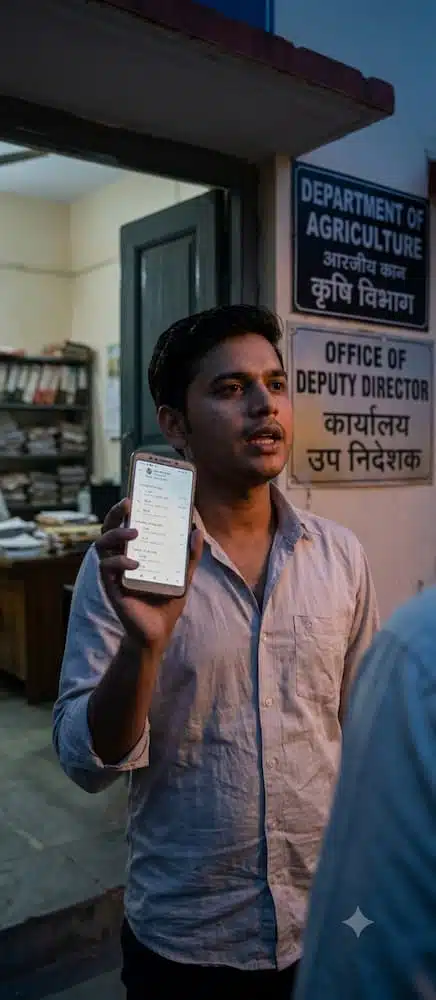
Confronting Administrative Arrogance & Demanding Accountability concerns with the working of Deputy Director of Agriculture Mirzapur. The actions and decisions made by this office have raised significant questions regarding transparency and responsibility. There is an ongoing debate about whether the individuals positioned as human rights defenders and RTI activists are actually functioning as mere Dalals or brokers of the public offices in Mirzapur. This suspicion undermines the very foundation of public trust and calls into question the legitimacy of their efforts. Moreover, it highlights the need for a thorough examination of the dynamics at play within this administrative framework. Stakeholders and citizens alike are increasingly calling for reforms that ensure accountability and genuine representation in public service, pushing for a system that prioritizes the community’s needs over self-serving interests.
Key Takeaways
- The article addresses the issues surrounding Deputy Director of Agriculture Mirzapur, highlighting concerns over transparency and accountability.
- It discusses the Right to Information Act as a critical tool for citizens to demand transparency and confront bureaucratic resistance.
- An incident illustrates the abuse of administrative power, where a public official used derogatory language instead of addressing inquiries properly.
- The piece emphasises the need for systemic reforms to ensure transparency, such as detailed personnel directories and adherence to transfer policies.
- Ultimately, it argues for the necessity of public accountability in administration, stating that citizens must not tolerate hostility from officials.
The Price of Transparency: Confronting Administrative Arrogance & Demanding Accountability in Public Service
The Right to Information (RTI) Act, 2005 stands as one of the most powerful tools for the Indian citizen. It transforms ordinary individuals into active guardians of democracy. Through this law, citizens question authority, expose inefficiencies, and demand transparency.
However, the path of a Human Rights Defender is rarely smooth. Active citizens frequently encounter deep-seated institutional resistance and bureaucratic inertia. In severe cases, they face outright hostility from public officials.
A recent incident in the District of Mirzapur, Uttar Pradesh, highlights this systemic friction. An administrative officer resorted to unparliamentary language and personal insults instead of providing factual public information. This behaviour signals a deeper malaise within the governance framework.
This post dissects the core issues surrounding the recent confrontation with the local agricultural administration. We explore the legal boundaries of official conduct. Finally, we outline the structural reforms required when citizens focus on Confronting Administrative Arrogance & Demanding Accountability.
The Flashpoint: An Abuse of Administrative Power
The conflict began with a statutory inquiry regarding the alleged withholding of benefits under the PM-Kisan scheme. A citizen filed an RTI application to investigate why a local farmer denied his lawful financial entitlements. The office of the Deputy Director of Agriculture chose a path of direct confrontation rather than processing the request through standard legal channels.
Evidence from official communication records reveals a pattern of persistent, unsolicited calls from the department’s executive phone lines. The climax occurred during a brief telephonic conversation. A senior official grew infuriated because the citizen declared his intent to pursue a Second Appeal before the State Information Commission.
The official hurled an aggressive, defamatory accusation: “Aap ki dalali to har vibhag me jari chalu hai”. This statement represents a profound breakdown of professional decorum. Public servants operate under strict statutory frameworks. They do not possess the authority to intimidate applicants. They cannot launch verbal assaults to suppress legal inquiries. An official abuses administrative power when they threaten to cancel a valid, statutory application simply because the applicant refuses to back down.
Legal Boundaries: Confronting Administrative Arrogance & Demanding Accountability
A public official commits premeditated character assassination when they use derogatory language against a citizen who has never even visited their physical office. In an organised democratic sector, government departments must handle official business through written records, notices, and lawful orders. They must not use late-evening phone calls filled with insults.
The Central and State Civil Services (Conduct) Rules explicitly mandate that every government employee must maintain absolute integrity. Officials must show devotion to duty and avoid any behaviour that is unbecoming of a public servant. Aggressive outbursts and baseless allegations of corruption directed at an applicant violate these rules completely.
Citizens do not have to endure such harassment silently. The law provides clear mechanisms to challenge this high-handedness. Citizens can file formal complaints through the state’s integrated grievance redressal systems (IGRS Jansunwai). They can also send detailed accounts directly to the District Magistrate. These actions force the state to initiate formal departmental inquiries.
Confronting Administrative Arrogance & Demanding Accountability means public officials must understand a vital truth. Their positions shield them from accountability only as long as they operate within the boundaries of the law.
Systemic Opaque Operations: Demanding Staff Transparency
The verbal hostility from the Mirzapur Agricultural Department is merely a symptom of a larger, systemic problem: a complete lack of structural transparency. When departments operate in the shadows, individual officials feel empowered to act like unaccountable rulers. The aggressive enforcement of Section 4(1)(b) of the RTI Act provides the most effective antidote to this arrogance. The law requires public authorities to publish their internal structures proactively.
To break this shield of anonymity, the applicant successfully filed a comprehensive statutory demand under Registration Number DRAGR/R/2026/60384. This application targets the very foundation of the department’s opaque operations by demanding: (Confronting Administrative Arrogance & Demanding Accountability)
- A Complete Personnel Directory: A full, itemised list of all employees categorized under Class 1, Class 2, Class 3, and Class 4 cadres.
- Employment Status Clarification: Clear identification of whether each staff member holds a permanent post, a temporary assignment, or an outsourced contract.
- Phone Line Accountability: The exact names and designations of the operators authorized to utilize the executive contact numbers, including 063931 220551.
By forcing these details into the public record, the department can no longer hide the identities of subordinate clerks. They cannot mask external operators who manipulate data entry systems or handle citizen queries poorly.
Enforcing the State Transfer Policy and Desk Rotation (Confronting Administrative Arrogance & Demanding Accountability)
The prolonged stagnation of specific employees on the same operational desks drives corruption and arrogance within local district offices. When a clerk or officer occupies a single seat for many years, they develop vested local interests. They build unauthorized networks and begin treating public service as a personal fiefdom.
The Government of Uttar Pradesh maintains a strict Annual Transfer Policy designed precisely to dismantle these networks. Furthermore, anti-corruption frameworks mandate periodic desk rotation for stationary staff who cannot move out of the district immediately. The head of the department must rotate the seat of any employee who has occupied the same desk for more than three consecutive years.
The active RTI application filed against the Agriculture Directorate explicitly demands the department’s internal Desk Rotation Register. It also demands the exact district joining dates for all personnel. When public authorities must reveal who has bypassed regular seat rotation, the disclosure becomes a powerful exercise in Confronting Administrative Arrogance & Demanding Accountability.
Conclusion: The Path Forward for Public Accountability
Public offices belong to the people. The taxpayers fund the salaries of every director, deputy, and clerk. An attitude of hostility toward public scrutiny has no place in a modern administrative system. (Confronting Administrative Arrogance & Demanding Accountability)
The successful registration of the RTI request marks the beginning of a crucial accountability process. The Deputy Director of Agriculture, Mirzapur, now faces a strict 30-day statutory countdown to provide factual answers. They must produce the administrative evidence that justified their defamatory remarks or face the legal consequences of their actions. True transparency arrives when citizens successfully use the law for Confronting Administrative Arrogance & Demanding Accountability.
Contact Details of the Concerned Public Authorities (Confronting Administrative Arrogance & Demanding Accountability)
| Public Authority / Designation | Executive Contact Numbers | Email ID | Portal / Web Reference |
| Agriculture Directorate, UP (Nodal Officer) | 8081560096 | dirag@up.nic.in | Departmental Portal |
| Deputy Director Agriculture, Mirzapur (Public Information Officer) | 7839882478 | ddamzp2012@gmail.com | Online RTI Service |
| Department Contact Lines (Subject to RTI Inquiry) | 063931 220551, 095803 06835 | ravikant1994pra@gmail.com | Outgoing Call Records |
Registered Application Details (Confronting Administrative Arrogance & Demanding Accountability)
- RTI Registration Number: DRAGR/R/2026/60384
- Online Reference Number: CPAGYIFXS3
- Applicant Mobile Number: +91-7379105911
- Applicant Email: yogimpsingh@gmail.com
The official web links for the concerned public authorities involved in your RTI submission are listed below: (Confronting Administrative Arrogance & Demanding Accountability)
- RTI Online Portal (Uttar Pradesh): You can track your application status (Registration Number: DRAGR/R/2026/60384) directly through the state transparency portal at rtionline.up.gov.in.
- Agriculture Directorate, Uttar Pradesh: The official departmental portal for the parent ministry is accessible at upagriculture.com.
- Integrated Grievance Redressal System (IGRS Jansunwai): To lodge a formal complaint against the officer regarding the verbal harassment and character assassination, use the official state grievance portal at jansunwai.up.nic.in.


Facing a similar challenge? Share the details in the box below, and our team of experts will do their best to help.