
₹50,000 Cheque Bounces in Mirzapur: A Citizen’s Fight for Justice
A bounced cheque feels like more than just a financial setback; it breaches trust and can significantly disrupt personal and professional relationships.
For Santosh Kumar Maurya of Mirzapur, a dishonoured cheque of ₹50,000 didn’t just inconvenience him—it spurred him into action and prompted him to reevaluate his financial dealings.
This unexpected situation not only brought about a sense of betrayal but also highlighted the vulnerabilities inherent in the banking and financial systems.
Determined to seek justice, Santosh took the necessary steps to understand his rights and the legal remedies available to him.
This post breaks down his case, exploring the complexities of how the financial system operates, highlighting the powerful law on his side, and showing how he uses the official grievance system to advocate for himself and navigate the path toward restitution, emphasizing the importance of standing up against financial wrongdoing.
The Core of the Complaint of Cheque Bounce: A Promise Unpaid
On December 13, 2024, the Uttar Pradesh government received a formal grievance filed by concerned individuals, which landed on the desk of the Superintendent of Police, Mirzapur.
The details paint a clear picture of a financial transaction gone wrong, revealing a troubling series of events that encapsulated allegations of fraud and mismanagement.
According to the grievance, numerous stakeholders had invested significant amounts of money into a construction project purportedly designed to enhance local infrastructure, only to discover that the funds had been misappropriated.
This scenario has not only incited distrust among the public but has also raised urgent questions regarding the oversight and accountability measures currently in place within the local government.
As the investigation unfolds, the community hopes for a swift resolution that will bring transparency and restore faith in the integrity of public projects.
- Complainant: Santosh Kumar Maurya
- Subject: The bank dishonoured a cheque for a significant amount of ₹50,000.
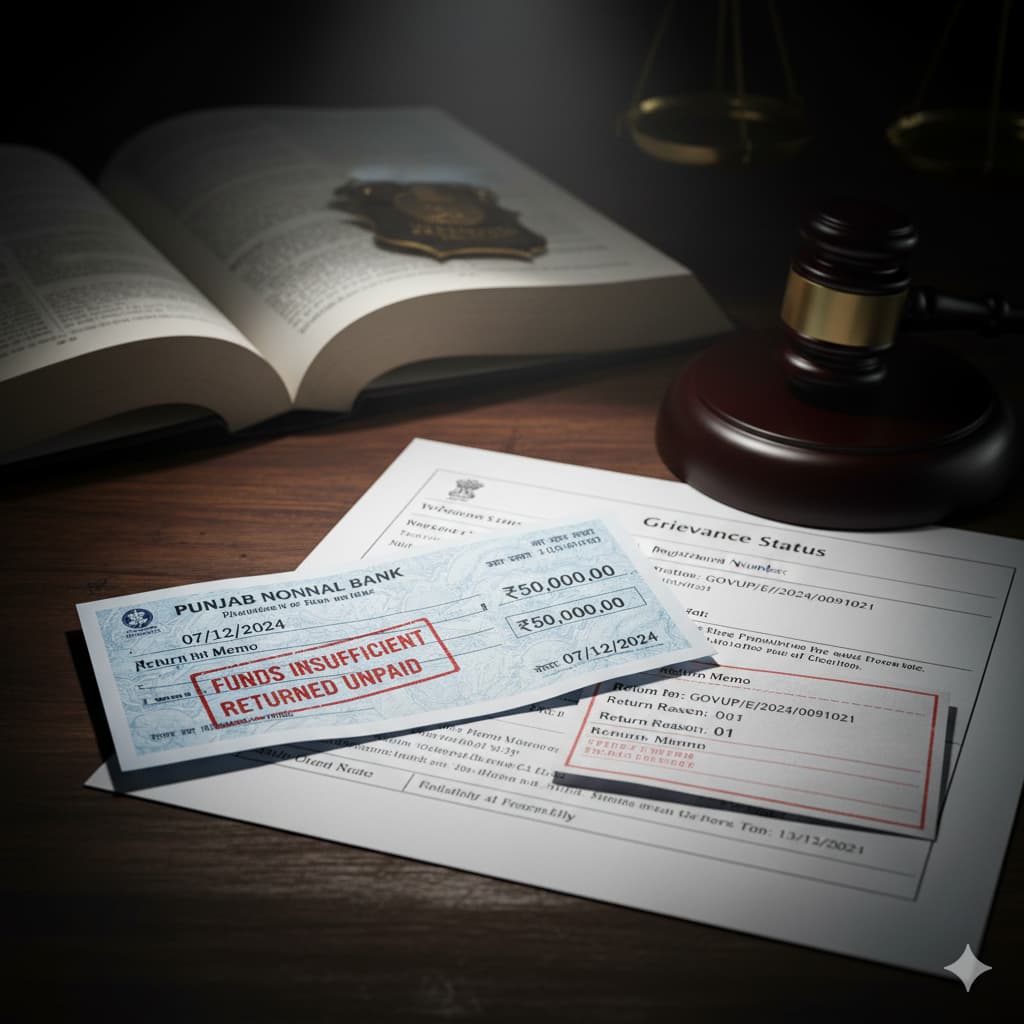
The evidence submitted was a “Return Memo” from the Punjab National Bank, Badli Katra Branch, which officially confirmed the cheque’s status.
Key Details of the Bounced Cheque:
- Cheque Number: 522172
- Cheque Amount: ₹50,000
- Cheque Date: 07/12/2024
- Return Date: 09/12/2024
- Reason for Return: “Funds insufficient”
The grievance explicitly names the individual who issued the cheque, Santosh Kumar S/O Lalta from Chilh, Mirzapur, and even includes identifying details to ensure swift action.
The Legal Hammer: Section 138 of the Negotiable Instruments Act, 1881
Mr. Maurya doesn’t just appeal for help; rather, he effectively grounds his complaint in a strong legal provision that underscores the seriousness of his situation. Specifically, he correctly cites Section 138 of the Negotiable Instruments Act, 1881, which consequently transforms a simple cheque bounce into a punishable offense, thus highlighting the legal ramifications that follow non-payment.
This provision serves as a critical safeguard for individuals who trust the integrity of financial transactions, ensuring that cheque dishonor is not taken lightly.
By invoking this legal framework, Mr. Maurya emphasizes not only his personal grievance but also the wider implications for trust and reliability in financial dealings, making his case more compelling and underscoring the necessity of strict compliance with financial obligations in commercial and personal engagements.
What does Section 138 say?
In simple terms, if a person issues a cheque to clear a debt or liability and it bounces due to “insufficient funds,” they have committed a criminal offense that can lead to significant legal consequences.
This situation not only affects the individual’s reputation but can also result in a loss of trust from creditors and business partners.
The law is not ambiguous and prescribes serious penalties: it may involve hefty fines, potential civil claims, or even imprisonment, depending on the severity of the offense and the number of incidents.
Such repercussions serve to deter individuals from engaging in this kind of financial irresponsibility, thereby maintaining the integrity of the banking and business systems that rely on the validity of cheques as a form of transaction.
It is, therefore, essential for anyone dealing with cheques to ensure that sufficient funds are available in their accounts to honor them, as the ramifications of failing to do so can be both far-reaching and detrimental.
- Imprisonment: Consequently, for a term that can extend up to two years.
- Fine: A monetary penalty that can be up to twice the amount of the cheque. In this case, that could be as high as ₹1,00,000.
- Both: The court has the discretion to impose both imprisonment and a fine.
By invoking this section, the complainant has clearly stated that this is not a civil dispute but a matter for criminal proceedings, urging the police to take decisive action against the “anarchy and lawlessness” of such an act. This cheque bounce resulted in criminal breach of trust.
Following the Official Trail: Where Does the Grievance Stand Now?
Transparency is key in any public grievance system, as it fosters trust and encourages individuals to come forward with their concerns.
The portal provides a clear trail of the complaint’s journey, ensuring accountability at every step of the process.
By allowing users to track the status of their grievances, it not only empowers complainants but also incentivizes the responsible parties to take prompt and appropriate action.
Moreover, the system is designed to be user-friendly, facilitating easy navigation and access to relevant information.
This commitment to transparency ultimately enhances the integrity of the grievance process and strengthens the relationship between the public and the institutions serving them.
- Registration Number:
GOVUP/E/2024/0091021 - Date of Receipt: 13/12/2024
- Current Status: Grievance received
Most importantly, they have officially forwarded the grievance for action rather than leaving it in a general queue.
- Forwarded To: Shri Arvind Mohan (Joint Secretary)
- Organisation: Uttar Pradesh, Chief Minister Secretariat, Lucknow
A high-ranking official in this matter of cheque bounce is now aware of the complaint; therefore, he is responsible for ensuring that the relevant authorities in Mirzapur address it promptly.
What Happens Next?
The authorities now officially acknowledge and forward the grievance; consequently, this prompts the Superintendent of Police in Mirzapur to thoroughly investigate the matter in a timely manner. This investigation is of utmost importance as it not only addresses the immediate concerns raised by the complainant but also reflects the commitment of law enforcement to uphold justice within the community. Furthermore, he will likely summon the accused for questioning, ensuring that their side of the story is heard, verify the facts presented by Mr. Maurya, and scrutinize any evidence that supports the claims made. Additionally, he will assess the context surrounding the incident, gathering testimonies from potential witnesses, and ultimately initiate legal proceedings as per the law, thereby reinforcing the principle that everyone, regardless of their status, is subject to the law and must face the appropriate repercussions for their actions.
This case serves as a powerful example for anyone who has been a victim of a bounced cheque. Furthermore, it shows that there are clear legal paths and official systems in place to fight back. By using the law and the public grievance portal, Santosh Kumar Maurya has taken the crucial first step from being a victim to, consequently, becoming an agent of his own justice.


Facing a similar challenge? Share the details in the box below, and our team of experts will do their best to help.