
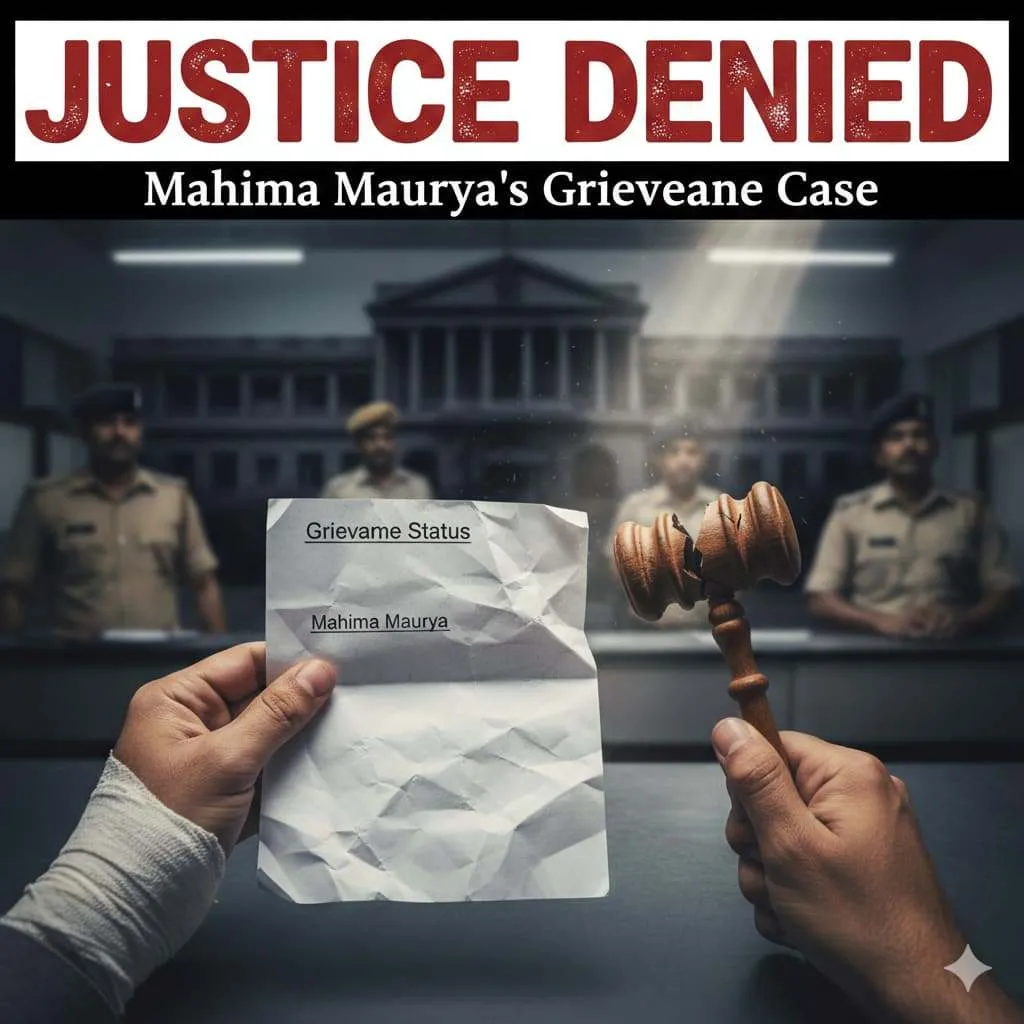
🚨 A Fight for Justice: Analyzing a Grievance and RTI Challenge in Mirzapur Police Case
The provided documents detail a complex and contentious dispute between a citizen, Mahima Maurya, and the police department in Mirzapur, Uttar Pradesh, stemming from an alleged assault on September 14, 2024. The core conflict revolves around the police’s failure to register a First Information Report (FIR) for serious injuries, the nature of the subsequent Non-Cognizable Reports (NCRs), and the authenticity of the medical evidence.
📅 Chronology of Events & Grievances
1. The Incident (September 14, 2024)
- The Allegation: Mahima Maurya was allegedly assaulted by her husband’s brother, Manoj Kumar Kushwaha, stemming from an old family dispute.
- Victim’s Claimed Injuries:
- Merciless beating.
- Fatal injury to the head requiring three stitches.
- Fracture of the thumb bone, requiring a plaster (allegedly confirmed by a government hospital in Allahabad).
- Police Action: The Vindhyachal Police registered two Non-Cognizable Reports (NCR No. 105/24 & 104/24) under BNS/BNSS provisions, but did not register an FIR. The police also initiated preventive action against both parties.
2. Grievance & Police Report (GOVUP/E/2024/0075478)
- Date of Receipt: October 22, 2024.
- Police Version (Circle Officer City, Mr. Vivek Chawla):
- The incident was a reciprocal fight between family members (Mahima’s husband, Pramod, and his brother, Manoj).
- The case was registered as an NCR.
- The complainant was advised to seek relief by filing a case in the Honourable Court.
- Complainant’s Rebuttal:
- The report cryptically overlooked the seriousness of the situation.
- Mahima Maurya’s name was not in the NCR, despite her being the main victim.
- The report fails to mention her serious injuries or the medical examination report.
3. Case Closure & Final Remarks (GOVUP/E/2024/0078462)
- Date of Action: November 23, 2024.
- Final Police Remarks:
- Reiterates that the matter was a mutual fight, registered as an NCR, and preventive action was taken.
- Crucial New Claim: The police allege that Mahima Maurya “is accustomed to giving the application again and again” and is showing a fracture in the finger due to injury elsewhere, claiming the medical report from 14.09.2024 had no fracture.
- The police state the applicant is making “baseless allegations” to pressurize the police.
- Complainant’s Response (Rating: 1/Poor):
- The police are submitting false reports to conceal their wrongdoings.
- Questions why an X-ray was not carried out by the police doctor despite the serious injury (fracture).
- Reiterates that the fractured bone and injuries are not mentioned in any police report.
🏛️ The Right to Information (RTI) Challenge
Following the closure of the grievance, Mahima Maurya filed an RTI application on November 23, 2024, to the Superintendent of Police Office, Mirzapur, to demand specific answers from the Public Information Officer (PIO) and establish the rule of law.
That’s a strong set of questions for an RTI. Organizing these points into a clear narrative paragraph, using transition words, helps emphasize the critical gaps in the police’s handling of the case.
📝 RTI Questions to the Superintendent of Police, Mirzapur (Narrative Format)
The RTI application seeks clarification on several procedural and evidentiary issues surrounding the assault investigation. Initially, the applicant demands the Reason for Exclusion, asking why Mahima Maurya’s name was not included in the Non-Cognizable Report (NCR) and the police diary, despite her status as the prime victim.
Furthermore, the applicant questions the police’s advisory role, requiring the provision of BNS/BNSS that constitutes the Counseling Authority for a police officer to direct a victim to file a case directly in the Honourable Court.
Regarding the medical evidence, the applicant seeks specific accountability for the incomplete initial procedure, demanding the X-Ray Failure reason, or why the test was not carried out immediately following the assault on 14.09.2024.1 In conjunction with this, the applicant seeks justification for the Verification Failure, asking why a subsequent medical test was not performed to verify the initial report, especially given that later diagnoses support the fracture claim.
Finally, the RTI challenges the police’s characterization of the applicant herself. In response to the police’s claim that she is “accustomed to giving the application again and again,” she requests proof of a Habitual Complaint, asking for a single complaint where the police submitted a report consistent with her submissions. And ultimately, she demands clarity on the police’s counter-allegations, requiring evidence for Defining “False Allegations”—the specific false allegations she has made against police personnel, supported by documented proof.
Would you like to draft a formal concluding statement for the RTI application based on this information, or perhaps search for the specific sections of the BNS/BNSS mentioned?
🔑 Summary of the Conflict
The entire issue boils down to a fundamental conflict of facts and procedure:
- Injury Verification: The applicant claims a head injury (stitches) and a fractured thumb. The police report acknowledges her medical examination but claims “no fracture” and suggests the fracture was from an “injury elsewhere.” The RTI challenges why the police doctor did not conduct an X-ray in the first place to definitively rule out a fracture.
- Procedural Legality: The police registered an NCR instead of an FIR, which is mandatory for serious/cognizable offenses. The victim’s exclusion from the NCR’s list of victims is a key point of contention.
- Role of the Police: The police’s advice to “go to court” for relief (instead of investigating a serious crime) and their remark that the victim is “accustomed to giving the application again and again” suggests a lack of seriousness and potential bias, which the RTI seeks to expose via legal provisions.
The RTI application marks a legal escalation, compelling the police to formally account for their actions, which is a necessary step in seeking transparency and accountability.
This application serves as a crucial tool for citizens, empowering them to request information about police activities and ensuring that law enforcement agencies operate within the framework of the law.
By initiating this formal process, individuals not only advocate for their right to information but also contribute to a broader movement that demands greater oversight and ethical conduct from those tasked with maintaining public safety.
Ultimately, the RTI application fosters an environment where accountability is prioritized, encouraging a culture of responsibility within the police force and reinforcing the trust between the community and law enforcement.
Would you like me to use the contact details provided to search for any updates or further information regarding the case’s status?


Facing a similar challenge? Share the details in the box below, and our team of experts will do their best to help.