
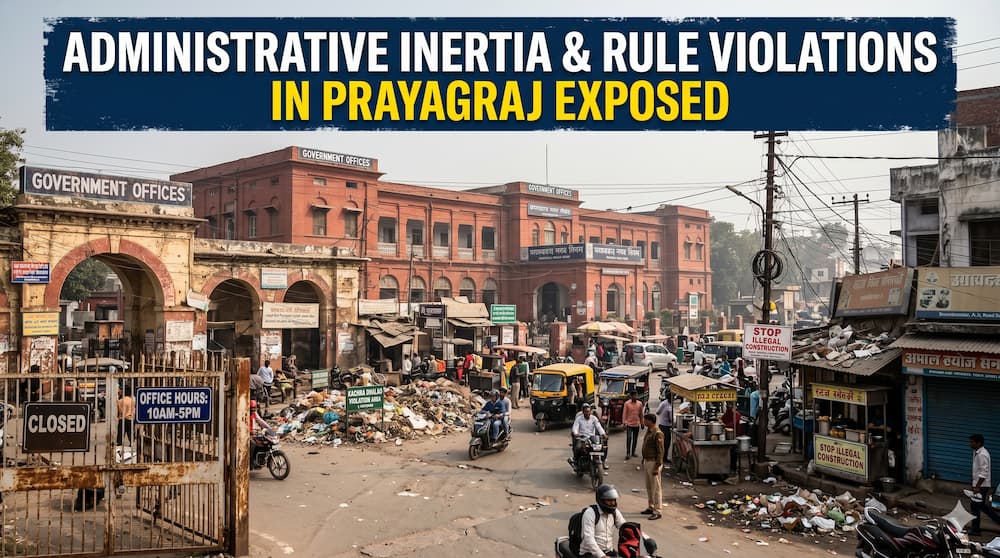
Administrative inertia in Prayagraj poses significant challenges to effective governance and public service delivery. This phenomenon refers to the reluctance of bureaucratic institutions to adapt or respond to evolving needs, often resulting in delayed decisions and stagnant processes. Moreover, the issue of Administrative Inertia & Rule Violations in Prayagraj is particularly pressing, as individuals and entities exploit regulatory loopholes, undermining the rule of law. The combination of these factors creates an environment where accountability is diminished, leading to public disillusionment. To combat these issues, it is crucial for local authorities to implement reforms focused on increasing efficiency, transparency, and adherence to regulations, ultimately fostering a more responsive administrative landscape.
By addressing these concerns, Prayagraj can pave the way for improved governance and enhanced civic trust.
Key Takeaways
- Administrative inertia in Prayagraj hampers governance and service delivery, leading to delays and diminished accountability.
- Rule violations arise as individuals exploit regulatory loopholes, deepening public disillusionment.
- Direct hiring information in public recruitment remains blocked, shielding departments from scrutiny.
- Key positions in Nagar Nigam fail to rotate as required, showcasing institutional capture and rule violations.
- Crucial records and compliance trails are intentionally concealed, sustaining administrative inertia and exacerbating rule violations in Prayagraj.
Administrative Inertia & Rule Violations: The Case of Nagar Nigam Prayagraj
A close look at official records, Right to Information (RTI) requests, and submissions before the Uttar Pradesh Information Commission shows serious administrative errors within Nagar Nigam Prayagraj. In many instances, one can clearly see the impact of administrative inertia combined with rule violations specifically affecting units in Prayagraj. Far from being just simple clerical mistakes, these problems highlight a regular disregard for transparency and established rules. Therefore, an examination of the state commission’s active files under Diary Numbers D-070620260008 and D-070620260009 is essential to uncover the main issues that currently affect this local public authority.
PDF+ 4
1. Cadre Manipulation and Identity Shuffling in Public Recruitment
The main crisis centers around the deliberate blocking of direct hiring information. Specifically, when people ask about public jobs, the Public Information Officer (PIO) often avoids answering the main question. As a result, this method protects the department from public scrutiny and allows administrative inertia and rule violations to go unchecked in Prayagraj recruitment cases.
PDF+ 2
Shifting Queries from Base Posts to Promotional Ranks
In transparency disputes, citizens often ask for certified copies of original job advertisements, direct hiring criteria, and appointment logs for direct “Sanitation Staff” (Safai Karmachari) positions. This process can create administrative inertia, amplify Prayagraj’s own rule violations, and weaken trust in standards being followed. However, the department actively changes the terms of the request. Instead of providing the basic direct hiring records, the PIO replaces the documents with promotional orders for the rank of “Safai Nayak” (Supervisor).
PDF+ 3
Exploiting Identity Variations
Furthermore, this action takes advantage of naming differences within internal payroll setups. For instance, the department might replace the service file of a person registered as Umesh Kumar Singh to meet a request aimed at Mukesh Kumar Yadav. By filling the state commission’s file with promotion letters and middle school certificates of a completely different group, the department creates a misleading appearance of compliance while entirely hiding the direct hiring history of the base position—this is yet another case that illustrates administrative inertia coupled with persistent rule violations throughout Prayagraj’s municipal systems.
PDF+ 4
2. Institutional Capture and Blatant Breach of State Transfer Policies
The second main issue within Nagar Nigam Prayagraj involves widespread institutional slowing down. As a result, this practice builds informal networks and leads to a clear refusal to carry out state-required employee rotations. There is a pattern of administrative inertia and rule violations in Prayagraj directly arising from such behaviour.
PDF+ 3
+-------------------------------------------------------------------------+| STATE MANDATED ROTATION PRINCIPLE || Standard policy requires senior cadres to rotate every 3 years to || prevent vested interests and maintain transparency. |+-------------------------------------------------------------------------+ | v+-------------------------------------------------------------------------+| ACTUAL RETENTION IN PRAYAGRAJ DISTRICT || * City Engineer (Civil) --> Stationed since 2016 (~9 Years) || * Chief City Auditor --> Stationed since 2021 (~4 Years) || * Assistant Engineer --> Stationed since 2021 (~4 Years) || * Class III/IV Personnel --> Stationed continuously for 15-30 Years|+-------------------------------------------------------------------------+
Chronic Non-Rotation of Sensitive Seats
According to the department’s own 30+ page official employee directory, several high-level and sensitive positions have skipped the required 3-year rotation system. This system is clearly set out under the Uttar Pradesh Annual Transfer Policy 2024-25. Such ongoing disregard for rotation rules is a strong example of administrative inertia combined with repeated rule violations, as found in Prayagraj’s Nagar Nigam. Key examples include:
PDF+ 1
- City Engineer (Civil): This official has been continuously stationed in Prayagraj since 01-02-2016, marking a 9-year uninterrupted tenure. PDF+ 1
- Chief City Auditor: This officer has stayed in the same district since 23-07-2021. PDF+ 1
- Assistant Engineer (Civil): The department has retained this employee continuously since 23-11-2021. PDF+ 1
Decadal Stagnation in Support Staff
Moreover, this administrative hold-up is even more obvious among Class III (Clerks) and Class IV personnel. Dozens of support staff, including drivers, junior clerks, and senior assistants, occupy the same desks for 15 to over 30 continuous years without regular changes, which is symptomatic of administrative inertia and repeated rule violations undermining effective functioning in Prayagraj.
PDF+ 4
3. Deliberate Suppression of the Compliance Trail
The root cause of the ongoing legal friction before the State Information Commission is not a simple lack of records. On the contrary, it stems from the intentional concealment of the administrative compliance trail. This is yet another sign of administrative inertia taking hold and rule violations occurring within the context of Prayagraj local governance.
PDF+ 1
When an RTI application explicitly demands the production of screening committee minutes, transfer eligibility registers, and written justifications for employee retention, the PIO’s standard response is to issue generic, highly diluted listings.
By actively holding back the Manav Sampada portal movement workflows, the PIO prevents improper record-keeping from independent checking. Additionally, they hide official CUG mobile numbers without any valid legal reasons under Section 8 of the RTI Act. Finally, this behaviour continues because of the lack of action from the First Appellate Authority (FAA), who often fails to issue clear orders or force the PIO to provide complete action-taken reports, thereby contributing to administrative inertia and allowing further rule violations in Prayagraj.
PDF+ 2
Key Takeaways
Withholding Evidence: Key accountability logs, including screening committee minutes, Manav Sampada records, and official contact directories, remain hidden from the public record to avoid external compliance audits. This pattern reflects persistent administrative inertia along with rule violations typical among Prayagraj authorities. PDF
Cadre Misdirection: Nagar Nigam Prayagraj dodges structural questions about direct hiring by replacing basic sanitation worker records with promotion supervisor files. Put simply, this is a textbook example of administrative inertia and serious rule violations repeated by officials in Prayagraj. PDF+ 1
Policy Evasion: The municipality’s own directory shows a failure to follow the UP Annual Transfer Policy, leaving important engineering and financial audit positions un-changed for 4 to 9 years. Therefore, the key problem remains: administrative inertia fuels rule violations, most notably across departments in Prayagraj. PDF+ 1
These findings fit a broader pattern documented across Nagar Nigam Prayagraj’s dealings with RTI applicants. For more on how deemed refusals, silent appeals, and inconsistent PIO records recur across cases, see our related coverage: Accountability in Prayagraj Nagar Nigam Issues.
Based on the official records and filings submitted before the Uttar Pradesh Information Commission, here is the structured directory containing the specific application details, contact numbers, emails, and web portals for the concerned public authorities:
1. Case File & Application Identification Numbers (Administrative Inertia & Rule Violations in Prayagraj)
#Case 1: Sanitation Staff Recruitment Dispute
- Commission File Number: S10/A/0501/2025
- RTI Registration Number: A-20250500801
- UPIC Diary Number: D-070620260008
- Original Online RTI Request ID: NGNPR/R/2024/60192
- Connected Historical Case ID: S10/A/1469/2024 (Registration No. A-20241001256)
Case 2: Annual Transfer Policy & Non-Rotation Dispute
- Commission File Number: S10/A/0496/2025
- RTI Registration Number: A-20250101887
- UPIC Diary Number: D-070620260009
- Original Online RTI Request ID: NGNPR/R/2024/60143
2. Concerned Public Authorities Contact Directory (Administrative Inertia & Rule Violations in Prayagraj)
A. Uttar Pradesh Information Commission (UPIC)
- Official Emails:
- Primary Hearing Court (S-10):
hearingcourts10.upic@up.gov.in
- Primary Hearing Court (S-10):
- Nodal Personnel in Correspondence:
- Rakesh Kumar (Court Representative)
B. Nagar Nigam Prayagraj (Municipal Corporation) (Administrative Inertia & Rule Violations in Prayagraj)
- Official Emails:
- Establishment / General Operations:
osnagarnigam@rediffmail.com - Municipal Health Officer / Sanitation Division:
nsa.nagarnigam@gmail.com
- Establishment / General Operations:
- Key Administrative Mobile Numbers:
- Shri Seelam Sai Teja (Municipal Commissioner):
7408422303 - Shri Rajiv Kumar Shukla (Additional Municipal Commissioner):
8303701004 - Shri Deependra Yadav (Additional Municipal Commissioner):
8303701030 - Shri Arvind Kumar Rai (PIO & Addl. Municipal Commissioner, Palika Services):
8303701003 - Shri Vikas Sen (Joint Municipal Commissioner):
6306074674 - Dr. Mahesh Kumar (Municipal Health Officer):
8303701067 - Shri Sanjay Kumar Katiyar (Chief Engineer, Electrical/Mechanical):
8303701007 - Shri Anil Kumar Maurya (City Engineer, Civil):
8303701012 - Shri Balendu Mishra (Chief City Auditor):
8303701056
- Shri Seelam Sai Teja (Municipal Commissioner):
C. Assigned Panel Advocates (Legal Representation) (Administrative Inertia & Rule Violations in Prayagraj)
- Shri Utkarsh Singh Chauhan, Advocate (Representing Case No. S10/A/0501/2025):
8299868486 - Shri Shailendra Singh Chauhan, Advocate (Representing Case No. S10/A/1469/2024):
9415470090
3. Web Portal & Digital Workflow Details (Administrative Inertia & Rule Violations in Prayagraj)
To check the status of your active appeals or track your digital diary entries (such as D-070620260008 and D-070620260009), you can use the Uttar Pradesh Information Commission Portal[cite: 3, 6].
#Moreover, to track the original online RTI applications (such as NGNPR/R/2024/60192 and NGNPR/R/2024/60143), you can log into the Uttar Pradesh RTI Online Gateway[cite: 2, 5].
To cross-verify the tenure logs, service books, and posting history of the municipal corporation’s centralized staff, you can access the Uttar Pradesh Manav Sampada Portal[cite: 4].
For general administrative notices or to review published updates from the local public authority, you can visit the Nagar Nigam Prayagraj Official Website[cite: 1, 4].


Facing a similar challenge? Share the details in the box below, and our team of experts will do their best to help.