
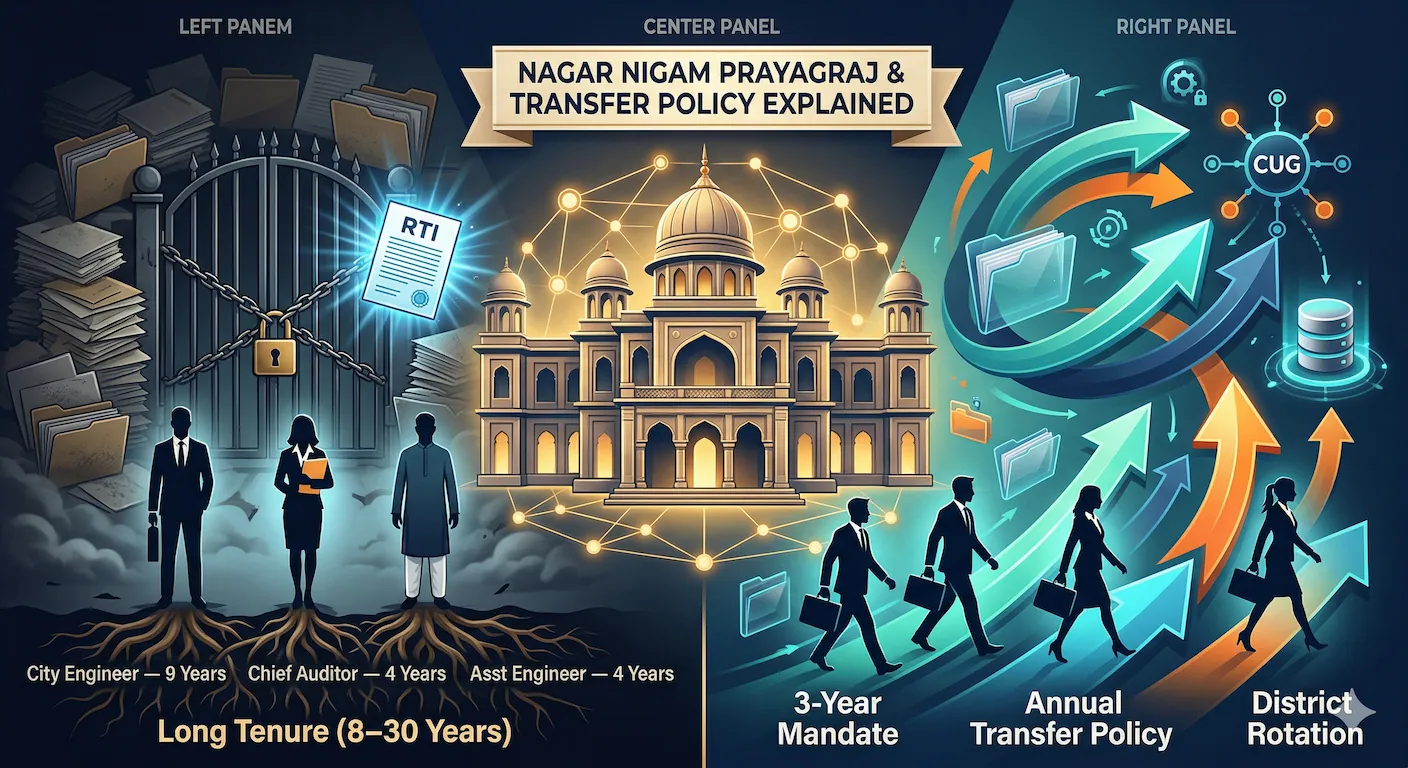
Key Takeaways (Nagar Nigam Prayagraj & Transfer Policy)
- Nagar Nigam Prayagraj faced scrutiny over its failure to adhere to the Uttar Pradesh Annual Transfer Policy, leading to concerns about long-tenure postings.
- The RTI application sought critical data, including posting histories and compliance files, to expose violations in the transfer policy.
- The PIO’s vague and evasive reply left key information unaddressed, raising suspicions of intentional withholding.
- The case illustrates the systemic issues related to long tenure in governance, such as corruption risks and erosion of public trust.
- The outcome of the case before UPIC might set important precedents for transparency and good governance in municipal authorities.
Nagar Nigam Prayagraj & Transfer Policy: An RTI Battle That Exposed Long‑Tenure Rotations
When citizens ask for transparency and institutions respond with silence or evasive replies, the Right to Information Act (RTI), 2005, becomes more than a legal tool—it becomes the last defense of accountability. This extended article examines a real case involving Nagar Nigam Prayagraj and serious irregularities in implementing the Uttar Pradesh Annual Transfer Policy. The story evolves from an RTI query to a full‑scale appeal before the Uttar Pradesh State Information Commission (UPIC), exposing deep systemic issues, unusually long employee tenures, and attempts to withhold critical information.
Why Transfer Policies Matter in Governance (Nagar Nigam Prayagraj & Transfer Policy)
Transfer policies exist for a fundamental reason: to prevent concentration of power, favoritism, and corruption. When officials remain in the same posting or district for long periods, they form local networks that can undermine impartial administration. In departments such as Engineering, Health, Audit, Revenue, Accounts, Street Lighting, Sanitation, and Licensing, routine rotation ensures that:
- No officer controls the same system indefinitely
- Accountability is maintained
- Public interest is protected
- Administrative capture is prevented
The Annual Transfer Policy 2024–25 of the Uttar Pradesh Government mandates transparent, rotation‑driven posting movements for urban local body staff. Yet evidence suggests that Nagar Nigam Prayagraj failed to adhere to these standards for years—if not decades.
The RTI Application: Seeking Proof of Compliance
The RTI applicant filed a carefully structured query targeting the most critical data points. The request demanded:
1. Posting Histories of All Class I–IV Employees
The applicant sought the full service trail, including: (Nagar Nigam Prayagraj & Transfer Policy)
- First posting
- District of origin
- Date of joining Prayagraj
- All past transfer orders
- Total tenure in the district
This information is essential to evaluate whether staff have exceeded the permissible station period.
2. CUG Mobile Numbers
These Closed User Group numbers are official contact details issued by the corporation. They enhance public accessibility and accountability, and are not exempt from disclosure unless specific harm tests apply.
3. Annual Transfer Policy 2024–25 Compliance File
The most important demand was for the policy compliance file, including: (Nagar Nigam Prayagraj & Transfer Policy)
- Long‑tenure lists
- Eligibility lists (those due for rotation)
- “Longest stay first” lists for Class III–IV
- Committee meeting minutes
- Proposals, approvals, and file notings
- Manav Sampada logs (digital posting history)
- Exception/retention orders with reasons
This is the core administrative evidence that shows whether Nagar Nigam Prayagraj followed the Transfer Policy fairly and systematically.
4. Certified Copies of All Relevant Records
The applicant sought documentation, not just statements.
5. District‑Wise Origin of Employees (Nagar Nigam Prayagraj & Transfer Policy)
This makes it possible to detect selective postings or favoritism.
The application was precise, factual, and grounded in public interest.
The PIO’s Reply: Generic, Incomplete, and Evasive (Nagar Nigam Prayagraj & Transfer Policy)
The PIO responded with a vague summary, stating that:
- The Transfer Policy exists
- Transfers of certain cadres occur at the state level
- Others are done as per “administrative necessity”
He appended general lists of employees but failed to provide the core information requested.
Critically missing items:
- No posting histories
- No first postings
- No transfer origins
- No tenure calculations
- No compliance records
- No committee minutes
- No exception files
- No Manav Sampada logs
- No CUG numbers
- No transfer policy workflow
This was not a simple oversight. The reply conspicuously avoided supplying the specific documents that would reveal systemic Transfer Policy violations.
What the Nagar Nigam Prayagraj Directory Revealed
Ironically, the wider employee directory attached by the PIO contained numerous entries with dates of posting going back many years—sometimes decades. Several senior and mid‑level officers had remained posted in Prayagraj far beyond normal limits.
Examples from the Directory
- One City Engineer had been posted continuously since 2016 (around nine years).
- A Chief City Auditor had remained in the same district for four years straight.
- An Assistant Engineer had a continuous posting of four years.
These durations, while seemingly moderate on the surface, exceed the expected three‑year rotation principle for urban technical and supervisory posts.
2. Lower Cadre Employees (Nagar Nigam Prayagraj & Transfer Policy)
Many Class III–IV employees showed postings dating back:
- 15–20 years
- Some even 25–30+ years in Prayagraj
This is completely incompatible with rotational norms.
The directory, unintentionally, became a catalogue of violations of the Transfer Policy. For the updated tenure figures as of September 2026 and the fourth Commission hearing in this appeal, see Transfer Policy of Government & Implementation Explained.
The FAA’s Role: Silence That Signals Collusion (Nagar Nigam Prayagraj & Transfer Policy)
The First Appellate Authority (FAA) is the first checkpoint within the public authority. Their role is:
- To review the PIO’s reply
- To correct deficiencies
- To order disclosure of missing information
- To issue a reasoned decision
But in this case, the FAA did none of these.
- No corrective action
- No order to provide missing records
- No assessment of the Transfer Policy compliance
- No examination of the long‑tenure anomalies
This inaction amounts to administrative collusion through silence. Under the RTI Act, such failure supports disciplinary action under Section 20(2).
Why Long Tenure Is Dangerous in Urban Governance
Long postings create systemic vulnerabilities: (Nagar Nigam Prayagraj & Transfer Policy)
1. Influence Networks
Over time, certain officers build personal relationships with contractors, vendors, local groups, and political actors. This undermines neutrality.
2. Corruption Risks
Extended control over resources, approvals, penalties, and tenders without rotation increases opportunities for misuse.
3. Administrative Capture
When officials do not rotate, departments are effectively “captured” by a few individuals.
4. Erosion of Public Trust
The very purpose of Transfer Policies is to ensure fairness. Non‑implementation creates opacity and erodes public confidence.
Nagar Nigam Prayagraj’s directory suggests the presence of exactly such risks. (Nagar Nigam Prayagraj & Transfer Policy)
Appeal Before the Uttar Pradesh State Information Commission (Nagar Nigam Prayagraj & Transfer Policy)
The applicant escalated the matter to UPIC with a strong, evidence‑based appeal, requesting:
1. Declaration of Evasion
A finding that the PIO’s reply was incomplete and misleading.
2. Penalties (Nagar Nigam Prayagraj & Transfer Policy)
- Section 20(1) penalty on the PIO
- Section 20(2) disciplinary action against the FAA
3. Directions for Full Disclosure (Nagar Nigam Prayagraj & Transfer Policy)
- Complete posting histories
- CUG numbers
- Transfer Policy compliance records
- Manav Sampada logs
- Certified documents
- In‑camera inspection of original files if required
4. Prospective Reforms
- Publication of annual tenure dashboards
- Mandatory Manav Sampada routing
- A public Transfer Policy compliance register
- Independent yearly audits
These suggestions aim to institutionalise transparency in Nagar Nigam Prayagraj.
Evidence Paradox: Attachments That Expose the Sender
The PIO’s attachments contradict the PIO’s narrative.
His reply says:
- “Transfer Policy is implemented.”
- “Transfers are done based on need.”
His annexures reveal: (Nagar Nigam Prayagraj & Transfer Policy)
- Repeated long tenures
- Lack of rotation
- Decades of continuous postings
- Absence of systemic compliance
This contradiction strengthens the case for intentional withholding.
What UPIC Can Do: Enforcement Tools (Nagar Nigam Prayagraj & Transfer Policy)
Under the RTI Act, UPIC can:
1. Impose Penalty Under Section 20(1)
If a PIO knowingly withholds information, provides misleading replies, or fails to act without reasonable cause.
2. Recommend Disciplinary Action Under Section 20(2)
When an FAA conspires through inaction.
3. Direct Comprehensive Disclosure
Including complete compliance records.
4. Order System Strengthening
Such as: (Nagar Nigam Prayagraj & Transfer Policy)
- Tenure dashboards
- HRMS‑based mandatory transfers
- Public registers
- Audit trails
These steps can transform the opaque operation of Nagar Nigam Prayagraj into a transparent, citizen‑responsive system.
Lessons for Every Citizen
This case shows:
1. Ask for the Right Records (Nagar Nigam Prayagraj & Transfer Policy)
The applicant did not ask general questions—he asked for administrative paperwork.
2. Identify Patterns in Annexures
Often, the violation is hidden inside a list supplied by the authority itself.
3. Persist Through Appeals
When the PIO and FAA fail, the Commission becomes the corrective body. (Nagar Nigam Prayagraj & Transfer Policy)
Conclusion: Toward a Transparent Nagar Nigam Prayagraj
The RTI battle against long‑tenure postings in Nagar Nigam Prayagraj is not just about records—it is about reclaiming accountability. The evidence shows:
- Many staff members stayed posted for years or decades
- Transfer Policy workflow documents were withheld
- Replies were incomplete
- Internal appeals were ineffective
The UPIC’s final order in this case could become a watershed moment for municipal transparency across Uttar Pradesh. If enforced properly, it will remind every public authority that Transfer Policies are not ceremonial—they are mandatory instruments of good governance.
Key Application / Case Identifiers
| Purpose | ID / Number |
|---|---|
| Diary Number | D‑220320260034 |
| Appeal Registration Number | A‑20250101887 |
| File Number (Case Number) | S10/A/0496/2025 |
| Hearing Room | S‑10 |
| Latest Hearing Date | 23/03/2026 |
Applicant (Citizen) Details (Nagar Nigam Prayagraj & Transfer Policy)
| Field | Information |
|---|---|
| Name | Indradev Yadav |
| Mobile Number | 9118208936 |
| yadavindramzp9118@gmail.com | |
| Address | ग्राम व पोस्ट चिल्ह |
Public Authority Details (Nagar Nigam Prayagraj)
PIO (Public Information Officer):
- Name: Arvind K. Rai
- Designation: Additional Nagar Ayukt (Additional Municipal Commissioner)
- Office:
- PIN: 211001
Email of Public Authority (as per your notices):
- osnagarnigam@rediffmail.com
CUG / Official Contact Numbers
(From the employee directory extract)
- Example senior‑officer CUG numbers:
- 8303701012
- 8303701056
- 7408422303
- 8303701030
- 6306074674
🏛️ Public Authority: Nagar Nigam Prayagraj
PIO (Public Information Officer)
- Name: Arvind K. Rai
- Designation: Additional Nagar Ayukt (Additional Municipal Commissioner)
- Office: Nagar Nigam, Prayagraj – 211001
- Email: osnagarnigam@rediffmail.com
Official Website (Outbound Link):
👉 https://prayagraj.nic.in
(These are safe outbound links — no embedded file names, no unwanted metadata)
🏢 Uttar Pradesh Information Commission (UPIC)
Hearing Court: S‑10
Email: hearingcourts10.upic@up.gov.in
UPIC Official Website (Outbound Link):
👉


Facing a similar challenge? Share the details in the box below, and our team of experts will do their best to help.