
Key Takeaways (24-Hours Supply of Electricity)
- The Citizen’s Charter aims to ensure accountable governance by setting standards for services, such as the promise of a 24-hours supply of electricity.
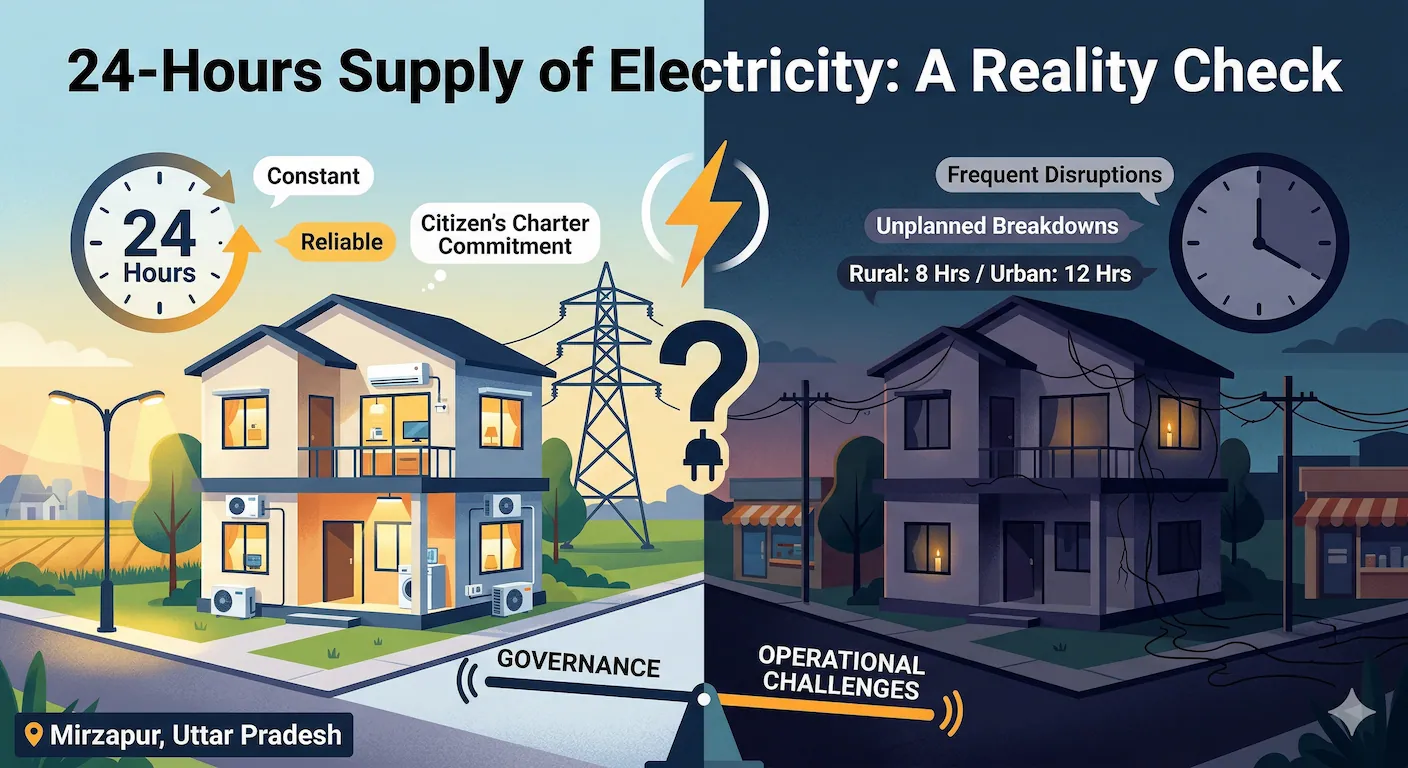
- There is a significant gap between the political promise of 24-hours electricity and the reality, with rural areas receiving only 8 hours and urban areas 12 hours.
- Key grievance redressal channels exist, including UPPCL and government helplines for escalating issues related to power supply.
- Obstacles like poor design, lack of awareness, and minimal citizen involvement hinder the effectiveness of the Citizen’s Charter.
- To improve service delivery, clear standards, citizen consultation, and linkages to grievance platforms are essential for accountability.
⚡️ The Citizen’s Charter and the Reality of Power Supply in Uttar Pradesh (24-Hours Supply of Electricity)
The concept of a Citizen’s Charter is a cornerstone of responsive and accountable governance in India. For example, guaranteeing a 24-hours supply of electricity can be an important element in these public promises. Including a commitment to a 24-hours supply of electricity highlights the significance of reliable power as part of these standards. It is essentially a public promise by a government organisation, outlining the specific services it offers, the standards of service delivery (like speed and efficiency), and the grievance redressal mechanism available to citizens.
Origin and Purpose of the Citizen’s Charter (24-Hours Supply of Electricity)
The Citizen’s Charter was first introduced in India in 1997 following the Chief Ministers’ Conference on Responsive Administration. The Department of Administrative Reforms and Public Grievances (DARPG) coordinates it. The core objective is to empower citizens by clearly defining their entitlements and holding public servants accountable. Since its introduction, various ministries and departments have issued over 700 charters.
The Promise of 24-Hour Electricity Supply
The grievances cited (GOVUP/E/2025/0082334 and GOVUP/E/2025/0079337) 24-hours electricity supply in Uttar Pradesh and the ground reality.
- The Claim: Political masters claim to provide a 24-hour supply of electricity.
- The Reality (as per complainant): There is frequent disruption and undeclared breakdown in supply, with the complainant stating that rural areas receive only 8 hours and urban areas receive 12 hours of electricity.
The discrepancy highlights a critical failure in service delivery standards, which the Citizens’ Charter aims to uphold and guarantee.
You are absolutely right to seek the direct channels for reporting and escalating grievances. Since your complaint relates to the electricity supply in Mirzapur (under the Purvanchal Vidyut Vitaran Nigam Limited – PuVVNL) and the subsequent follow-up is with the Chief Minister’s Office (CMO), here are the key web links and contact details for both levels of authority.
📞 Key Contacts for 24-Hours Supply of Electricity & Grievance Redressal
1. UPPCL (Electricity) – Primary Grievance Channels
The Uttar Pradesh Power Corporation Limited (UPPCL) and its subsidiary Distribution Company (DISCOM), Purvanchal Vidyut Vitaran Nigam Limited (PuVVNL), manage the supply.
| Channel | Contact Details | Purpose |
| UPPCL Toll-Free Helpline | 1912 | Universal 24×7 number for registering all types of electricity complaints (outage, billing, metering, etc.). |
| PuVVNL Toll-Free Number | 1800-180-5025 | Dedicated toll-free number for the Purvanchal region (which includes Mirzapur). |
| UPPCL Complaint Portal | https://consumer.uppcl.org/wss/ | For online registration, tracking, and status check of electricity complaints (1912 complaint registration). |
| Consumer Grievance Redressal Forum (CGRF) | https://cgrf.uppcl.org/ | Escalation Point: For complaints that remain unresolved by the local UPPCL/PuVVNL office within the time limits set by the Citizen’s Charter. |
2. Government of Uttar Pradesh – Apex Grievance Channel
The system creates and monitors your registration number (GOVUP/E/2025/…) through the CMO. (24-Hours Supply of Electricity)
| Channel | Contact Details | Purpose |
| CM Helpline/Jansunwai | 1076 | The Chief Minister’s official helpline number for registering public grievances across all departments. |
| Jansunwai Portal (Online) | http://jansunwai.up.nic.in/ | The primary online platform for registering, tracking, and viewing the status of complaints (like the GOVUP/E/… numbers). |
| Chief Minister Office (CMO) Email | cmup@nic.in | For formal communication and escalation to the highest office. |
3. Contact for Joint Secretary (Mentioned in Grievance)
The Joint Secretary in the Chief Minister’s Secretariat received your original grievance.
| Officer | Designation | Contact Details |
| Shri Arvind Mohan | Joint Secretary, Chief Minister Secretariat | Contact Number: 0522-2226350 |
Email: arvind.12574[at]gov[dot]in |
💡 Suggested Next Steps for Your Grievance (24-Hours Supply of Electricity)
- Re-Register via 1912: Use the 1912 helpline to register a fresh complaint specifically for the current day’s power outage, citing the past failure to resolve the systemic issue (the lack of 24-hour supply).
- Track on Jansunwai: Regularly check the status of your existing complaint (
GOVUP/E/2025/0082334) on the Jansunwai portal to monitor the comments from the CMO. - Escalate to CGRF: If UPPCL doesn’t resolve specific power interruption complaints within the 8-24 hour timeframe outlined in their Charter, escalate the issue to the Consumer Grievance Redressal Forum (CGRF). Make sure to mention their failed commitment from the Citizens’ Charter.
The Challenge of Grievance Redressal
The grievance status reveals that an officer forwarded Yogi M. P. Singh’s complaint, submitted on July 20, 2025, to the Chief Minister’s Secretariat on the same day. However, the complainant expresses frustration over pending issues that require urgent action. They also claim that someone closed previous grievances with arbitrary, inconsistent, and false reports. (24-Hours Supply of Electricity)
This points to a key challenge in the implementation of the Charter and grievance platforms like CPGRAMS (Centralized Public Grievance Redress and Monitoring System):
- Timeliness: Urgent matters are reportedly delayed in action.
- Accountability: Investigators accused Officials of submitting false reports to close grievances, which undermines the trust and effectiveness of the redressal system.
Obstacles to an Effective Citizen’s Charter (24-Hours Supply of Electricity)
People perceive the Charter as being “put into a dustbin” due to the common challenges they encounter in implementing it, as the background information highlights.
- Poor Design: Charters often suffer from vague commitments and lack of specificity.
- Lack of Awareness: Many citizens often remain unaware of the commitments outlined in the Charter.
- No Evaluation: Charters seldom undergo updates or evaluations to align with changing needs or assess actual performance.
- Minimal Citizen Involvement: The absence of citizen consultation during the drafting process leads to Charters that do not address real-world needs.
In the case of electricity supply, a robust Citizens’ Charter from the power utility would clearly define the minimum hours of supply, the maximum duration of an unplanned outage, and an automatic compensation/penalty mechanism for failure to meet these standards.
✅ Making the Citizen’s Charter an Effective Tool
To ensure the Citizen’s Charter is a powerful tool for good governance, the focus must shift from merely issuing a document to effective implementation and public consultation.(24-Hours Supply of Electricity)
| Strategy | Action Point |
| Citizen Consultation | Consult citizens and frontline staff during the formulation to ensure standards are realistic and relevant. |
| Clear Standards | Use simple language and measurable standards for service delivery (e.g., “99.5% uptime” instead of “good supply”). |
| Feedback Loop | Implement feedback mechanisms and conduct periodic reviews and updates of the Charter. |
| Linkage to Grievance | Link the Charter directly with grievance platforms like CPGRAMS so that a failure to meet a Charter commitment triggers a formal redressal process. |
The gap between the promise and delivery of essential services, such as 24-hour power, will keep eroding public faith until authorities make the mechanisms of accountability, such as the Citizens’ Charter and associated grievance redressal systems, genuinely effective and result-oriented. (24-Hours Supply of Electricity)
Based on the search results for the Citizen’s Charter published by the Uttar Pradesh Power Corporation Limited (UPPCL)/Energy Department, here are the key commitments and timeframes for addressing electricity supply issues, which directly relate to the grievances you provided.
The charter outlines the maximum time allowed for the power utility to resolve different types of electricity supply interruptions.
UPPCL Citizen’s Charter: Commitments for Addressing Supply Interruptions
The Charter specifies the following time limits (in hours) for restoring power after a breakdown:
| S. No. | Type of Consumer Service / Grievance | Urban Area Time Limit (Hours) | Rural Area Time Limit (Hours) |
| 1. | Normal Electricity Supply Interruption (विद्युत आपूर्ति में बाधा – सामान्य) | 8 hours | 24 hours |
| 2. | Abnormal Electricity Supply Interruption (विद्युत आपूर्ति में बाधा – असामान्य) | 24 hours | 48 hours |
| 3. | Major Faults (e.g., Damaged Transformer, Underground Cable Fault, Switchgear Fault, Local Voltage Problem due to Breakdown) | 48 hours | 72 hours |
Note: These time limits are for resolution following the registration of a complaint and are generally specified in working days/hours based on the original document, which uses “कार्य दिवसों में” (in working days) but lists time in “घण्टे” (hours).
Other Key Commitments (24-Hours Supply of Electricity)
The charter also specifies time limits for other consumer services:
| S. No. | Consumer Service | Urban Area Time Limit (Working Days) | Rural Area Time Limit (Working Days) |
| 1. | New Electricity Connection (if distribution network is available/not overloaded) | 7 days | 10 days |
| 2. | Increase in Electrical Load | 7 days | 10 days |
| 3. | Issuance of Permanent Disconnection Bill | 6 days | 6 days |
Grievance Redressal Mechanism within the Charter
The Citizen’s Charter specifies a tiered mechanism for addressing a failure to meet these timeframes:
- Initial Complaint: Consumers must first register their complaint via channels like the 1912 helpline or the relevant local office.
- Escalation: If you do not take action within the specified time limits of the Citizen’s Charter, you have the right to file a grievance with the Grievance Redressal Cell (शिकायत निवारण प्रकोष्ठ) at the Chief Engineer’s Office.
- Accountability: The Chief Engineer’s Office must ensure that it resolves escalated complaints in a timely manner and provides reasons for any delays. Additionally, it must take action against officials responsible for any unwarranted delays in resolving these complaints.
The contrast between the Charter’s commitment to resolve normal interruptions in 8 to 24 hours and the complainant’s assertion of receiving only 8 to 12 hours of total supply per day highlights the core conflict: the issue is not just slow grievance redressal, but an alleged systemic failure to meet the promised standards of continuous supply itself.


Facing a similar challenge? Share the details in the box below, and our team of experts will do their best to help.