
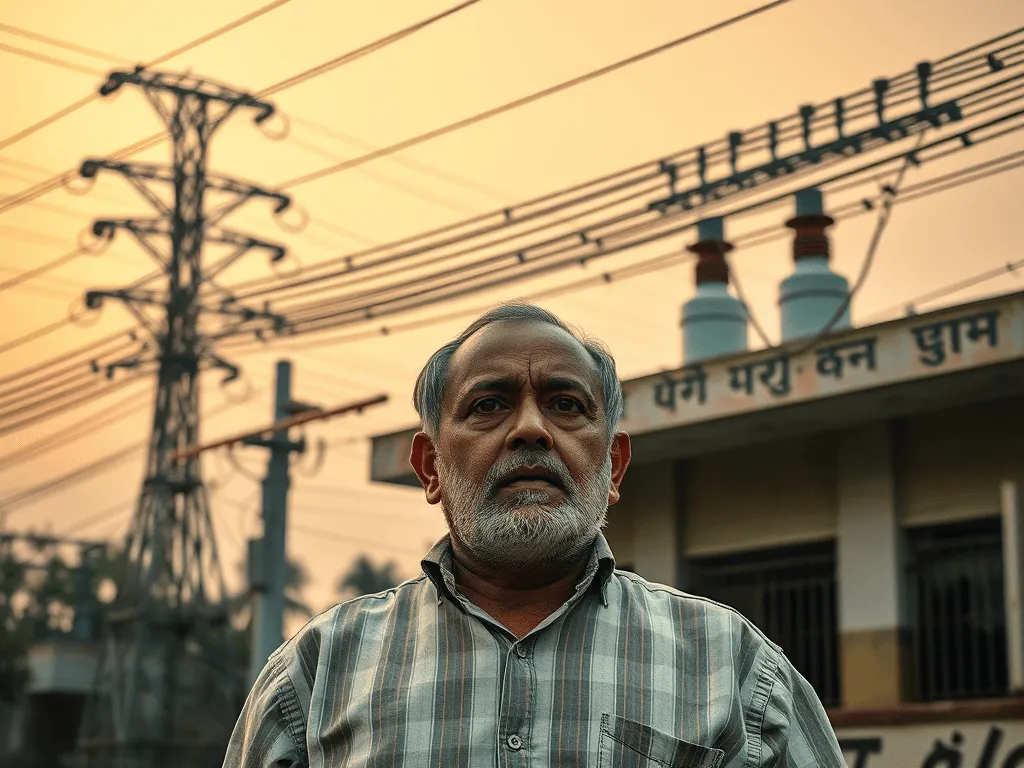
Mirzapur’s persistent electricity supply disruptions starkly contradict the local administration’s claims of providing 24-hour power. Furthermore, numerous recent reports highlight recurring outages that undermine local leaders’ assurances. As a result, this troubling situation creates significant inconvenience for households and businesses. Ultimately, this dynamic fuels community frustration.
This situation significantly inconveniences households and local businesses. Furthermore, unpredictable power cuts adversely affect essential activities, such as studying, working from home, and running small enterprises.
Key Takeaways
- Electricity Supply Disruptions in Mirzapur reveal a gap between political promises and reality, leading to public frustration.
- Residents face routine power outages, affecting essential activities like studying and working from home.
- A formal complaint highlights the flawed rationale behind city-wide outages for localised repairs, questioning government accountability.
- Citizens demand modernisation of the electricity infrastructure to ensure reliable 24-hour power supply.
- Action steps include investigating outages, enforcing targeted load shedding, and implementing preventive maintenance for lasting improvement.
⚡️ Electricity Supply Disruptions in Mirzapur: Mirzapur’s Electricity Crisis
The persistent and often unscheduled power outages in Mirzapur are starkly illuminating the gap between political promises and the ground reality of public services.
Furthermore, a recent grievance filed with the Prime Minister’s Office emphasizes the consumer’s frustration.
Consequently, it directly questions the much-publicized commitment to a 24-hour electricity supply.
The Grievance: A Critical Look at Disruption (Electricity Supply Disruptions in Mirzapur)
The formal complaint, registered as PMOPG/E/2025/0042006, exposes a significant flaw in local practice. Specifically, it illustrates how authorities exploit routine maintenance as a justification for city-wide, day-long power shutdowns. Consequently, these actions not only undermine but also directly contradict the government’s ambitious claims.
📝 Key Details of the Complaint
- Complainant: Yogi M. P. Singh
- Date of Receipt: 26/03/2025
- Received By: Prime Minister’s Office
- Concerned Authority: Executive Engineer Electricity Distribution Division II, Fataha, Mirzapur. Consequently, they are responsible for addressing issues related to electricity supply in the region.
- Current Status (as of 26/03/2025): Currently, the case is Under Process. Consequently, the team has forwarded the case to Shri Arvind Mohan, Joint Secretary in the Chief Minister Secretariat, Uttar Pradesh.
🚧 The Reason for Disruption: A Flawed Rationale
Technicians cited the renovation of a dilapidated low-voltage (LV) line near the Bathua Road transformer as the immediate cause of the outage.
In addition, the complainant argues that technicians must repair this LV line, which sits directly below the medium/high-voltage (MV/HV) line.
Moreover, the authorities de-energise the entire grid for a repair covering only 200 metres. (Electricity Supply Disruptions in Mirzapur)
As a result, residents view this as an overly disruptive, flimsy excuse for city-wide power cuts.
The complainant argues that technicians must repair the low-voltage (LV) line located just below the medium/high-voltage (MV/HV) line.
However, rather than addressing this specific issue, they de-energise the entire supply grid for a localised repair of only 200 metres of wire.
Consequently, residents view this as an overly disruptive and flimsy excuse for cutting power to the entire city.
📊 Understanding the Three Tiers of Power Distribution
“The grievance astutely breaks down the transmission process to challenge the necessity of large-scale shutdowns. Specifically, it outlines three tiers of power distribution: (Electricity Supply Disruptions in Mirzapur)
1- High Voltage (HV) Transmission (≈ 33,000 V): Authorities send power from production centres, such as Anapra or Obara, to district-level distribution centres. They use step-up transformers for this process.
2- Medium High Voltage (MV) Transmission ($>$ 1,000 V): Power is supplied from distribution centres. It is also efficiently delivered to local transformers via step-down transformers. (Electricity Supply Disruptions in Mirzapur)
3- Low Voltage (LV) Transmission ($\approx$ 440 V): Ultimately, this segment represents the final supply provided by local transformers to consumers’ houses; thus, it is the segment that specifically required repair. (Electricity Supply Disruptions in Mirzapur)
Obviously,the complainant argues that city areas have a vast network of local transformers. Thus, a fault in a short segment of the final LV wire should logically only require isolating and disrupting power from that specific local transformer. Hence, It should not affect the entire city’s supply sourced from the upstream MV/HV line.
🗣️ The Political-Administrative Disconnect (Electricity Supply Disruptions in Mirzapur)
The most scathing part of the complaint is, undoubtedly, the direct comparison between “election rhetoric” and “frequent disruption.”
On one side of the screen, there is a claim of 24 hours supply of electricity by our political masters; however, on the other side of the screen, there is frequent disruption in the supply of electricity on flimsy grounds. Ultimately, we understand everything; we are not stupid.
This sentiment reflects a deep public fatigue with an infrastructure system that seems either technically incapable of targeted repairs or, alternatively, structurally organized in a way that prioritizes simplicity for the utility over convenience for the consumer. Moreover, the dependence of LV repairs on shutting down major upstream lines suggests a significant network design issue that, consequently, guarantees repeated, city-wide inconvenience for necessary routine maintenance.
💡 Electricity Supply Disruptions in Mirzapur: Demand for Modernisation and Accountability
The resolution of this grievance will be a litmus test for the administration. If the root cause is indeed the network’s architectural constraint—where LV lines pass under MV/HV lines, necessitating a full shutdown for safety during maintenance—it demands a long-term, systematic fix, potentially under schemes like the Revamped Distribution Sector Scheme (RDSS).
Citizens are demanding accountability and, consequently, a move beyond paper-based “disposal” of complaints to genuine infrastructure modernisation that, in turn, aligns with the promised 24/7 power supply.
🛠️ From Promise to Performance: Steps for the CM and PM to Ensure 24/7 Power
Mirzapur’s grievance highlights a critical breakdown: the local electricity distribution network fails to sustain the 24-hour power supply that the Chief Minister and Prime Minister promise. Furthermore, technicians conduct Low Voltage (LV) line repairs by shutting down the entire city’s Medium/High Voltage (MV/HV) supply, a measure authorities cite for safety due to the physical stacking of the lines. Consequently, government offices must address this systemic flaw instead of merely processing a single complaint. To turn this promise into reality, the CM and PM offices must coordinate the following steps:
For Low Voltage (LV) line repair, workers need to shut down the entire city’s Medium/High Voltage (MV/HV) supply, a measure they take for safety because the lines are physically stacked.
2- The response from the government offices must, therefore, address this systemic flaw comprehensively, rather than merely focusing on the single complaint.
Here are the essential steps that the CM’s Office and the PM’s Office must, therefore, coordinate effectively to turn the promise into a reliable reality:
I. Immediate Actions: Accountability and Mitigation (Electricity Supply Disruptions in Mirzapur)
| Action | Responsibility | Description |
| 1. Investigate and Issue a Public Explanation (Electricity Supply Disruptions in Mirzapur) | CM’s Office/UP Energy Dept. | Mandate a system for mandatory, timely, and geo-specific SMS/app notifications to affected consumers for any scheduled outage, providing a clear start and end time (not “the entire day”). Undeclared breakdowns should be strictly penalized. |
| 2. Enforce Targeted Load Shedding | UP Energy Dept. (Executive Engineer) | Immediately adopt a protocol where routine maintenance affects only the supply from the specific Distribution Transformer (DT) being worked on, not the entire feeder or city area. Use mobile generators or temporary bypasses if isolation is technically impossible. |
| 3. Implement Strict Communication Protocol | UP Energy Dept. | Mandate a system for mandatory, timely, and geo-specific SMS/app notifications to affected consumers for any scheduled outage, providing a clear start and end time (not “the entire day”). Undeclared breakdowns should be strictly penalised. |
II. Medium-Term Structural Reforms: Network Modernisation (Electricity Supply Disruptions in Mirzapur)
This is the most critical area; consequently, it requires capital investment under central schemes like the Revamped Distribution Sector Scheme (RDSS), which the UP government is, in fact, already implementing.
- A. Separation of Feeder Lines (De-stacking):
- Action: Consequently, undertake a major project to physically separate or re-route low-voltage (440V) lines. Thus, they do not run directly underneath or in close proximity to the medium-voltage (e.g., 11kV) lines. This effectively eliminates the safety requirement of shutting down the entire MV line for routine LV work.
- Justification: This directly addresses the core complaint: a localised LV fault will no longer necessitate a city-wide power cut.
- B. Adoption of Aerial Bunched Cables (AB Cable):
- Action: Accelerate the replacement of bare LV overhead conductors with AB Cables (which are insulated). Consequently, this strategy significantly reduces faults caused by wire entanglement, tree branches, or other physical disturbances, thereby minimizing the need for emergency repairs.
- Status in Mirzapur: UP is expediting a project to replace bare conductors with AB Cables in urban areas like Mirzapur.
- C. Installation of Isolation/Ring Main Units (RMUs):
- Action: Install more Ring Main Units (RMUs) and load-break switches at the Distribution Substation (DSS) level. Moreover, these devices allow the utility to isolate only the faulty section of a feeder line while keeping the rest of the feeder operational, thereby reducing the affected area from the entire city to a small colony.
III. Long-Term Policy Vision: Sustained Reliability
- A. CM/PM Oversight on Implementation: (Electricity Supply Disruptions in Mirzapur)
- Action: The CM’s office should establish a “24/7 Power Dashboard” with real-time data on supply hours, AT&C losses, and maintenance-related disruptions for every major city (like Mirzapur). This moves the conversation from political rhetoric to data-driven governance.
- Role of PMO: Additionally, ensure the Central Government’s financial and technical support (like RDSS grants) is flowing efficiently to the state, while also guaranteeing that project deadlines are met.
- B. Prioritise Preventive Maintenance (PM):
- Action: Consequently, shift the distribution company’s focus from reactive repair to scheduled, planned Preventive Maintenance. Moreover, PM should be done during off-peak hours (e.g., late night/early morning) to minimize consumer impact.
- Incentives: Link the Executive Engineer’s performance appraisal directly to the number of unscheduled power cuts and the average duration of outages. (Electricity Supply Disruptions in Mirzapur)
By implementing these structural and operational changes, the offices of the CM and PM can not only demonstrate that their promise of 24-hour electricity is backed by concrete action but also effectively create a modern, resilient power distribution network.
For addressing public grievances regarding the electricity supply in Mirzapur, the following contact details for the relevant authorities are provided:
1. Local Electricity Authority (Mirzapur)
- Office: Electricity Office, Fataha, Mirzapur
- Email: czepuvvnlmirzapur@gmail.com
- Website: Mirzapur District Electricity Office
2. Uttar Pradesh Power Corporation Limited (UPPCL) Headquarters
- Address: Shakti Bhawan, 14, Ashok Marg, Lucknow, Uttar Pradesh
- Consumer Helpline: 1912 (for complaint registration and resolution)
- Official Website: UPPCL
- Consumer Services Portal: UPPCL Consumer Services
3. State Government (Chief Minister’s Office)
- Email: cmup@nic.in
- Key Contacts Website: UP CMO Key Contacts (contains specific contact numbers for various departments and officials in the CM Secretariat).
4. Central Grievance Portal (CPGRAMS)
For matters that require escalation to central authorities or for tracking grievances submitted to the Prime Minister’s Office:
- Grievance Portal: CPGRAMS
- Note: The portal is the primary platform for lodging grievances. Emails sent directly to the PMO are generally not entertained.
Please ensure you have your unique registration number (such as the one provided in your PMOPG/E/2025/0042006 case) ready when communicating with these offices to help them track your complaint efficiently.


Facing a similar challenge? Share the details in the box below, and our team of experts will do their best to help.