
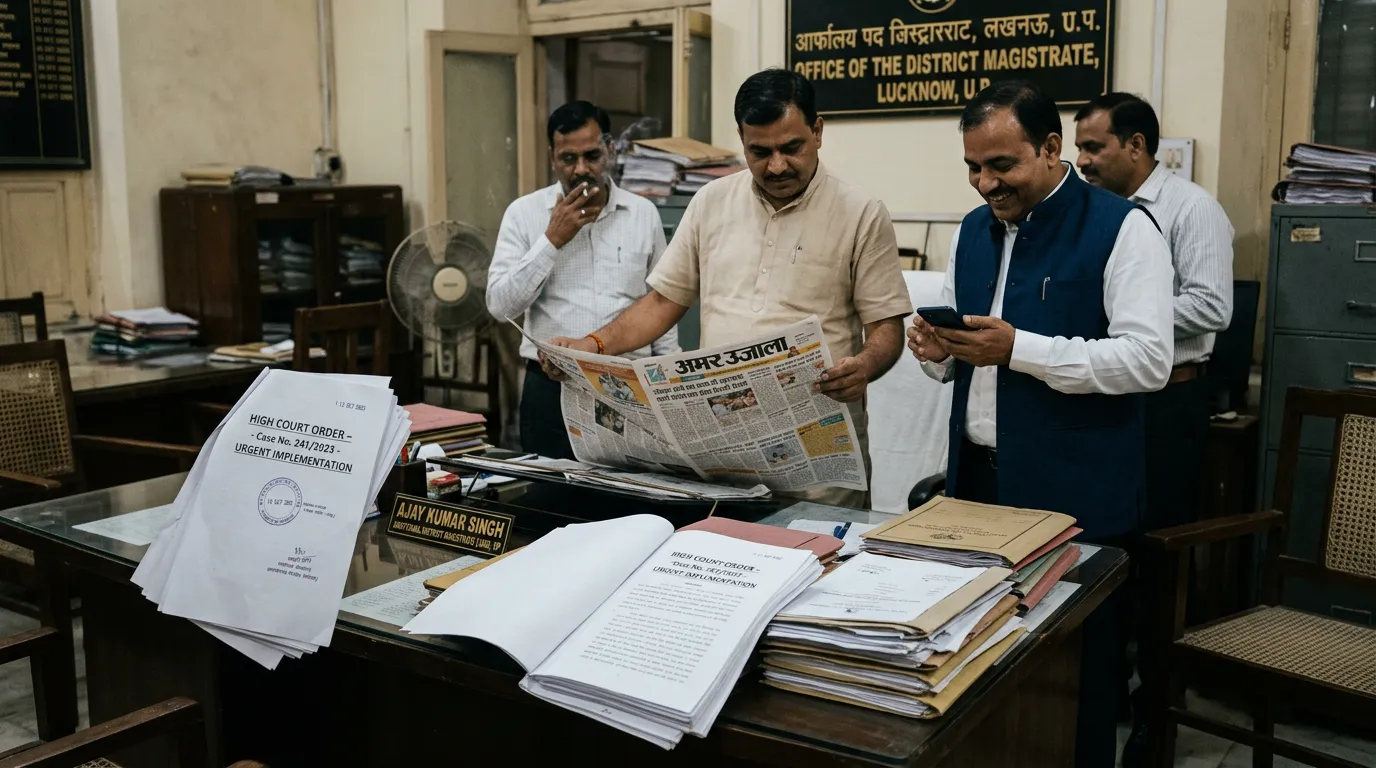
A High Court order overlooked by UP officials leaves NHM petitioners waiting in a state of uncertainty and frustration. This oversight not only delays the resolution of their pleas but also raises serious questions about the accountability of public officials and the judicial system’s ability to enforce its rulings. The significance of this directive cannot be overstated, as it highlights the crucial intersection of law and governance, where the rights of citizens must be upheld. Stakeholders are left to ponder the timeline laid out by the court, which serves as a guiding framework for the expected actions. Furthermore, it prompts a discussion on what accountability looks like in such cases—whether it involves consequences for inaction or a reassessment of how judicial orders are implemented across administrative systems in the state.
Key Takeaways
- A High Court order overlooked by UP officials causes delays for petitioners and raises concerns about accountability.
- The NHM failed to comply with a clear court directive, which highlights systemic issues in governance.
- Activist Yogi M. P. Singh’s grievance reveals a troubling pattern of administrative evasion and non-compliance.
- Public trust erodes when officials disregard judicial mandates, creating a cycle of litigation for citizens.
- To restore faith in governance, officials must enforce accountability and ensure judicial orders receive proper adherence.
High Court Order Overlooked: A Crisis of Accountability at NHM Uttar Pradesh
A democracy’s strength, after all, doesn’t come from the rhetoric of its leaders. Instead, it comes from the integrity of its institutions and how faithfully they follow the rule of law. So when executive authorities start treating judicial mandates as mere suggestions, the constitutional machinery itself begins to crumble. This article examines one clear case: a High Court order overlooked by public authorities in Uttar Pradesh.
Recently, activist Yogi M. P. Singh (Registration No: GOVUP/E/2025/0002832) filed a grievance that exposes this disturbing trend. Specifically, public authorities are blatantly failing to comply with clear directives from the High Court of Judicature at Allahabad. In short, this High Court order overlooked by the National Health Mission (NHM) is a microcosm of a larger systemic failure, where officials prioritize administrative convenience over judicial orders and citizen rights. Such failures are far from isolated, echoing similar findings of administrative corruption in Tehsil Lalganj.
The Judicial Directive Behind the Overlooked High Court Order
At its core, the matter centers on an order from the Single Bench of the Allahabad High Court, presided over by Hon’ble Justice Neeraj Tiwari. Specifically, in Kanhaiya Lal And 6 Others vs. State of U.P. and Another (WRIT – A No. 14572 of 2024), the court provided a specific remedy.
In particular, the court directed Respondent No. 2 (Director, National Health Mission, UP) to decide on the petitioners’ representation dated September 3, 2024. Moreover, the court set an explicit timeline: a decision within a maximum of two months from the date the petitioners submitted a certified copy of the order.
Accordingly, the petitioners submitted that certified copy on October 28, 2024. Therefore, by the rules of legal mathematics and administrative ethics, officials should have resolved the matter and issued a reasoned order by December 28, 2024 — well before this High Court order went overlooked.
How the High Court Order Was Overlooked: A Timeline of Non-Compliance
However, as of January 9, 2025 — the date of the formal grievance — the deadline had expired, and still, NHM authorities had taken no action. Importantly, this delay isn’t a “procedural hiccup.” Instead, it directly violates a court order, which in legal terms constitutes contempt of court under the Contempt of Courts Act, 1971.
Indeed, the grievance highlights a painful reality. Despite the petitioner’s proactive approach in submitting the required documentation, the respondent chose silence. Consequently, citizens get pulled back into the legal system, and as a result, they create a “litigation loop” where they spend more time and resources just to get an official to do what a judge already ordered — a burden that falls hardest on those already affected by an overlooked High Court order.
The Administrative Response: Evasion as a Strategy
When the grievance reached the Chief Minister’s Secretariat, the National Health Mission (NHM), Uttar Pradesh, nevertheless responded dismissively. On February 6, 2025, for instance, officials marked the case “Closed” based on a report from the General Manager (Human Resources).
Specifically, the official remarks stated:
“The said recruitment process has been ended, the notification of which is uploaded on the website of National Health Mission, Uttar Pradesh.
Overall, this response is fundamentally flawed and arbitrary for several reasons:
- Non-Addressal of the Representation: First, the High Court never asked NHM to state whether the recruitment ended. Rather, it commanded them to decide on the petitioners’ specific representation.
- Lack of a Reasoned Order: Similarly, a website notification can’t substitute for a formal, reasoned order addressed to the petitioners, as Justice Neeraj Tiwari mandated.
- Timing: Finally, authorities waited until someone filed the grievance before offering this generic excuse. As a result, that timing alone suggests the judicial deadline would have gone ignored indefinitely without external pressure.
This pattern — an official response that sidesteps the actual directive — is exactly why the High Court order overlooked in this case matters beyond one recruitment drive. A similar pattern of judicial disregard surfaces in another matter, detailed in this related case study.
The Erosion of Public Trust When a High Court Order Goes Overlooked
In light of this, the complainant, Yogi M. P. Singh, raises a question that resonates with millions of citizens: Is this “Good Governance”? For example, the Uttar Pradesh government under Chief Minister Yogi Adityanath, and the Central Government under Prime Minister Narendra Modi, frequently invoke slogans like “Minimum Government, Maximum Governance” and “Rule of Law.” However, this case reveals a significant gap between that rhetoric and the ground reality.
Furthermore, when the Chief Minister’s Office (CMO) and the IGRS (Integrated Grievance Redressal System) close cases with arbitrary reports instead of real relief, they undermine the credibility of the entire digital grievance infrastructure. Ultimately, if the state’s highest offices appear to shield negligent officials rather than hold them accountable, ordinary citizens are left with nothing but despair — and every unresolved, overlooked court order deepens that erosion of trust. This is not an isolated pattern either — similar lapses surfaced in how police handled UPHRC directives.
Transparency and the Right to Information
In addition, the grievance touches on the state’s failure to uphold the Right to Information (RTI) Act, 2005. After all, transparency remains the best disinfectant for corruption and inefficiency. Yet, by failing to provide clear information or respond to grievances in “letter and spirit,” the administration effectively operates behind a veil of secrecy. For readers navigating similar requests, this overview of filing RTI applications with NHM — and this account of PIO-level information violations — offer useful context.
In a functioning democracy, meanwhile, citizens shouldn’t need to approach the courts over every minor administrative decision. And when they do — and officials then ignore the resulting court order too — that, in turn, signals a state of administrative lawlessness, with the overlooked High Court order at its center.
Conclusion: A Call for Accountability After the Overlooked Order
To be clear, Registration No. GOVUP/E/2025/0002832 isn’t just about seven petitioners or one NHM recruitment process. Rather, it’s about the sanctity of the judiciary. Consequently, when a Director-level officer feels empowered to ignore a High Court deadline, that sends a message of impunity to the entire bureaucracy.
Therefore, to restore faith in governance, officials need to take these steps:
- Accountability for Delays: First, officials who miss court-mandated deadlines should face departmental inquiries and personal costs.
- Effective Oversight: Next, the CM’s Secretariat must stop simply forwarding “arbitrary reports” and start auditing administrative performance instead.
- Judicial Intervention: Finally, the High Court must take a stern view of “compliance-only-on-paper” attitudes to keep its orders from becoming “dead letters.”
Above all, the principle of Satyamev Jayate (Truth Alone Triumphs) demands that the administration act truthfully — not just speak truthfully. Until that happens, therefore, citizens like Yogi M. P. Singh will keep fighting a vital reminder: liberty and justice require eternal vigilance.
Indeed, this case highlights a critical gap between judicial pronouncements and administrative execution. So when a senior bureaucrat — such as the Mission Director of NHM — appears to bypass a clear High Court mandate, the damage goes beyond delaying a recruitment. In effect, it challenges the entire hierarchy of our constitutional framework.
Will the Court Notice This Overlooked Order? Monitoring Mechanisms Explained
So, will the section of the High Court that monitors order implementation take notice of this overlooked directive? Fortunately, the Allahabad High Court does maintain institutional frameworks for these issues:
- The Registrar (Compliance): To begin with, the Registry includes officers who track directives issued to state authorities. However, this section typically operates on a “report-back” basis. In other words, if the respondent fails to file a compliance affidavit, the Registry flags it — but the primary responsibility for pushing action still falls on the petitioner.
- The Contempt Jurisdiction: In addition, under Section 12 of the Contempt of Courts Act, 1971, the High Court can punish “willful disobedience.” For example, in Jyotirma Rai v. Pinky Jowel (Contempt Application No. 2665/2024), the court previously had to pull up this same office for non-compliance. Typically, moreover, the court grants one final “grace period” before issuing a bailable or non-bailable warrant against the official.
- Special Arrears & Monitoring Committees: Additionally, the High Court often forms committees to monitor case disposal and decree execution. Although these committees usually focus on internal efficiency, a formal letter-petition can still bring blatant defiance by a public official to the notice of the Administrative Committee or the Chief Justice.
The “Dignity of the Court” vs. Administrative Apathy
Notably, closing a recruitment drive — as Mission Director Pinky Jowel allegedly did through the February 6th notification — while a court-ordered representation remains pending is a high-risk legal maneuver, and another example of a High Court order overlooked in practice.
| Actor | Impact of Defiance |
|---|---|
| The Judiciary | As a result, officials render its orders “toothless,” which reduces public trust in the legal system. |
| The Bureaucracy | Consequently, this creates a culture of “Administrative Impunity” where officials feel they’re above the law. |
| The Citizen | In turn, citizens get forced into a cycle of “secondary litigation” (Contempt petitions), which costs them time and money. |
A Path Forward for Accountability
Generally speaking, for the High Court’s Monitoring Section to act on this overlooked order, these triggers usually need to happen:
- Contempt Petition: Above all, this is the most potent weapon. Once someone files a Contempt Application, for instance, the “dignity of the court” becomes the central issue, and the officer must justify the delay or risk being sent to jail.
- Letter to the Registrar General: Alternatively, someone can send a formal letter citing the case number (WRIT – A No. 14572 of 2024) and the specific act of defiance — namely, the arbitrary closure of recruitment without deciding the representation — to the Registrar General to flag the matter for the Monitoring Cell.
- Judicial Notice: Finally, during a follow-up hearing, if the petitioner’s counsel demonstrates that the official deliberately bypassed the order, the judge can summon the Mission Director for a Personal Appearance. Often, in fact, that’s the only way to break bureaucratic arrogance.
In short, this isn’t just a grievance — it’s a direct challenge to the Article 141 and 144 principles, which require all authorities to act in aid of the High Court and Supreme Court.
Therefore, based on the official records and the grievance details, here are the structured contact details of the relevant public authorities and officers.
1. Primary Public Authority: National Health Mission (NHM), Uttar Pradesh
To begin with, NHM is the direct respondent (Respondent No. 2) in the High Court writ petition, and the authority ultimately responsible for the overlooked order.
| Authority Detail | Information |
|---|---|
| Principal Officer | Dr. Pinky Jowel, I.A.S. (Mission Director, NHM UP) |
| Office Address | State Programme Management Unit (SPMU), NHM, 16, A.P. Sen Road, Charbagh, Lucknow-226001 |
| Official Website | upnrhm.gov.in |
| Primary Email | mdupnrhm@gmail.com |
| Alternative Email | gmupnuhm@gmail.com (NUHM Section) |
| Office Phone | 0522-2237595 / 0522-2237498 |
| NHM Helpline | 1800-180-1900 (Toll-Free) |
2. Higher Oversight: Chief Minister’s Secretariat, Lucknow
Since officials closed the grievance with an “Arbitrary Report,” moreover, the following CMO officers hold oversight responsibility for how the overlooked order is handled going forward.
| Officer / Cell | Name / Room No. | Contact Details |
|---|---|---|
| Joint Secretary (Oversight) | Shri Arvind Mohan | Phone: 0522-2226350 Email: arvind.12574@gov.in |
| Appellate Authority (PG) | Smt. Anjana Tripathi | Room: 318, Lok Bhawan Phone: 0522-2226364 |
| Public Grievance Sec-3 | Shri Anurag Sinha | Room: 330, Lok Bhawan Phone: 0522-2226454 |
| CM Helpline | Integrated System | Short Code: 1076 |
| Official CMO Email | General Desk | cmup@nic.in |
3. Web Links for Monitoring & Legal Action
Finally, to track this overlooked High Court order and the subsequent “arbitrary” closure of the grievance, use these resources:
- Jansunwai (IGRS) Portal: jansunwai.up.nic.in (Use Registration No. 2025/0002832 to appeal the “Closed” status.)
- Allahabad High Court Case Status: allahabadhighcourt.in (Search for WRIT – A No. 14572 of 2024.)
- NHM UP Recruitment Portal: upnrhm.gov.in/Home/Opportunities (Verify the notification the HR Manager referenced.)
Important Application Identifiers
- Grievance Registration Number: GOVUP/E/2025/0002832
- High Court Writ Citation: 2024:AHC:167107 (Writ – A No. 14572 of 2024)
- SPMU Internal Reference: Letter No. 13/SPMU/DAP-HR/Jansunwai/2024-25/7191 (Dated 04-02-2025)
Note on Nodal Officer: Ultimately, the General Manager (Human Resources) forwarded the response you received. However, for IGRS matters, the General Manager (Monitoring & Evaluation) actually serves as NHM’s Nodal Officer.
This case remains a clear, documented example of a High Court order overlooked by the very officials bound to enforce it — and a reminder of why persistent, informed follow-up still matters.eminder of why persistent, informed follow-up still matters.serves as NHM’s Nodal Officer.tor Dr. Pinky Jowel using these contact details?


Facing a similar challenge? Share the details in the box below, and our team of experts will do their best to help.