
Key Takeaways
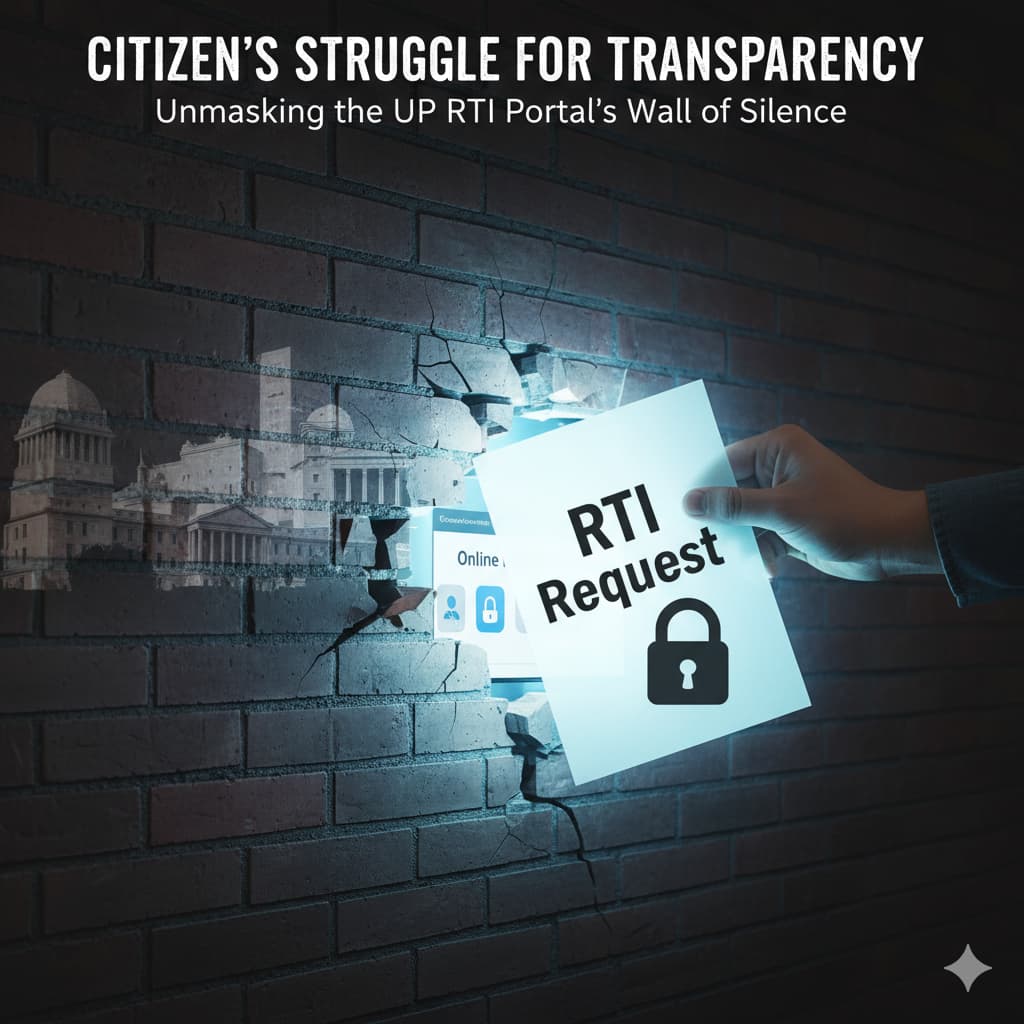
- The article highlights a Citizen’s Struggle for Transparency in the UP RTI portal. It focuses on the absence of key authorities like UPHRC.
- Applicant Yogi M P Singh filed an RTI application challenging the Administrative Reforms Department for not including essential information.
- The RTI application poses five key questions to the department. It demands clarity on the non-availability of UPHRC and NIC Uttar Pradesh.
- The inquiry aims to push the Administrative Reforms Department to rectify systemic lapses or provide a justification for exclusion.
- The absence of these bodies significantly hinders accessible governance, reflecting the ongoing struggle for transparency.
📢 The Wall of Silence: A Citizen’s Struggle for Transparency in UP RTI Portal
The successful filing of a Right to Information (RTI) inquiry has brought to light critical concerns. These concerns are about the accessibility and transparency of key public authorities on the Uttar Pradesh government’s online RTI portal.
This situation exemplifies a Citizen’s Struggle for Transparency. Applicant Yogi M P Singh has challenged the Administrative Reforms Department. This department is responsible for the portal’s content.
The challenge focuses on the conspicuous absence of the Uttar Pradesh State Human Rights Commission (UPHRC).
There is also a notable absence of NIC Uttar Pradesh from the online filing system. This raises significant concerns regarding accessibility and efficiency. These concerns impact citizens needing to engage with government services.
This clearly highlights the broader citizen’s struggle towards achieving transparency in governance mechanisms. Many individuals find themselves at a disadvantage. They struggle when attempting to access important information or services that should be readily available. Without a functional online system, many are forced to navigate outdated processes. They endure long wait times and face unnecessary hurdles. These issues ultimately undermine trust in government institutions. Digital solutions are paramount today. Without an online presence, civic engagement becomes complicated. It also prevents citizens from holding their leaders accountable for their actions and decisions.
The core of the issue lies in the obvious contradiction between the RTI Act’s spirit of transparency and the challenges. Citizens face practical obstacles when trying to seek information from these crucial public bodies through the state’s central online mechanism. It’s emblematic of the citizen’s struggle for transparency, showing how arduous the process can be.
📝 Details of the RTI Inquiry in matter of Citizen’s Struggle for Transparency
The application was filed on November 11, 2024, with the Administrative Reforms Department, Government of Uttar Pradesh. It seeks pointed answers to administrative questions. These questions directly impact a citizen’s right to information. This impact is a struggle clear in the ongoing quest for transparency.
| Detail | Information |
| Registration Number | DPTAR/R/2024/60109 |
| Date of Filing | 11-11-2024 |
| Request Filed With | Administrative Reforms Department |
| Concerned PIO | SMT SHUBRA SECTION 2, Section Officer |
| Nodal Officer | DR SHEEL ASTHANA |
Export to Sheets
5 Key Questions Posed to the Department
The RTI application demands specific information on five points. This forces the Department of Administrative Reforms to account for the current state of the online RTI system. It reflects the ongoing citizen’s plight for transparency. The struggle embodies the citizen’s demand for greater transparency in accessing information.
- Communication for Login Details: Details about sending User ID and Password are included. They also contain screenshots of electronic communications. These were sent to the Nodal Officers of the UP Human Rights Commission and NIC Uttar Pradesh for portal access.
- Reason for Non-Availability: The official reason for the non-availability of both the UPHRC and NIC Uttar Pradesh on the UP government’s RTI portal is not yet clarified. We do not have detailed information. More information is awaited. This is despite the Administrative Reforms Department providing the site’s content.
- Staff Management Details: The name and designation of the public staff within the Administrative Reforms Department are provided. They are responsible for managing the feeding of information onto the RTI portal site.
- Rationale for Exclusion: A detailed reason for the non-availability of UPHRC and NIC Uttar Pradesh on the state’s portal. This is especially important because the National Human Rights Commission (NHRC) has earlier denied information on UPHRC matters. They cited state jurisdiction for this denial.
- UPHRC Nodal Officer Information: The details concern the Nodal Officer of the State Human Rights Commission of Uttar Pradesh. Their RTI-related information under Section 4(1)(b) on the UPHRC homepage reportedly mirrors that of the National Human Rights Commission.
🏛️ Implications for Transparency
The absence of key bodies creates a major barrier. These bodies include the Uttar Pradesh State Human Rights Commission and the state unit of the National Informatics Centre (NIC). Their absence from the centralized online filing mechanism is significant. It significantly hinders accessible governance. This situation highlights the citizen’s ongoing struggle for transparency.
Human Rights Accountability:
- The UPHRC’s role as a human rights watchdog is crucial. Its non-inclusion makes filing online RTIs challenging and cumbersome for the citizens. Citizens seeking accountability on rights issues at the state level face significant difficulties. This leads to a potential erosion of trust in governmental processes. This truly showcases the depth of a citizen’s effort in struggling for transparency. It highlights their commitment. It also reveals the barriers that exist in the pursuit of justice and equality.
Technical Transparency:
- The NIC is the technical backbone for government systems, supporting critical operations and connectivity across various departments and agencies. Its absence creates an accountability loophole that can hinder effective governance and oversight. This is especially true about queries related to system management and data, as the lack of a robust infrastructure may lead to inefficiencies and gaps in information flow.
Contradiction of Legal Mandate:
- Section 4(1)(b) of the RTI Act, 2005, requires public authorities to suo motu publish certain information in a transparent manner. A fully functional and centralized portal is essential to this mandate, ensuring that the information is readily accessible to the public. Excluding major authorities from this requirement seems to contradict the very spirit of the Act, undermining the goal of promoting openness and accountability in government operations.
Citizen’s Struggle for Transparency
This RTI inquiry serves as a critical test of the accountability and transparency mechanisms within our governance structure. It pushes the Administrative Reforms Department to take action. They must rectify this systemic lapse. This issue has raised serious concerns about inclusivity and representation.
Alternatively, they must provide a strong public justification for excluding these key public authorities. This action is crucial not only as a procedural measure but also to maintain public trust.
This inquiry reflects his commitment to the principles of transparency and accountability. It also sheds light on the broader struggle citizens face for government transparency. This struggle occurs in an era where information is often withheld. Moreover, it underscores that an engaged citizenry is crucial. Citizens must demand clarity behind governmental actions. This demand fosters a more collaborative and informed relationship between the state and its citizens.
Would you like me to track the public response of the Administrative Reforms Department to this RTI application? Or should I find details on the prescribed procedure for filing an offline RTI with the UPHRC?
Complaint made against information commissioner overlooked by the accountable public functionaries
RTI Online An initiative of Uttar Pradesh Government is not working as in dilapidated state


Facing a similar challenge? Share the details in the box below, and our team of experts will do their best to help.