
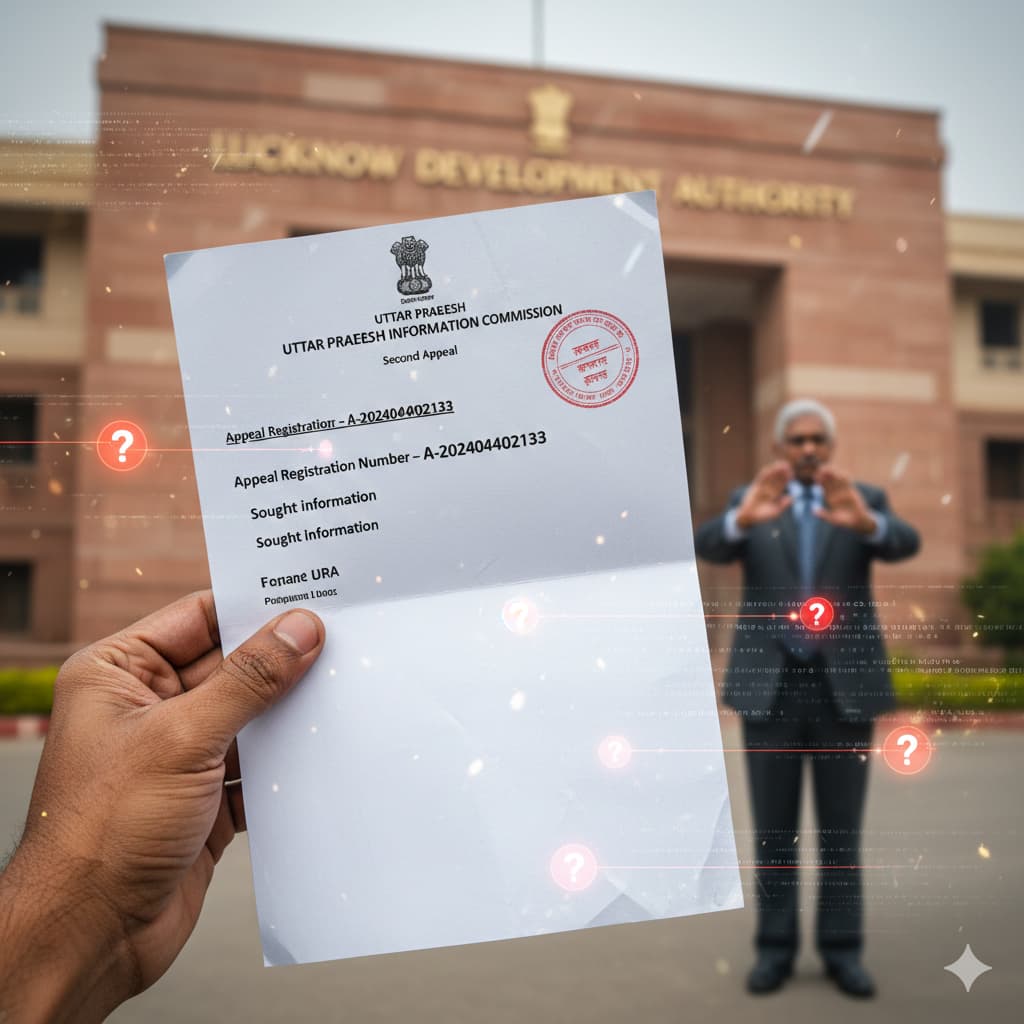
The Information Struggle: UP RTI Applicant Faces ‘Missing’ and ‘Vast’ Data from Lucknow Development Authority
Yogi M P Singh (Registration No. A-20240402133) filed a second appeal before the Uttar Pradesh Information Commission (UPIC), bringing serious allegations to light that could have significant implications for the transparency and accountability of public authorities in the region.
This case emphasizes the Information Struggle, as the Lucknow Development Authority (LDA) allegedly conceals crucial information and fails to disclose basic public service information, which is essential for fostering trust and ensuring that citizens are informed about governance matters that affect their lives.
The commission will hear the appeal on December 27, 2024, marking a pivotal moment in this ongoing battle for the right to information.
Singh challenges Snigdha Chaturvedi, the LDA’s Public Information Officer (PIO), who is accused of providing “misleading and incomplete information,” a serious breach of her duties that undermines the principles of the Right to Information Act.
This appeal not only seeks redress for the alleged negligence but also aims to hold public officials accountable, thereby promoting a culture of transparency within government agencies.
Allegations of RTI Act Violations caused Information Struggle
The core of the appellant’s submission revolves around two main allegations that merit thorough examination.
First, it is asserted that the LDA has not struggled to supply readily available information to the public, suggesting a lack of transparency and an apparent unwillingness to engage with the community’s right to access information. This situation is particularly concerning when considering the role of public bodies in fostering trust and accountability.
Second, the LDA did not properly follow the mandate of the Right to Information (RTI) Act, 2005, which is designed to empower citizens by ensuring that they have the means to obtain essential information from governmental entities. This failure not only highlights an ongoing information struggle but also raises questions about the LDA’s commitment to uphold the principles of the RTI Act, thereby undermining the rights of individuals seeking vital information that could impact their lives and communities profoundly.
1. The Case of the ‘Missing’ First Posting Details
The appellant sought the first posting details (district and date) of the current Vice Chairman of the LDA, as this information is crucial for understanding the professional background and career trajectory of the individual in question.
Such details not only illuminate the Vice Chairman’s initial assignment but also provide context regarding the experiences that may have shaped their approach to leadership and governance within the Lahore Development Authority.
By tracing the early stages of their career, we may uncover how their formative experiences and the challenges encountered at the outset contributed to their development as a leader.
This deeper understanding is particularly relevant, as it enables both the public and stakeholders to appreciate how past roles have influenced present decision-making processes and policy implementations.
Gathering this information could shed light on the qualifications and the path that led to their current role, thereby informing the public and stakeholders about the dynamics of leadership within governmental agencies.
Furthermore, understanding these foundational experiences can help in evaluating the effectiveness of leadership strategies employed by the Vice Chairman in various projects and initiatives undertaken by the LDA, fostering a more informed dialogue about governance in the region.
- PIO’s Response: “बिन्दु 01 प्राधिकरण अभिलेखों में उपलब्ध नही है। (Point 01 is not available in the Authority records.)”
- Appellant’s Submission: Mr. Singh argues that if the information was not with the LDA, the PIO had a legal obligation. They needed to transfer the RTI application. They had to send it to the relevant public authority under Section 6(3) of the RTI Act. The failure to do so is cited as a direct violation of the Act.
2. Basic Staff Data Deemed ‘Vast’ and ‘Unavailable’
The most contentious part of the appeal relates to the LDA’s response to requests for fundamental employee details, which illustrates their ongoing struggle with information transparency.
This lack of clarity not only raises questions about the organization’s commitment to open governance but also fosters skepticism among stakeholders regarding their operational integrity.
As various parties demand access to this essential data, it becomes increasingly evident that the LDA’s reluctance to provide timely information may hinder constructive dialogue and trust-building efforts within the community.
Consequently, the implications of their withholding practices could ripple through public perception, ultimately affecting their credibility and effectiveness in fulfilling their mission.
- PIO’s Response: For all three categories (Points 3, 4, and 5). The PIO stated: “आवेदक द्वारा मॉगी गयी वांछित सूचना वृहद है, जो संकलित रूप में उपलब्ध नहीं है . The desired information sought by the applicant is vast and is not available in a compiled form.
- Appellant’s Submission: The appeal strongly argues that the organization must proactively disclose details about its few Class 1 officers, as well as Class 2 and Class 3 officers. This information must be, compiled and published, as required under Section 4(1)(b) of the RTI Act. This section mandates that public authorities voluntarily publish details about their organization, including the functions, duties, and powers of their officers and employees.
Why Is This Information So Crucial?
The appellant indicates that the non-disclosure of employee transfer and posting details may link to deeper systemic issues within the organization, raising concerns about transparency and accountability.
This lack of clarity not only affects employee morale but also casts doubt on the fairness of the hiring and promotion processes.
Furthermore, this situation intensifies the information struggle that applicants face, as they are left to navigate a complex web of uncertainties, ultimately leading to feelings of frustration and disillusionment with the recruitment system.
By failing to provide essential information, the organization risks alienating potential candidates and undermining the trust that is vital for a healthy workplace environment.
“They are concealing this information because of corruption. Many staff have been at their posts for many years. They are violating the provisions of new transfer policy formulated by the government of Uttar Pradesh. This violation is the root cause [of the PIO] escaping from providing this information.”
Mr. Singh highlights that the LDA does not provide the necessary information. It should have voluntarily disclosed it within 120 days of the RTI Act’s implementation in 2005. This failure continues even 19 years later.
A Call for Commission Intervention
The appeal ends with a heartfelt plea for the Information Commission to urgently intervene and safeguard the core principles of the RTI Act.
This intervention is particularly crucial, considering the apparent disinterest exhibited by the Public Information Officer in adhering to the stipulated guidelines.
The concern intensifies as this lack of engagement persists, even in the wake of the commission’s multiple and repeated orders designed to ensure compliance.
Such disregard for the established processes undermines the very foundation of transparency that the RTI Act aims to promote.
The relentless struggle for information continues unabated, reflecting a broader issue where individuals seeking answers are often met with resistance rather than cooperation, casting a shadow over the effectiveness of the act itself.
The Second Appeal serves as a critical reminder. Public transparency is not an optional courtesy. It is a fundamental legal obligation under the RTI Act. When basic information about public servants is considered “vast” and “unavailable,” it raises serious questions. These questions pertain to the accountability and integrity of the public body in question.
What do you think of the LDA’s justification that basic employee details are “too vast” to give?
L.D.A. must give posting details of its staff if there is transparency and accountability
Snigdha Chaturvedi/ PIO of LDA did not give posting details so second appeal made against her


Facing a similar challenge? Share the details in the box below, and our team of experts will do their best to help.