
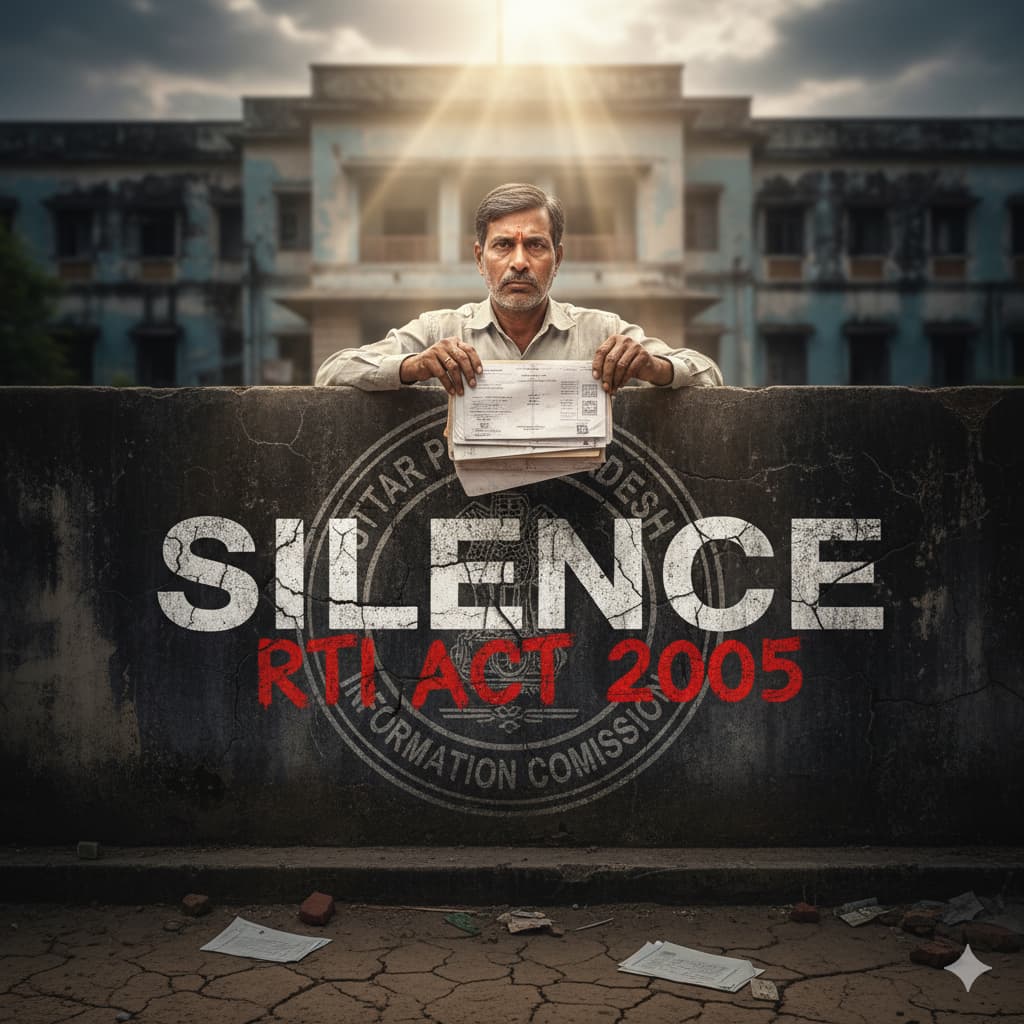
🚨 When Transparency Fails: A Citizen’s Battle Against Silence in the UP RTI System
The Department of Uttar Pradesh Power Corporation Limited in Mirzapur is procrastinating on the critical issue of providing compensation to a farmer whose crops were tragically destroyed due to a short circuit incident.
Despite the farmer’s repeated pleas for assistance and the significant losses endured as a result, there seems to be a lack of urgency and action from the department.
The prolonged delays not only add to the farmer’s distress but also raise concerns about the accountability of the authorities in addressing such vital matters that directly impact the livelihoods of local agricultural workers.
It is essential for the department to prioritize this case and ensure that the farmer receives the necessary compensation to recover from this unfortunate setback.
🛑 The Power of RTI and the Wall of Administrative Silence necessitating Citizen’s Battle Against Silence
The Right to Information (RTI) Act, 2005, is a powerful tool for Indian citizens. It is designed to promote transparency and accountability. Nonetheless, the experience of Yogi M. P. Singh from Mirzapur, Uttar Pradesh, showcases a frustrating reality. The Citizen’s Battle Against Silence is evident in what happens when public servants simply choose to ignore the law.
His recent filing of a Second Appeal with the U.P. Information Commission (UPIC) reveals a disturbing pattern that raises critical concerns regarding transparency and accountability within the system.
The Public Information Officer (PIO) within the Energy Department, Mirzapur District has shown inaction, neglecting their duty to address the legitimate requests of citizens who seek information.
This persistent battle of a citizen striving against the silence of bureaucratic procedures underscores the power deficit inherent within public information mechanisms, especially when the First Appellate Authority (FAA) also displays a worrying trend of inaction.
This lack of responsiveness not only perpetuates the frustration of individuals but also highlights the broader implications for governance, where citizens feel increasingly marginalized and unheard, calling into question the effectiveness of such institutions designed to uphold their rights.
🔍 The Information Denied: A Quest for Justice on Crop Compensation
The core of Mr. Singh’s RTI application (dated 22-08-2024) was a desperate try to obtain crucial information in a situation that had caused significant distress. He sought clarity and accountability about compensation for crop damage as he faced severe losses attributed to an unfortunate electrical short circuit, which not only devastated his crops but also placed financial strain on his family.
In light of such circumstances, the urgency of his request was palpable, as he needed to protect his livelihood and ensure that those responsible were held accountable for their actions.
The five points of information sought were highly specific and critical for due process: clarity on the criteria for compensation eligibility, details on the assessment process carried out by the authorities, timeframes for resolution, responsibilities of various departments involved, and avenues for further appeal should his application be denied.
- The Right to Reason: Why did the Executive Engineer reject the revenue inspector’s approval letter for compensation?
- Legal Clarity: What provisions of law allow an individual (Dayanand Singh) to ‘sort out defects’ in the official compensation letter?
- Administrative Inaction: What efforts has the Executive Engineer made over the past three years? They need to rectify the defects in the compensation amount letter with the Sub-Divisional Magistrate’s office.
- Official Format: The required proforma passed by UPPCL for the sanction of compensation amounts.
- UPPCL Guidelines: The District and Sub-Divisional Magistrates approve compensation according to issued the guidelines. They are responsible for approving compensation for farmers whose crops burn due to short circuits.
🚧 The Double Failure: PIO and FAA Violations
The timeline of administrative failure is stark, showing a clear disregard for the statutory deadlines set by the RTI Act. This distinct battle of a citizen against pervasive silence highlights the broader pattern of institutional failure.
- PIO’s Default: The RTI application the department forwarded to the PIO, Manish K Shrivastava (EE EDD II), on 27/08/2024. The PIO did not give any information within the stipulated time. This directly violates Section 7(1) of the RTI Act.
- FAA’s Complicity by Silence: The appellant filed a First Appeal (under Section 19(1)) on 29/09/2024 to the FAA, RAM BHUJARAT. The FAA marked the appeal status as “RTI APPEAL RECEIVED,” but the FAA did not entertain the appeal or issue any order. This inaction reflects a disregard for the spirit of the provisions of the Right to Information Act 2005.
Both authorities failed. This left the citizen with no option but to escalate the matter to the Second Appeal stage, demonstrating the ongoing struggle of the Citizen’s Battle Against Silence.
⚖️ The Final Plea: Action Against the Wrongdoers
In his Second Appeal (UPICR20240000149), Mr. Singh is not just seeking the information; he is demanding punitive action to restore public faith in the network. His prayer is explicit:
- Action against the PIO: The authorities must take action against the Public Information Officer. Section 20 of the Right to Information Act, 2005, requires this action for the failure to give information.
- Disciplinary Action against the FAA: Disciplinary action is necessary against the First Appellate Authority. They supported the illegal stand of the public information officer by ignoring the appeal.
“This is a humble plea. How can it be justified to withhold public services without reason? How can one promote anarchy, lawlessness, and chaos arbitrarily? This mockery of the law can’t be accepted. There is need of the hour to take harsh steps against the wrongdoer…”
The outcome of this appeal will be a crucial test. It will decide if the Uttar Pradesh Information Commission will uphold the sanctity of the RTI Act. This decision will powerfully reflect the end of a Citizen’s Battle Against Silence. It must send a strong message against administrative apathy. It should stop the arbitrary denial of a citizen’s fundamental right to know. This action echoes the core theme of a Citizen’s Battle Against Silence.
What are your thoughts on this case? Do you think the Information Commission should impose a penalty on the PIO and FAA?
The office issued a memo to block compensation for farmers whose crops burned due to a short circuit during COVID. Now they are not registering FIRs.
Grievance is for registering F.I.R. in matter of burning of crops due to short circuit but arbitrarily sent to EE EDD II instead of S.H.O. Vindhyachal


Facing a similar challenge? Share the details in the box below, and our team of experts will do their best to help.