
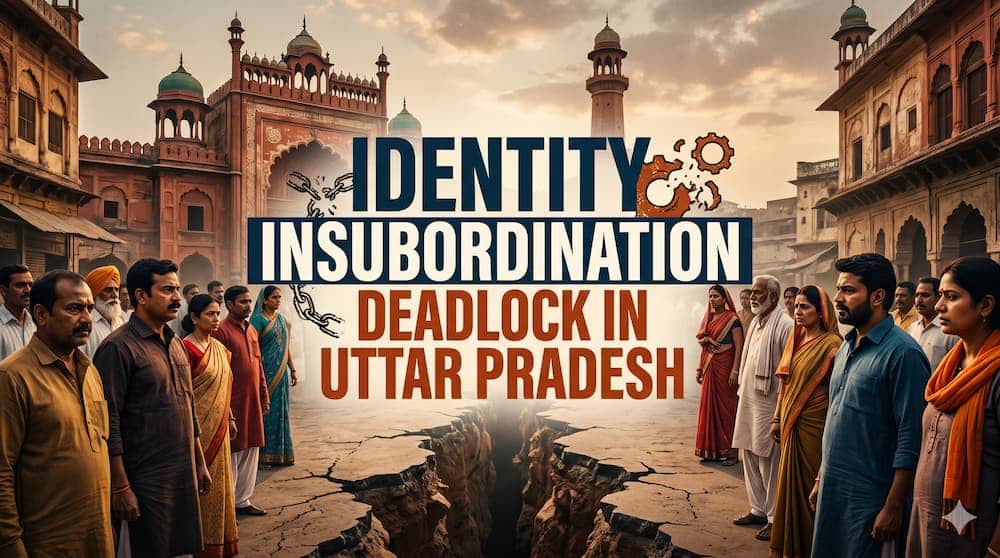
Identity Insubordination & Deadlock in Uttar Pradesh: Under Section 12 of the Registration of Births and Deaths (RBD) Act, 1969, a certified birth certificate serves as clear proof of identity. The UIDAI demands extra approval. This approval must come from local officials. This requirement creates an arbitrary barrier. The barrier is unnecessary. This overreach by the government directly conflicts with established legal rules. These rules state that internal guidelines cannot ignore documents that are official. This deadlock seriously weakens the rule of law. It turns a minor’s guaranteed legal right into a privilege. This privilege is bureaucratic in nature. It relies entirely on the choices of uncooperative local officials.
Key Takeaways
- The UIDAI’s demand for secondary magistrate validation undermines the statutory proof of identity provided by birth certificates, creating an arbitrary hurdle.
- The case of Narayan Pratap Singh in Uttar Pradesh illustrates systemic failure in obtaining essential identity documents due to bureaucratic deadlock.
- Despite having a valid birth certificate, local bureaucracy obstructs access to required identity documentation, highlighting ground-level insubordination.
- Proposed reforms include direct integration of UIDAI with health departments and penalties for local officials who evade directives.
- The situation exemplifies the fragility of digital governance in India, where local inefficiencies threaten the promise of streamlined civic processes.
Identity Insubordination & Deadlock in Uttar Pradesh: A Case Study of Identity, Insubordination, and Deadlock in Uttar Pradesh
In an era driven by public assertions of digital equity and streamlined, paperless governance, the physical reality of navigating civic administration can frequently reveal a deep, troubling chasm. Far beneath high-level policy declarations lies a complex network of local offices in Uttar Pradesh, characterised by Identity Insubordination and often mired in deadlock due to overlapping jurisdictions. This situation can lead to algorithmic gridlocks.
As a result, everyday citizens are left stranded. A stark illustration of this administrative breakdown has recently come to light in Mirzapur, Uttar Pradesh. It documents a father’s multi-layered legal and bureaucratic battle. He is trying to secure a foundational identity document—an Aadhaar card—for his minor son, Narayan Pratap Singh. This case is not a mere story of a delayed application. Instead, it serves as a textbook example of systemic failure. It demonstrates how institutional friction exists between state departments. There is also local insubordination and automated corporate federalism. These factors can systematically deny a minor child their basic rights to a legal identity and state recognition.
1. The Origin of the Conflict: A Clash of Validations (Identity Insubordination & Deadlock in Uttar Pradesh)
The controversy centres on the Aadhaar enrolment of the minor child Narayan Pratap Singh. He was born on September 11, 2016. The child’s father, Keshav Pratap Singh (known widely in public petitions as Tantrik K.P. Singh), holds a digitally verifiable Birth Certificate. This document was issued by the Registrar of Births and Deaths at the Primary Health Centre (PHC) in Vijaypur under Registration Number B-2023: 9-58804-009512.
2. The Legal Contradiction of Corporate Federalism
The refusal by UIDAI RO Lucknow, under Deputy Director Vipin Verma, to acknowledge a state-verified, QR-coded document raises profound legal questions. The central statutory framework of the Aadhaar Act explicitly lists birth certificates among its acceptable documentation. However, the Regional Office demanded a secondary manual verification order from a Subdivisional Magistrate (SDM). The state health department formally observed that this requirement was entirely redundant. It is unique to the UIDAI’s internal processing habits. (Identity Insubordination & Deadlock in Uttar Pradesh)
This dynamic creates a baffling legal paradox within the state’s structure. The UIDAI entirely blocked the child’s identity documentation. Meanwhile, the state’s Revenue Department had already successfully evaluated his residency. They issued a digitally signed Domicile Certificate (Number 691232072043) signed by the SDM of Mirzapur. Consequently, the state officially recognises the child’s residency within its borders. However, it remains entirely paralysed in documenting his core identity. This situation traps the minor in a manufactured legal void.
3. Ground-Level Insubordination and Technical Evasion (Identity Insubordination & Deadlock in Uttar Pradesh)
When the applicant sought to break this institutional deadlock by complying with the demand for secondary verification, the case exposed a severe failure of local accountability. On November 17, 2025, the Subdivisional Magistrate (SDM) Sadar, Mirzapur, issued an explicit, manual directive ordering the Block Development Officer (BDO) of Chhanbey, Mirzapur, to execute a technical field inquiry and file a conclusive report regarding the certificate’s underlying validity.
What followed highlights a pervasive culture of bureaucratic evasion. On January 13, 2026, local Lekhpal Pawan Kumar Shukla submitted a report that omitted any answer to the SDM’s specific query.
Instead of validating the certificate as ordered, the report simply advised the father to file an online application.
. This evasion completely ignored the superior officer’s directive, stalled the field verification process, and locked the case into an artificial administrative stalemate.
Structural Progression of the Case (Identity Insubordination & Deadlock in Uttar Pradesh)
Stage 1: Initial Public Grievance ( GOVUP/E/2026/0024498)
Filed on 25/02/2026 against the BDO Chhanbey & UIDAI RO Lucknow.
Routinely exceeded the 30-day Citizen’s Charter window without a substantive Action Taken Report.
Stage 2: Urgent Chief Minister Reminder
Filed on 04/04/2026, addressed directly to Joint Secretary Shri Arvind Mohan.
Escalated to enforce accountability and demand a 48-hour clear summons to field staff.
Stage 3: Statutory RTI Request ( DMOMR/R/2026/80037) (Identity Insubordination & Deadlock in Uttar Pradesh)
Filed originally at the CM Secretariat on 04/04/2026.
Transferred on 09/04/2026 to Tehsildar Vishal Kumar Sharma at the DM Office Mirzapur.
The lack of a timely response completely broke down access to information. (Identity Insubordination & Deadlock in Uttar Pradesh)
Stage 4: Formal First Appeal ( DMOMR/A/2026/60066)
The case was escalated on 21/05/2026 before the First Appellate Authority, Asha Ram Verma (SDM Sadar, Mirzapur), on the grounds of non-disclosure.
4. The Digital Illusion: Automated Closures and Silenced Channels
Faced with persistent delays, the complainant sought relief through the Integrated Grievance Redressal System (IGRS)
Under the IGRS Citizens’ Charter, such filings carry strict timelines.
But the application stayed “Under Process” forever.
The applicant stated that the UIDAI systematically closed previous filings with generic, automated replies that entirely ignored the state health department’s validation letter. To worsen matters, the official email channels for the UIDAI Regional Office suffered from permanent DNS delivery failures, leaving citizens with no functional path for direct communication or escalation.
5. Weaponizing the Right to Information Act (Identity Insubordination & Deadlock in Uttar Pradesh)
To expose the internal handling of these files, an RTI application under Section 6(1) was filed on April 4, 2026, seeking the specific names of desk officers responsible for the delay, internal file notings, and records of disciplinary actions against the non-responsive local staff
. Proving how central desks often offload complex queries, the application was transferred on April 9, 2026, to the District Magistrate Office, Mirzapur, assigning Tehsildar Vishal Kumar Sharma as the Public Information Officer (PIO).
When the statutory period passed with no response from the PIO, the case moved to a formal First Appeal (DMOMR/A/2026/60066) on May 21, 2026. This escalation creates a notable administrative intersection: the designated First Appellate Authority (FAA) is SDM Sadar Asha Ram Verma—the exact official whose original field inquiry order from November 2025 was compromised by local field staff. (Identity Insubordination & Deadlock in Uttar Pradesh)
6. Structural Lessons for Public Administration
The Fiction of Centralized Digital Efficiency
Automated grievance platforms and digital signatures provide little relief when central identity bodies reject local documents without issuing formal, clear speaking orders explaining their rationale.
7. Local Accountability Deficits
The deliberate evasion by field staff, such as the Lekhpal, shows that local administrative layers can easily stall directives from superior offices. Such behaviour occurs if strong oversight and clear penalties are absent.
The churn of transferred petitions is problematic. Continuously transferring public applications from central secretariats down to local desks frequently fragments administrative accountability. This process turns a clear-cut case into a prolonged dispute over jurisdictional ownership.
8. Proposed Policy Interventions: Bridging the Chasm
To prevent cases like these from becoming the norm, we urgently require a severe restructuring of inter-departmental protocols. The resolution demands more than just clearing a single backlog; it necessitates systemic reform. (Identity Insubordination & Deadlock in Uttar Pradesh)
Direct API Integration Over Manual Verification: The UIDAI must directly integrate its backend verification systems with the digital databases of State Health Departments and the Civil Registration System (CRS). If a birth certificate is digitally verifiable via a state-issued QR code, we should legally prohibit secondary manual verification by local magistrates. This measure will help eliminate redundant bottlenecks.
Enforceable Penalties for Insubordination:
The Right to Information Act and the IGRS must be equipped with immediate, automated punitive measures. When field officers—such as the Lekhpal in this instance—blatantly ignore or evade directives from superior Appellate Authorities, it should trigger mandatory disciplinary hearings rather than routine file closures.
Inter-Departmental Arbitration: There needs to be a specific, fast-track appellate authority for when departments can’t agree. When a central agency (UIDAI) and a state department (Directorate of Medical and Health Services) clash over document validity, the citizen should not be the one forced to mediate.
Conclusion: The Fragility of Digital Governance (Identity Insubordination & Deadlock in Uttar Pradesh)
The ordeal of Narayan Pratap Singh serves as a clarion call for the administration. It starkly exposes the fragility of “Digital India”, which rests on a foundation of fragmented bureaucracies, corporate-style federalism, and unchecked local insubordination. True digital equity and paperless governance cannot exist as long as central identity bodies have the unchecked power to reject state-validated documents without consequence. Until genuine accountability is restored at both the central processing desks and the local field offices, the promise of streamlined governance in Uttar Pradesh will remain nothing more than an illusion for the common citizen.
Would you like me to expand further on the specific legal precedents surrounding the Registration of Births and Deaths (RBD) Act of 1969, or would you prefer to weave in more details from the specific RTI responses you received?
Data Sources and Official References (Identity Insubordination & Deadlock in Uttar Pradesh)
Integrated Grievance Redressal System (IGRS), UP: Reference Portals: Status Prints and
Right to Information (RTI) Online Tracking Network, UP: Reference Portals: (Requests & Appeals Matrix and Appeal Reference DMOMR/A/2026/60066)


Facing a similar challenge? Share the details in the box below, and our team of experts will do their best to help.