
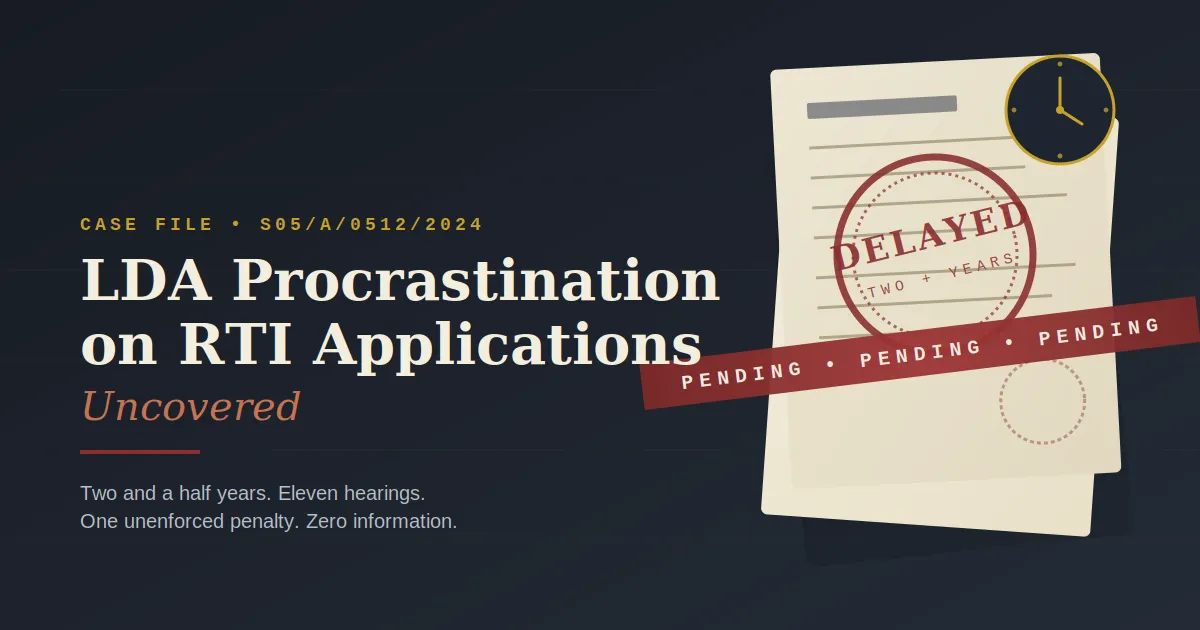
LDA Procrastination on RTI Applications: Two and a Half Years and Counting
Obviously, LDA Procrastination on RTI Applications is not a vague grievance — it is a documented, dated timeline stretching well over two years. On 10 February 2024, an applicant filed a routine RTI request before the Public Information Officer of the Lucknow Development Authority, asking for five narrow, factual details tied to a disputed property registry. What followed was a slow-motion pattern now familiar to RTI activists across Uttar Pradesh: months of silence, a rejection built on a rule that doesn’t fit the facts, a First Appellate Authority finding that confirmed nothing had ever been sent, and a State Information Commission penalty that went unserved for weeks after it was passed. This case captures, in granular detail, exactly how LDA Procrastination on RTI Applications operates — not through outright refusal, but through delay layered on delay until accountability quietly disappears.
Key Takeaways
- LDA procrastination on RTI applications leads to significant delays, with one request unresolved for over two years.
- An applicant filed an RTI request for specific details, but LDA’s repeated rejections and procedural delays have obstructed access to information.
- The First Appellate Authority confirmed that the PIO failed to disclose any information, highlighting chronic delays at LDA.
- The State Information Commission imposed a penalty on the PIO, but enforcement of this order remains unfulfilled, raising concerns about accountability.
- The upcoming hearing must ensure compliance with the Commission’s order and finally release the requested documents without further delay.
Introduction
LDA procrastination on RTI applications is not an abstract complaint. It is a documented, dated timeline. On 10 February 2024, an applicant filed an RTI request (Registration No. LKDPA/R/2024/60085) before the Public Information Officer (PIO) of the Lucknow Development Authority (LDA). Two and a half years have passed since then. The PIO rejected the request once. The Commission imposed a penalty once. The case has gone through at least eleven hearings. Yet the core information still hasn’t reached the applicant. This case — now Second Appeal No. S05/A/0512/2024 (Registration No. A-20240701538) before the Uttar Pradesh State Information Commission — shows how LDA procrastination on RTI applications wears down the RTI Act’s safeguards through delay, procedural excuses, and unenforced orders.
The Information Actually Sought — What LDA Procrastination on RTI Applications Has Kept Buried
Strip away the procedural history. The request itself is narrow and factual, not analytical or speculative. The applicant asked for five things:
- Title suit details. LDA’s own files record a woman as Anuradha Singh, also referred to as Guddi Singh or Aradhana Singh. The applicant wants details of her title suit, plus the name and designation of the LDA official who executed the registry in her favour.
- A certified copy of the court order that decided this title suit. The Allahabad High Court passed the underlying directions in Writ Petition No. 135 of 2006, ordering the claimant to first establish her title through a civil suit before a competent court.
- Names, designations, and postings of the LDA staff who executed the registry of the disputed plots to allottees.
- Details of the internal committee LDA says it formed to inquire into irregularities in these allotments — names, designations, postings, and the date each member joined.
- Details of who nominated that committee, plus the timeframe LDA fixed for it to finish its inquiry.
None of this requires the PIO to form an opinion, draw an inference, or create new data. A court order either sits on file or it doesn’t. A registry either names an executing officer or it doesn’t. A committee either has a notified membership or it doesn’t. This simple fact makes the PIO’s ground for rejection worth scrutinising closely.
The Rejection: Rule 4(2)(b)(ii) as a Tool of LDA Procrastination on RTI Applications
The PIO sat on the application for roughly seventeen months — itself a clear instance of LDA procrastination on RTI applications. She then rejected it on 16 July 2025, citing Rule 4(2)(b)(ii) of the U.P. RTI Rules, 2015. This rule blocks disclosure only when supplying the information would require “new interpretation or analysis of existing data, drawing of inferences, making of assumptions, or providing advice or opinion.
The problem with this ground is simple. Producing a copy of an existing court order is retrieval, not analysis. Listing the officials who signed a registry is retrieval too. The applicant may draw his own connection between the High Court’s 2006 directions and LDA’s later conduct — but that’s his inference, not the PIO’s. The underlying documents don’t need interpretation before LDA can hand them over. If a different exemption genuinely applied, the Act requires the PIO to name and justify it. She cannot substitute a rule that doesn’t fit the facts.
The First Appellate Authority’s Own Finding Confirms the Pattern
Before the matter reached the State Information Commission, it passed through LDA’s own First Appellate Authority (FAA). According to the applicant, the FAA checked LDA’s dispatch register directly. It found no record that anyone had sent the applicant any information at all. This finding matters because it isn’t just the applicant’s allegation — the FAA verified it against LDA’s own internal records. The PIO had failed her basic obligation even before the case reached the Commission. Despite this confirmed instance of LDA procrastination on RTI applications, the PIO ignored the FAA’s direction to disclose too, and the matter moved to a second appeal.
The Commission’s Response to LDA Procrastination on RTI Applications — and Its Own Delay
The applicant filed the second appeal on 20 July 2024. The Commission has since listed it at least eleven times: 10.10.2024, 28.11.2024, 31.12.2024, 28.01.2025, 06.03.2025, 23.07.2025, 24.09.2025, 11.12.2025, 24.02.2026, 13.05.2026, and 09.06.2026. At nearly every hearing, the Commission recorded that both parties stayed absent and that the information remained undisclosed. To its credit, the Commission didn’t dismiss the appeal outright. Instead, it kept issuing “final opportunity” notices to the PIO.
That restraint eventually turned into action. On 13 May 2026, the Commission imposed a ₹25,000 penalty on the PIO under Section 20(1) of the RTI Act for willful non-disclosure. But the case then took a telling turn. At the very next hearing, on 9 June 2026, the Commission discovered that nobody had served the penalty notice on the PIO. An order the Commission had already passed sat unenforced for weeks — through no fault of the applicant. The most recent notice, dated 8 July 2026, fixes the next hearing for 19 August 2026. It still doesn’t confirm that service has happened or that recovery of the ₹25,000 has actually begun.
Why Enforcement Matters as Much as Adjudication
This is the crux of the case right now. The PIO’s two-and-a-half-year defiance of the RTI Act’s disclosure requirements is no longer in question — the FAA established it, and the Commission’s own penalty order confirmed it. The live concern is different: will LDA procrastination on RTI applications now stretch into the enforcement of the Commission’s own order? Or will the Commission let this slide into yet another procedural notice, repeating a pattern this case has shown again and again?
This concern isn’t hypothetical. In a separate matter — Appeal No. S09/A/1103/2024, against the DPRO Mirzapur — the same Commission closed a second appeal simply because both parties missed a hearing. It never examined whether the PIO had complied. If information-seekers must keep attending hearing after hearing indefinitely, while defaulting officers simply wait out the process, the RTI Act’s three-tier structure — PIO, First Appeal, Second Appeal — starts rewarding silence instead of penalising it.
What the Case Now Calls For: Ending LDA Procrastination on RTI Applications
The 19 August 2026 hearing needs to settle three things. First, the Commission should confirm that it has served the 13 May 2026 penalty and started recovering it. Second, it should direct the PIO to disclose all five original points of information without further delay. Third, it should commit to deciding the matter on its merits and the written record already before it — not dismiss or defer it again for want of personal attendance.
After two and a half years, the applicant isn’t asking for a fresh investigation. He’s asking LDA to hand over documents that already sit in a government office, and asking the Commission to let its own order — passed months ago — finally take effect.
a fresh investigation. It is simply that documents already sitting in a government office be handed over, and that LDA procrastination on RTI applications finally give way to an order the Commission has already passed being allowed to take effect.
Based on the documents in this case, here are the application IDs, contact details, and web links for the concerned public authorities:
Case & Application Identifiers
| Item | Detail |
|---|---|
| Original RTI Registration No. | LKDPA/R/2024/60085 |
| RTI Filing Date | 10.02.2024 |
| Second Appeal No. | S05/A/0512/2024 |
| Commission Registration No. | A-20240701538 |
| Latest Diary No. (filing dated 31.07.2026) | D-310720260167 |
| Hearing Room | S-5, UP State Information Commission |
| Next Hearing Date | 19.08.2026 |
Public Information Officer — Lucknow Development Authority
- Name: Sangeeta Raghav (PIO/OSD)
- Address: Lucknow Development Authority, Lucknow, Pin: 226012
- Mobile: 9918001893
- Email: raz.9125@gmail.com
Uttar Pradesh State Information Commission
- Hearing Court Email (S-5): hearingcourts5.upic@up.gov.in
- Website: upsic.up.gov.in
- Online Filing/Portal: upsic.up.gov.in/cispu/citizen (as referenced in case notices)
- Case Status Tracking: upsic.up.gov.in/cispu/online_case_info
Applicant
- Name: Yogi M.P. Singh
- Mobile: 7379105911
- Email: yogimpsingh@gmail.com
- CC Email (LDA RTI cell): ldartionline@gmail.com
- Address: Surekapuram Colony, Jabalpur Road, Mirzapur City, Pin: 231001


Facing a similar challenge? Share the details in the box below, and our team of experts will do their best to help.