
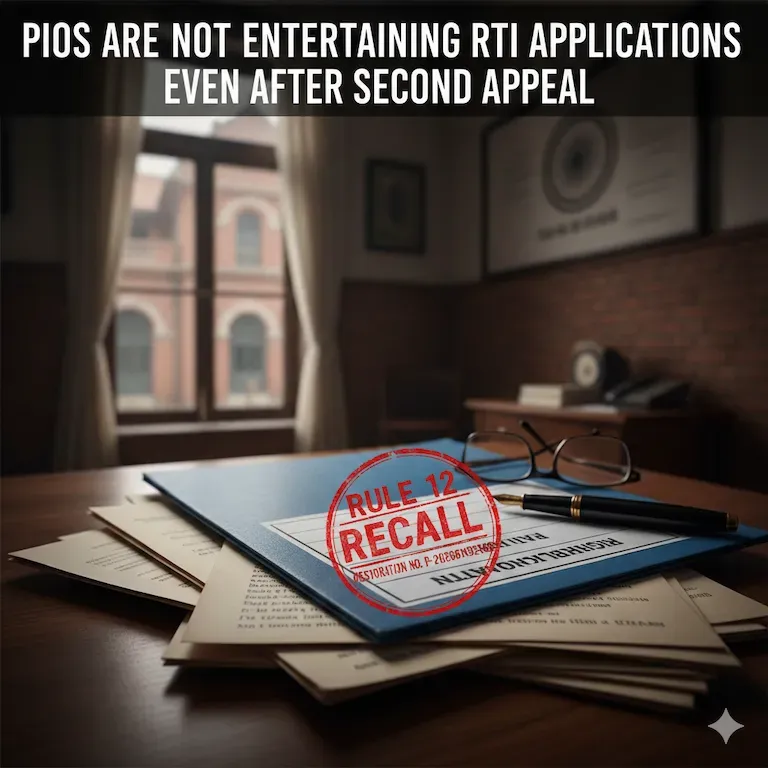
The key takeaway is the systemic defiance of the RTI Act. This defiance is by the local administration in Mirzapur. A subsequent legal effort aims to restore accountability through a Rule 12 Recall Application.
1. Defiance of Statutory Authority
The core issue is that the Public Information Officer (Tehsildar Hemant Kumar) has acted deliberately. He has ignored the authority of the Uttar Pradesh Information Commission. The Commission issued “clear orders and directions” to provide the information. The PIO remained absent from multiple hearings. He failed to submit any written evidence of compliance. Restoring accountability is crucial in ensuring that public officials adhere to their obligations.
2. Strategic Avoidance of Disclosure (Restoring Accountability)
The “runaway” behavior of the Tahsildar appears to be a calculated effort. It aims to avoid disclosing specific staff details that would prove violations of the New Transfer Policy. The authority is withholding posting dates and service commencement details for Class I through Class IV employees. This effectively shields potential administrative irregularities. It also leads to long-term stagnation of staff in the same office.
3. Procedural Failure and the Rule 12 Remedy
The Commission initially disposed of the case (File No. S09/A/1963/2024) based on a “lack of interest” due to the appellant’s absence. However, the appellant has now legally challenged this closure by filing a Recall Application under Rule 12 (Restoration No. P-20260102140), citing “sufficient cause” for the delay: Restoring Accountability.
- Lack of Notification: The appellant was never informed of the final hearing or disposal via email or SMS.
- Zero Delay: The restoration request was filed on January 24, 2026. It was the same day the disposal was manually discovered. This shows active interest in the case.
4. The Goal: Transparency in Staffing (Restoring Accountability)
The ultimate objective remains obtaining the 4-point information regarding employee tenures. We aim to implement transfer policies as well. This ensures that the Revenue Department operates with the transparency and accountability required by law.
Administrative Defiance vs. Rule of Law: The Battle to Restore Appeal No. A-20241100263 (Restoring Accountability)
The Revenue Department of Mirzapur has dramatically pursued transparency. After the Tahsildar, Sadar, obstructed administration for months, Yogi M. P. Singh formally challenged the Uttar Pradesh Information Commission’s closure order in the case against the PIO. On 24 January 2026, they registered a recall application under Rule 12 (Restoration No. P-20260102140), signalling a determined stand against the ‘culture of silence’ that has plagued this RTI inquiry.
The Genesis of the Struggle: Seeking Truth in Transfers
The core of this dispute lies in four simple but powerful questions regarding the staff of Tehsil Sadar. The appellant sought the posting history of all employees. This includes their service commencement dates and transfer details. These details cover from Class I officials down to Class IV staff.
The objective was clear to determine. Whether the Uttar Pradesh government actively implements its new transfer policy or if it remains merely on paper. Restoring accountability becomes crucial. This happens when a public authority refuses to disclose how long an employee remained posted to a specific position. It is troubling questions and concerns about transparency and accountability arise. This lack of openness fuels worries about potential corruption, entrenched interests, and the emergence of local power monopolies.
The Procedural Trap: How the Case kept Silenced (Restoring Accountability)
On September 2, 2025, the Information Commission (Court S-9) passed a final order. It disposed of the appeal. The file was consigned to the records. The justification provided was a “lack of interest” because the appellant failed to appear for hearings.
However, the reality of the situation reveals a deeper systemic failure:
- The “Runaway” PIO: The Commission’s own record confirms that the Public Information Officer, Tahsildar Hemant Kumar, was persistently defaulting. He failed to appear or provide information. This happened despite “clear orders/directions” issued as early as March and April 2025.
- The Notification Gap: The appellant was never served the final hearing notice or the disposal order via email or SMS. They discovered the closure only through a manual search of the portal months later.
Invoking Rule 12: The Legal Path to Restoration
The Recall Application was recently filed under Rule 12 of the Uttar Pradesh Information Officer Rules, 2015. It is the primary weapon in the appellant’s arsenal. This rule provides a safeguard against orders passed in the absence of an appellant. This happens when there is “sufficient cause” for that absence.
Key Grounds for the Recall: (Restoring Accountability)
- Technical and Procedural Lapse: The appellant claims the absence was not deliberate. It resulted from not receiving timely email notifications from the CATS (Complaint and Appeal Tracking System).
- Documented Defiance by the PIO: The PIO’s defiance is well documented. He willfully disobeyed multiple directives of the Commission. Closing the case due to the appellant’s absence effectively rewards the PIO for his own non-compliance.
- The Persistence of the Information Seeker: The filing of a Knowledge of Fact (K.O.F.) document under Diary Number D-240120260001 serves as undeniable proof of the appellant’s continued interest and active pursuit of justice.
The Gravity of Administrative Defiance
When a Tahsildar—a key administrative officer—ignores the summons of the State Information Commission, it is more than a personal slight. It affects an information seeker. Also It undermines the respect for the RTI Act, 2005. It is an assault on the RTI Act, 2005. The Commission is vested with the powers of a Civil Court to enforce the attendance of public servants.
By failing to appear, the PIO has bypassed the judicial process. If the Commission does not recall the order, it must enforce its presence. Restoring Accountability is crucial; otherwise, it sends a dangerous message to all public authorities in Uttar Pradesh. If you ignore the RTI long enough, the case will eventually be dismissed for procedural reasons.
Transparency in Staffing: Why it Matters (Restoring Accountability)
The information sought—posting details and transfer policy compliance—is vital for the health of local administration.
- Preventing “Seat Fixers”: Employees who stay in one location for decades often develop illicit networks.
- Upholding Government Orders: The “New Transfer Policy” was designed to ensure fresh oversight and prevent stagnation.
- Public Accountability: Citizens have a right to know who is serving them. They also have the right to know whether they are stationed there in accordance with the law.
Conclusion: The Road Ahead (Restoring Accountability)
The registration of the restoration application (P-20260102140) has hit the “reset” button on this battle for transparency. The appellant has officially challenged the disposal and requested the Commission to:
- Recall the order dated 02.09.2025.
- Restore the appeal to its original status.
- Initiate penalty proceedings under Section 20(1) against the PIO for his documented defiance.
The Information Commission now has a choice. It can uphold the procedural finality of a flawed closure. Alternatively, it can enforce the spirit of the RTI Act. It can compel the Tahsildar to come out of the shadows. This would provide the truth.
Would you like me to help you track the progress of Restoration Number P-20260102140? Or would you prefer that I draft a reminder for the Commission’s Registrar?
The information you have sought strikes at the heart of administrative accountability. It also challenges the legal rotation of staff within Tehsil Sadar, Mirzapur. You are trying to uncover whether public servants are overstaying their tenures. This investigation seeks to determine if such actions violate state mandates.
The 4-Point Information Sought (Restoring Accountability)
The core of your RTI application (Registration No. DMOMR/R/2024/60077) consists of the following four critical demands for transparency:
- Class I and II Employee Posting History: * Full posting details of all first-class and second-class officers.
- The specific date they commenced service within Mirzapur district.
- Total duration of their current posting and the location of their very first assignment.
- Class III (Clerical) Staff Details: * Complete posting timelines for all third-class employees.
- The exact date they began their service in the district.
- Identify the previous district from which they were transferred to Mirzapur.
- Class IV Support Staff Details: * Posting records for all fourth-class employees currently stationed in the district.
- The start date of their service within the district.
- Transfer history, specifically noting if they were moved from other districts to Mirzapur.
- Transfer Policy Implementation Status: * Is the department actively following the New Transfer Policy issued by the Uttar Pradesh Government? The statement should clearly define this.
- If followed, a “step-by-step” account should detail the efforts. It should also include the actions taken by the department to comply with said policy to date.
Why this Information is Legally Significant (Restoring Accountability)
The PIO’s refusal, specifically by Tahsildar Hemant Kumar, to provide this data is concerning. This refusal occurs despite clear directions from the Commission. It suggests a systemic failure to adhere to the Uttar Pradesh Government’s New Transfer Policy.
- Tenure Tracking: The data on “service commencement dates” would reveal if staff members have been entrenched in the same office for decades, which is often a precursor to administrative corruption.
- Compliance Verification: Point 4 directly asks for the “efforts taken.” This requirement forces the department to produce documentary evidence of policy implementation. Verbal assurances are not sufficient.
- Accountability of Superior Officers: The inclusion of Class I and II officers ensures fairness. The request applies the law equally across all ranks of the Revenue Department.
Current Legal Standing of the Information
As of today, January 24, 2026, we have registered your Restoration Application (P-20260102140). This registration ensures that we will finally disclose the information. The Commission’s previous order acknowledged that it had already issued “clear orders/directions” to the PIO. PIO had to provide this specific 4-point information. However, the PIO chose to remain absent and non-compliant.
To ensure Order Recall Application (P-20260102140). Whether effectively pursued or not, you will need specific information. Here are the essential identification numbers and contact details for the public authorities involved in your case.
1. Key Case Identifiers (Restoring Accountability)
You must reference these numbers in all future correspondence to ensure your filings are correctly linked:
- Restoration Registration Number: P-20260102140
- New Diary Number: D-240120260001 (Dated 24/01/2026)
- Second Appeal Registration Number: A-20241100263
- Commission File Number: S09/A/1963/2024
- RTI Application ID (Online Portal): UPICR20240000149
- Original Section 6(1) Application Number: DMOMR/R/2024/60077
2. Uttar Pradesh Information Commission (UPIC)
The Commission is the judicial body handling your Rule 12 recall request.
- Web Link (Portal): upsic.up.gov.in
- Online Hearing Link: https://upsic.up.gov.in/cispu/onlinehearing/493d8b
- Court S-9 Email: hearingcourts9.upic@up.gov.in
- Official Address: RTI Bhawan, 7/7 A, Vibhuti Khand, Gomti Nagar, Lucknow, UP – 226010.
3. Public Information Officer (PIO) – Tehsil Sadar
The PIO, Tahsildar Hemant Kumar, is the officer who has allegedly failed to provide the staff posting details.
- Official Email: teh-sadar.mi@up.gov.in
- Secondary Email: tehsilsadar025@gmail.com
- CUG Mobile Number: 9454416823
- Office Address: Tahsildar Office, Tehsil Sadar, District Mirzapur, Pin Code: 231001
4. First Appellate Authority (FAA) – SDM Sadar
The SDM, Asha Ram Verma, is the supervisor who reportedly did not entertain the initial appeal.
- Official Email: sdm-sadar.mi@up.gov.in
- CUG Mobile Number: 9454416810
- Office Address: Sub-Divisional Magistrate Office, Sadar, District Mirzapur, Pin Code: 231001
5. Summary of the Authority Structure (Restoring Accountability)
The core issue remains the PIO’s documented defiance. The Commission sent links and notices on multiple dates in 2025. Despite this, the PIO failed to appear. They also did not submit a written statement regarding the transfer policy implementation.
Would you like me to draft a brief status update request? You can email it to Court S-9 using your new Restoration Number P-20260102140.

Facing a similar challenge? Share the details in the box below, and our team of experts will do their best to help.