
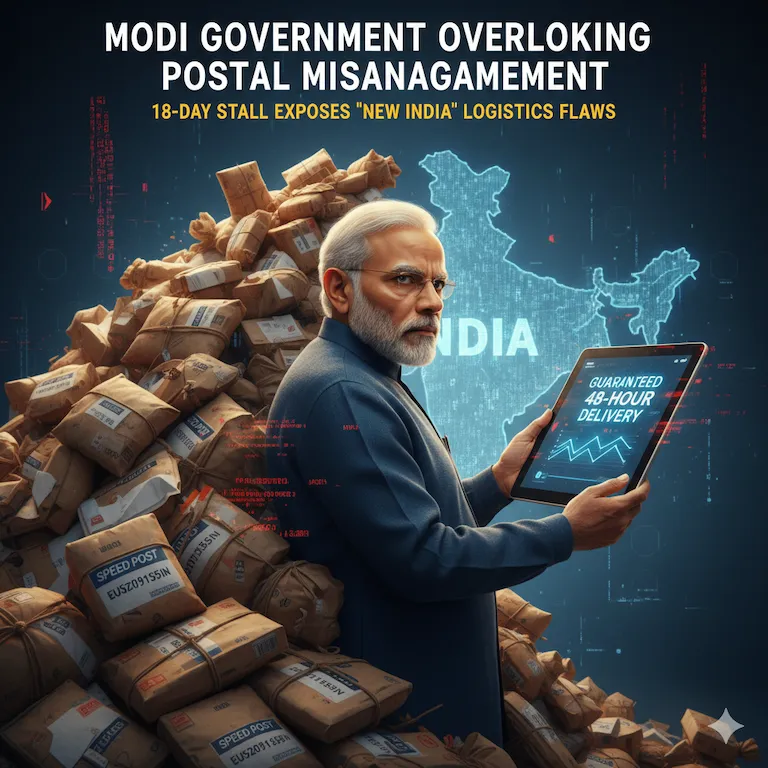
Key takeaways from the blog post (Modi Government)
The blog post highlights a critical disconnect. It contrasts the Government of India’s modernized logistics promises for 2026 with the actual service experience of its citizens. The Modi Government has set ambitious goals, but the reality for many remains quite different.
Here are the key takeaways:
- Failure of “Speed Post 24/48″ Claims: “Speed Post 24” and “Speed Post 48” services started with a promise. They guaranteed delivery within 1–2 days. However, actual cases, like the 18-day stall at Prayagraj NSH, prove these guarantees are frequently unmet.
- The Sorting Hub “Black Hole”: Modern digital tracking cannot overcome physical stagnation. Items often reach a National Sorting Hub (NSH) quickly. However, they then vanish from the digital radar due to mismanagement or lack of follow-up scans.
- Infrastructure & Regional Hurdles: High mail volumes at major hubs create challenges. Seasonal road closures in regions like Jammu & Kashmir also bottleneck the system. This happens even with the new IT 2.0 framework.
- Increased Costs vs. Decreased Reliability: The merger of Registered Post into Speed Post has forced a 20–25% cost increase on citizens. It has not ensured the promised “modern logistics powerhouse” performance.
- Legal & Financial Recourse: Citizens are not powerless. They are entitled to postage refunds for delays. They can seek significant compensation through consumer courts for losses resulting from postal negligence.
- Accountability via CPGRAMS: Escalating issues through the Centralised Public Grievance Redress and Monitoring System (CPGRAMS) is highly effective. It forces local officials to account for systemic delays.
Would you like me to help you track the progress of your specific grievance number DPOST/E/2026/0003663? We can check if any official comments have been added.
The “Speed” in Speed Post: A Myth or a Reality? Analyzing the 18-Day Stall (Modi Government)
For decades, the Indian postal system was the heartbeat of national communication. In 2026, the Government of India emphasized this legacy. Union Minister Jyotiraditya Scindia announced a transformative upgrade: Speed Post 24 and Speed Post 48. These services were designed to guarantee delivery within 24 to 48 hours, effectively redefining the standards for domestic logistics. Yet, for many citizens, the reality on the ground—or rather, the silence at the sorting hub—paints a starkly different picture.
The recent case of a document stalled for 18 days between Mirzapur and Ramban is not just an isolated delay. It directly contradicts the government’s “guaranteed” delivery claims.
The Grand Promise: 24 to 48 Hours Across India
In January 2026, the Modi Government and India Post launched its most ambitious service overhaul to date. The goal was simple: move away from the traditional 3–5 day delivery window and compete directly with private logistics giants.
- Speed Post 24: Aimed at delivering domestic mail within a single day.
- Speed Post 48: Designed to cover long-distance deliveries within two days.
This modernization was backed by the IT 2.0 framework, which promised real-time track-and-trace capabilities and smart sorting facilities. On paper, India Post had become a “modern logistics powerhouse.
The Reality Check: When “Real-Time” Stands Still (Modi Government)
Despite these high-tech upgrades, the system frequently falters at critical junctions. In the Mirzapur-to-Ramban instance, the document reached the Prayagraj National Sorting Hub (NSH) on January 6, 2026. This was within 24 hours of booking. It was perfectly aligned with the new standards. Then, the digital trail went cold.
For 18 days, the status remained “Item Received At PO”. This “black hole” in the logistics chain highlights a systemic mismanagement by the Modi Government. Even the most advanced digital tracking cannot compensate for physical stagnation at a sorting hub. A premium, time-sensitive document, intended for a hilly region like Ramban, was left un-scanned and un-moved for nearly three weeks. This neglect makes the government’s claim of a “guaranteed” 48-hour window for long-distance mail a hollow marketing slogan.
Infrastructure Gaps and Regional Hurdles
Why does a service backed by a ₹380 billion logistics sector vision fail so routinely? The answers lie in the “gritty reality” of Indian infrastructure:
- Sorting Hub Bottlenecks: Major hubs like Prayagraj NSH handle massive volumes. There need to be strict “first-in, first-out” protocols. If a small 12g document is misplaced, it can stagnate for weeks. It can do so without a follow-up scan.
- The “Last Mile” in Remote Areas: India Post is the “automatic choice” for remote regions like Jammu & Kashmir. However, these areas face significant seasonal challenges. Winter weather frequently disrupts the logistics backbone, such as NH44. The tracking system often fails to show these regional “force majeure” delays to the customer. The Modi Government has implemented various initiatives aimed at improving connectivity and logistics in these areas.
- Inefficient Hand-offs: The transition from a sorting hub to a transport mail office (TMO) is critical. Many articles go missing from the digital radar during this transition.
The Consumer’s Recourse: Beyond Nostalgia
The government has recently merged Registered Post into Speed Post to “streamline the delivery ecosystem. However, this merger has also increased costs for the average citizen by 20–25%. Citizens pay more for a “guaranteed” faster service. Yet, they receive 18-day delays instead. The “nostalgia” for the old, reliable postman is replaced by modern frustration.
What can you do when Speed Post fails? (Modi Government)
- Compensation: If delivery exceeds the stipulated norms, you are eligible for a refund. Typically, the norms are 4–5 days for the “rest of India.”
- Legal Precedent: Indian courts have upheld orders in the past. These orders impose significant compensation on the Postal Department. The compensation can be up to ₹25,000 for delays causing tangible loss, such as missing a job application deadline.
- Grievance Portals: Platforms like CPGRAMS (DPOST/E/2026/…) allow citizens to bypass local apathy and escalate issues directly to the Superintendent of Post Offices.
Conclusion: A Powerhouse in Transition (Modi Government)
India Post’s journey toward becoming a “profit-oriented enterprise” by 2029 is a noble goal. However, achieving it requires more than just announcements. Articles can sit in a National Sorting Hub for 18 days without a single digital update. Therefore, the claim of “guaranteed 48-hour delivery” remains a work of fiction.
Modernisation is not just about new apps and API integrations. It also involves accountability, particularly under the Modi Government. This includes the person at the sorting desk and the truck on the highway. Until that gap is closed, the “Speed” in Speed Post will continue to be a gamble for the Indian citizen.
Next Step: If your article is still stalled, I can help you draft a formal Notice of Demand for Compensation. This notice is under Rule 66-B of the Indian Post Office Rules. You can submit it to your local Postmaster. Would you like to proceed with that?
To resolve your grievance regarding Speed Post EU520791355IN, here are the contact details. These are the comprehensive details of the relevant public authorities as of early 2026.
1. Primary Grievance Authority
Your registered grievance (DPOST/E/2026/0003663) is currently assigned to this office.
- Application ID: DPOST/E/2026/0003663
- Concerned Officer: Rajeev Sharma, Superintendent of Post Offices
- Office: Udhampur Postal Division (Administrative head for Ramban)
- Address: Superintendent Post Offices, Udhampur Division, Udhampur, Pin-182101
- Email:
doudhampur.jk@indiapost.gov.in - Phone: 01992-270558
2. Higher Administrative Authorities (Escalation) (Modi Government)
If there is no movement within 48 hours, you should contact the circle-level heads.
- Chief Postmaster General (CPMG), J&K Circle:
- Officer Name: D.S.V.R. Murthy, IPoS
- Email:
cpmg_jnk@indiapost.gov.in - Phone: 0194-2483000
- Postmaster General (PMG), Prayagraj Region (Origin side stall):
- Officer Name: Pranav Kumar
- Phone (Mobile): 7757082222
- Email (General):
pmg_allahabad@indiapost.gov.in(Prayagraj region falls under Allahabad PMG)
3. National Support & Portals
- India Post National Toll-Free Number: 1800 266 6868 (9 AM – 9 PM, Mon–Sat)
- CPGRAMS Helpdesk (Technical issues only):
cpgrams-darpg@nic.in - Web Links:
- Live Tracking: [suspicious link removed]
- Grievance Status Portal: CPGRAMS Official Site
- Official Contact Directory: India Post Contact Us Page
Recommended Next Step (Modi Government)
Would you like me to draft a concise follow-up email directed specifically to the Udhampur Superintendent? I will also CC the Prayagraj PMG. This will ensure both the origin and destination ends are held accountable for the stall.


Facing a similar challenge? Share the details in the box below, and our team of experts will do their best to help.