
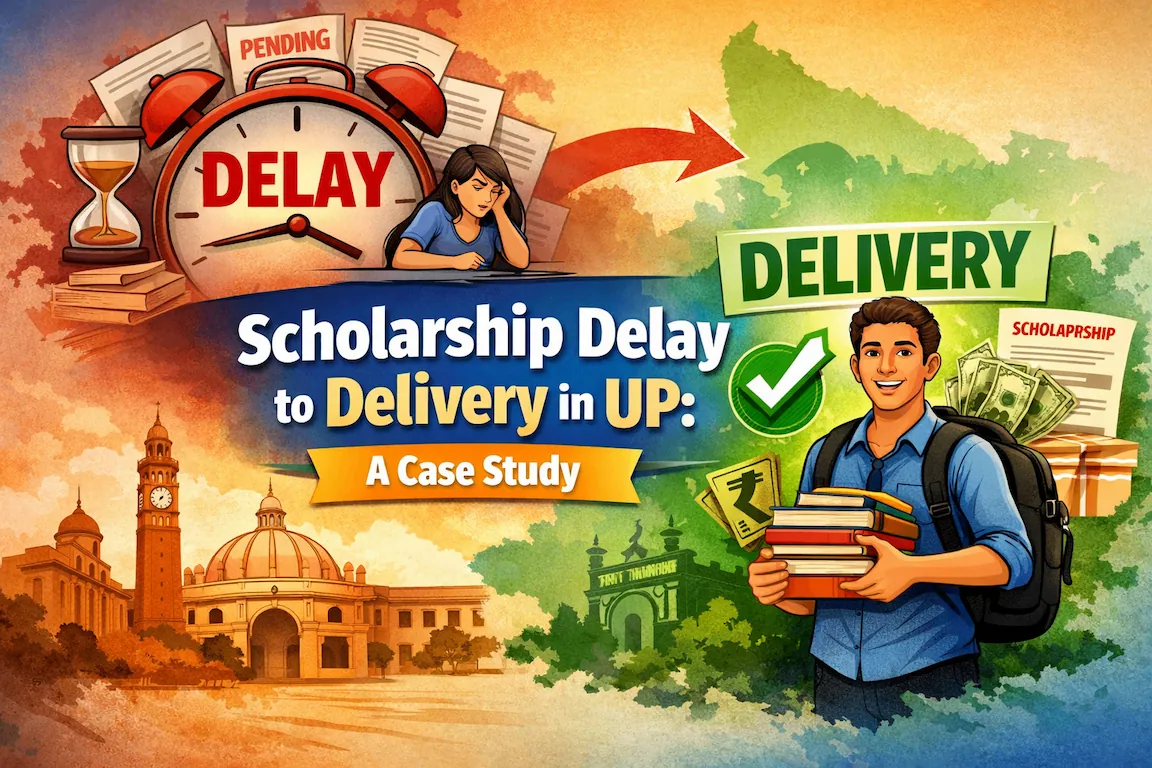
Scholarship Delay to Delivery in UP: A Citizen’s Experience with Post-Matric Scholarship Grievance Redressal in Uttar Pradesh
Introduction
Timely financial support is vital for students from low-income backgrounds. This blog shares a real case of Scholarship Delay to Delivery in UP and its resolution, highlighting broader lessons for governance and student welfare.
Key Takeaways
- The blog discusses a real case of scholarship delay in Uttar Pradesh, highlighting the complexities of the Post-Matric Scholarship grievance redressal system.
- Authorities stalled applications at various stages for months, demonstrating administrative stagnation that impacts students’ financial support.
- Delayed scholarships affect low-income students disproportionately, leading to financial stress and the potential for educational disruption.
- The applicant filed a formal grievance via the Jansunwai portal, which prompted the authorities to resolve the issue and deliver funds promptly.
- To address these delays, authorities must implement automated alerts, enforce strict timelines, and enhance transparency in the scholarship process.
Background: Understanding Scholarship Delay in UP
The grievance focused on the delayed processing of Post-Matric Scholarship applications for 2025–26. Managed by the UP Social Welfare Department through the Scholarship and Fee Reimbursement Online System (SAKSHAM), both students completed all formalities on time. Still, authorities left their applications at an intermediate stage for months—a textbook case of scholarship delay that turned into delivery failure in UP.
Key Details of the Case
- Applications were successfully submitted and verified at the institutional level.
- Attendance, academic results, and fee details were properly recorded.
- The institution forwarded the applications in December 2025.
Still, the process stalled after this stage: university scrutiny, data verification, account validation, and final approval—all key steps—remained pending, with no progress.
The Core Problem: Administrative Stagnation Behind Scholarship Delay in UP
The UP scholarship portal (scholarship.up.gov.in) kept applications at a specific workflow stage for months without progress, revealing a recurring problem in public administration across Uttar Pradesh. These procedural bottlenecks widen the gap in scholarship delivery and deprive eligible students of urgently needed financial support.
Where the Process Stalled
- Stage 4: Forwarded by Institution
- No progress in subsequent stages:
- University/Affiliating Body Scrutiny
- Data Verification
- Account Authentication
- Sanction Approval
- Payment Processing
Impact on Students
In UP, these scholarship delays are more than procedural inconveniences. Instead, they bring lasting consequences for students and families. The delay in scholarship delivery disproportionately affects SC, ST, OBC, General (EWS), and Minority category students, who rely on these funds to continue their education.
- Financial stress for students and families
- Such financial strain may force students to discontinue education, rely on loans, or seek external support, making grievance filing an essential step toward resolving scholarship delays in UP.
For many students in Uttar Pradesh, scholarships are not optional — they are essential. As a result, bridging the scholarship delay-to-delivery gap in UP is not an administrative nicety. Rather, it is a matter of educational equity.
Recognising the seriousness of the scholarship delay in UP, the applicant submitted a formal grievance to the concerned department via the official Jansunwai portal (jansunwai.up.nic.in) — one of the fastest official channels for resolving such complaints. The complaint clearly outlined the delay and provided full details of the application. Furthermore, it requested expedited processing to ensure the scholarship amount is delivered on time. imely delivery of the scholarship amount.
Key Aspects of the Complaint
- Clear identification of affected students
- Detailed explanation of the delay
- Emphasis on urgency due to the academic and financial impact
- Respectful request for intervention
This step demonstrates the importance of citizen participation. Proactive engagement often proves the most effective next step when the system stalls.
Administrative Response and Resolution: From Scholarship Delay to Delivery in UP
After months of inaction, the grievance prompted authorities to review the case and take corrective action.
Final Outcome
- Authorities marked the grievance as resolved.
- The authorities transferred ₹6605 directly to the student’s Aadhaar-linked bank account via Direct Benefit Transfer (DBT). This is the UP government’s primary disbursement mechanism. Importantly, it ensures that funds reach beneficiaries without any intermediaries.
- Authorities addressed the delay, demonstrating that escalating issues through proper channels can lead to resolution. However, ideally, the process should not require such escalation.
Lessons Learned: Strengths and Gaps in Governance
What Worked Well
- Grievance Redressal Mechanism
An official platform provided citizens with a structured way to formally raise and track the issue. - Final Accountability
Authorities responded to the grievance and made the payment without further delay. - Direct Benefit Transfer (DBT)
Aadhaar-linked bank accounts enabled the government to credit funds directly to beneficiaries, eliminating middlemen. - Timeliness of Processing
The most critical authority delayed the process by over three months — the most critical failure in this case. Such timelines directly defeat the purpose of financial aid. Workflow
Applicants could view application stages, but authorities did not clarify why those stages stalled or when they would move forward. - Proactive Monitoring
Relevant authorities must identify and resolve bottlenecks before citizens need to file. Authorities informed neither applicant of the reasons for the delay nor the expected resolution timeline. This silence added unnecessary anxiety to an already stressful situation.lay or the expected timelines.
Efficient governance means completing tasks on time. In Uttar Pradesh, lakhs of students rely on the UP Scholarship scheme every year. When authorities cause delays, they directly disrupt academic progress and create unnecessary financial stress. Therefore, closing the scholarship delay-to-delivery gap must be a governance priority, not an afterthought.
Timely action reflects:
- Administrative responsibility
- Respect for citizens’ needs
- Commitment to public welfare
When systems function efficiently and on time, they build lasting public trust.
For Authorities
- Implement an automated system that immediately alerts both applicants and authorities to stalled applications, enabling timely intervention.
- Set and enforce clear, strict timelines for each processing stage, with consequences for missing deadlines, to ensure accountability.
- Increase coordination by establishing regular meetings and information-sharing protocols among institutions, universities, and departments.
- Provide real-time, stage-wise status updates directly to applicants using email, SMS, or a dedicated portal, so they stay informed and empowered.
For Citizens
- Frequently check the application status online or through official channels to catch delays early and act promptly if issues arise.
- Maintain proper documentation
- File a grievance through official platforms, such as the Jansunwai portal, if progress stalls, ensuring the complaint includes clear details and supporting evidence.
- Contact authorities using clear language that states the issue, the desired outcome, and the urgency, while remaining polite and respectful throughout the communication.
Conclusion
This case powerfully reminds us that accountability mechanisms can drive resolution, even when the problem of scholarship delivery in UP runs deep. Authorities eventually disbursed ₹6605, which brought immediate relief to the student. More importantly, this result reaffirmed the value of raising one’s voice through proper channels—bridging the gap between a stalled application and a student’s continued education.
However, we should not settle for delayed correction. Instead, we must pursue timely delivery from the outset. To truly end the scholarship delay to delivery cycle in UP, the system must undergo structural reform, not just reactive grievance resolution. Above all, authorities must prevent problems before they arise. Transparency, accountability, and efficiency must work together to ensure every eligible student in Uttar Pradesh receives the scholarship they deserve—without unnecessary struggle.
A responsive administration does more than resolve grievances—it inspires lasting confidence in the entire system. Ultimately, authorities must make such responsiveness the rule rather than the exception. They must continually renew their commitment to effective governance.
Here are the structured contact and reference details of the concerned public authority based on your grievance:
📄 Application / Grievance Details (Scholarship Delay to Delivery in UP)
- Registration Number (Application ID): GOVUP/E/2026/0035742
- Date of Submission: 21/03/2026
- Department: Social Welfare Department, Government of Uttar Pradesh
👤 Concerned अधिकारी (Officer Details)
- Name: Shri Arvind Mohan
- Designation: Joint Secretary
- Office: Chief Minister Secretariat, Lucknow
📞 Contact Information
- Mobile / Contact Number: 0522-2226350
- Email Address: arvind.12574@gov.in (formatted from official record)
🌐 Official Web Portal
You can track or file grievances through the official portal:
- Uttar Pradesh Jansunwai Portal: https://jansunwai.up.nic.in
📍 Office Address (Scholarship Delay to Delivery in UP)
- Chief Minister Secretariat
- Room No. 321
- U.P. Secretariat, Lucknow, Uttar Pradesh
ℹ️ Notes (Scholarship Delay to Delivery in UP)
- Always use your Registration Number while communicating.
- Keep screenshots or acknowledgements for records.
- For follow-ups, prefer the portal for transparency and tracking.


Facing a similar challenge? Share the details in the box below, and our team of experts will do their best to help.