
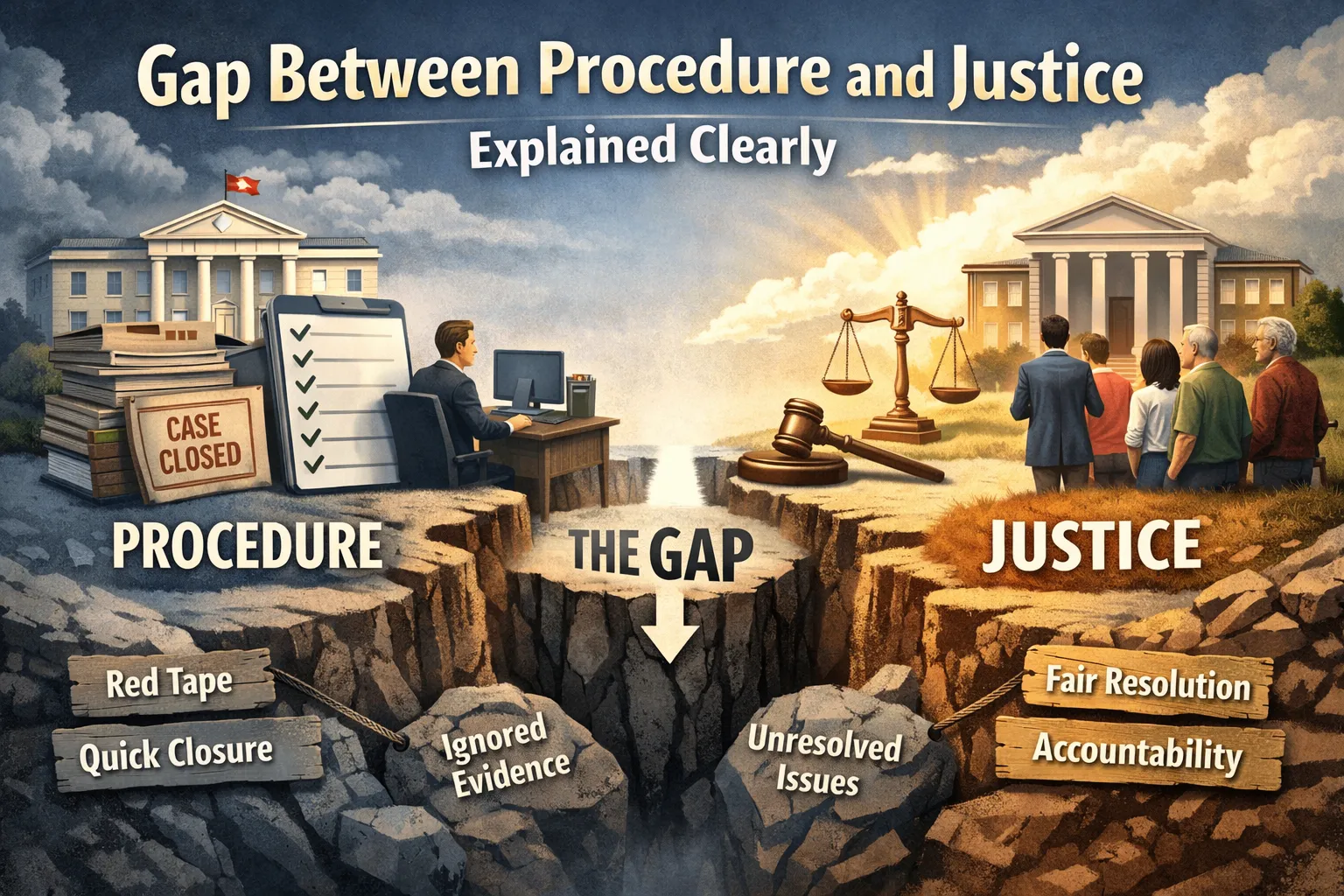
The Gap Between Procedure and Justice: When the System Responds but Doesn’t Resolve
The gap between procedure and justice often reveals the flaws in our legal system. While rules and regulations are essential for maintaining order, they can sometimes hinder the delivery of true justice. Addressing this disconnect is vital to ensuring legal proceedings.
Introduction: The Gap Between Procedure and Justice
In modern democracies, citizens expect institutions to act as problem-solvers—not just administrators. Filing a grievance or seeking redress should lead to resolution, yet many find the outcomes unsatisfactory. The system responds, but doesn’t resolve: the gap between procedure and justice. Too often, the issue is not inaction, but ineffective action.
This growing disconnect reflects a deeper structural problem and signals why the following sections matter. The gap between procedure and justice widens every time a case is closed without being truly resolved. In short, an unsupportive system prioritises process over people.
The Illusion of Responsiveness
Government departments are increasingly digitised. Platforms now allow citizens to lodge complaints, track progress, and receive updates. On paper, this looks efficient and citizen-friendly. In practice, however, lived experience tells a different story—one that exposes the gap between procedure and justice at every stage of the process.
Officials often mark complaints “disposed of” or “closed” quickly. This suggests efficiency, but it raises a critical question: did they truly resolve the issue, or simply process it?
Often, closure depends on receiving a response—not on whether it meaningfully addresses the grievance—creating an illusion of action without real results.
Procedural Compliance vs Substantive Justice
At the heart of the problem lies a fundamental imbalance. Government systems are designed to ensure procedural compliance—acknowledging complaints, forwarding them to relevant departments, and recording responses. However, these systems frequently fall short when it comes to ensuring substantive justice, which involves:
- Verifying the accuracy of responses
- Assessing whether the grievance has been genuinely resolved
- Holding parties accountable for inadequate or misleading replies
When procedural metrics—such as response time or closure rate—become the primary indicators of success, they dilute the actual purpose of grievance redressal.
Delegation Without Accountability. Another contributing factor is the hierarchical structure of governance. Higher-level offices routinely redirect complaints to lower-level offices for action. While decentralisation is necessary for administrative efficiency, (Gap Between Procedure and Justice)
- Repetitive handling of the same issue
- Lack of ownership at higher levels
- Minimal oversight on how grievances are resolved
Citizens often feel that officials are “passing around” their concerns rather than addressing them. Furthermore, the absence of accountability mechanisms at each level compounds the problem.
The Citizen’s Burden: Navigating a Complex System
For many individuals, engaging with government grievance systems becomes an exhausting process. Instead of receiving support, the system requires them to:
- Reiterate their complaints multiple times.
- Provide repeated documentation
- Interpret vague or generic responses.
This shifts the burden from the institution onto the citizen. Consequently, instead of receiving support, individuals must navigate complex procedures and advocate entirely for themselves. Over time, this breeds frustration, disengagement, and a gradual loss of trust in public institutions.ns.
When Replies Replace Resolutions
A common pattern in grievance handling is the reliance on standard or template responses. These replies often fail to address the citizen’s actual concerns. In some cases, they even contradict the evidence. Yet officials accept them as sufficient for closure. This is the gap between procedure and justice made visible: a reply exists, but resolution does not.
This practice highlights a critical flaw: the system values the existence of a reply far more than its quality or accuracy.
The Risk of Systemic Blind Spots
When officials treat individual grievances in isolation and close them without thorough evaluation, broader patterns go unnoticed. Indeed, the gap between procedure and justice is not only an individual experience—it is a systemic one. Issues affecting multiple citizens, such as unclear policies, misleading practices, or service deficiencies, remain unexamined at a structural level.
As a result, this creates blind spots in governance. Recurring problems persist simply because no one aggregates or analyses them.
Moreover, an effective grievance system should not only resolve individual cases but also identify trends and trigger policy-level interventions when necessary.
Rebuilding Trust. To close the gap between procedure and justice, a fundamental shift in approach is required. Specifically, government departments must move beyond procedural efficiency and commit to outcome-oriented governance. The following key steps can drive that change:vernance. Key steps include:
1. Prioritising Resolution Quality (Gap Between Procedure and Justice)
Ensure closure is based on confirmed grievance resolution by directly assessing if the citizen’s underlying concern has been addressed, not just if a response exists.
2. Strengthening Accountability
Require officials at all levels to review the substance and completeness of grievance handling. Establish clear mechanisms for independent review and escalation after unsatisfactory outcomes.
3. Enhancing Transparency
Inform citizens not only of actions taken but also of the specific reasons for decisions. Make decision rationales accessible for review and follow-up.
4. Recognising Systemic Issues (Gap Between Procedure and Justice)
Require departments to analyse repeated complaints on similar issues, investigate root causes, and initiate formal policy reviews when patterns are detected.
5. Supporting the Citizen Journey
Departments should streamline steps and provide detailed, step-by-step guidance so citizens can quickly understand and complete procedures.
Conclusion: From Formality to Fairness
An effective grievance system that bridges procedural and justice gaps is a core challenge. The procedural and justice gaps are a core challenge. When citizens feel heard and supported, trust grows; when processes seem mechanical, confidence fades.
The challenge before government departments is not merely administrative—it is ethical. Therefore, it demands a commitment to fairness, accountability, and genuine problem-solving.
Ultimately, moving from a culture of formality to one of fairness is essential. Only then can governance remain responsive, credible, and truly aligned with the needs of the people it serves.
📌 Key Public Authorities & Contact Details (Gap Between Procedure and Justice)
1. Department of Consumer Affairs (DoCAF)
- Application IDs (your cases):
- DOCAF/E/2026/0005045
- DOCAF/E/2026/0004833
- DOCAF/E/A/26/0001009
- DOCAF/C/A/26/0001405
- Ministry: Department of Consumer Affairs
- 📧 Email: consumer-affairs@nic.in (general helpdesk)
- ☎️ Phone: 1800-11-4000 (via NCH)
2. National Consumer Helpline (NCH)
- Docket Numbers:
- 9057729 (Google-related grievance)
- 8942160 (Amazon-related grievance)
- Organization: National Consumer Helpline
📱 Contact Options:
- ☎️ Helpline: 1915 / 1800-11-4000
- 📱 WhatsApp: 8800001915
- 📧 Email: nch-ca@gov.in
🔗 Track Complaint: (Gap Between Procedure and Justice)
3. Public Grievance Officer (Appeal Authority)
- 📧 Email: sonch-ca@gov.in
- ☎️ Phone: 011-23385723
👉 Handles:
- Appeals against NCH closures
- Escalated grievance review
4. Central Consumer Protection Authority (CCPA) (Gap Between Procedure and Justice)
- Regulator: Central Consumer Protection Authority
📧 Email:
📍 Role:
- Policy-level issues
- Unfair trade practices
- Dark patterns / systemic violations
5. Consumer Court (e-Daakhil Portal)
🔗 File Case Online:
📧 (varies by district/state)
- District Commission Mirzapur / nearby jurisdiction
🧾 How to Use This Information (Important) (Gap Between Procedure and Justice)
For your Google issue:
- Use Docket 9057729 → Reopen on NCH
- Escalate to CCPA (policy issue)
For your Amazon issue:
- Use Docket 8942160
- File consumer court case (strong evidence)


Facing a similar challenge? Share the details in the box below, and our team of experts will do their best to help.