
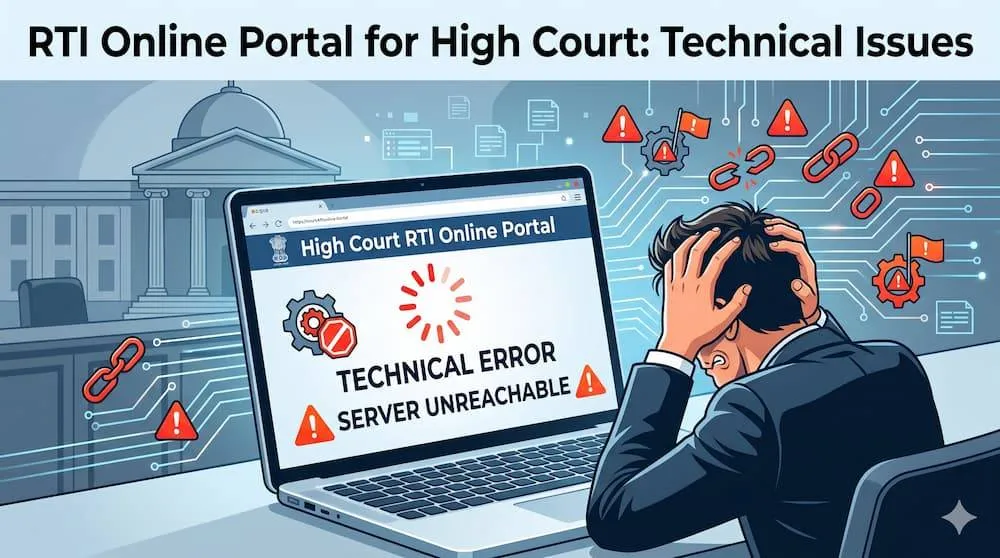
The RTI Online Portal for the High Court of Judicature at Allahabad (and its subordinate District Courts) has recently faced significant technical challenges. These issues particularly pertain to the final processing of applications after payment. Your case documentation reveals that these glitches create a “legal vacuum.” Citizens
The RTI Online Portal for the High Court of Judicature at Allahabad (and its subordinate District Courts) has recently faced significant technical challenges. These challenges particularly affect the final processing of applications after payment. Your case documentation shows that these glitches create a “legal vacuum.” Citizens pay fees but cannot access their submitted applications. This situation undermines public trust in the judicial system. It also raises concerns about the timely administration of justice, including the issuance of formal registration numbers.
Below is a structured analysis of the dysfunction, the legal implications of these portal errors, and the necessary workarounds.
Key Takeaways
- The RTI Online Portal for High Court of Judicature at Allahabad has faced technical failures, creating a ‘legal vacuum’ for applicants.
- Issues include payment processing gaps, missing notifications, and upload errors that disrupt application progress.
- The High Court has established protocols for addressing these system failures, but manual follow-ups are often required.
- Applicants must take steps, such as establishing a manual paper trail and appealing administrative decisions, to safeguard their rights.
- The ongoing dysfunction raises concerns about transparency and the timely administration of justice, highlighting the need for accountability.
1. Technical Failures: The “Payment-Registration” Gap
The most critical issue involves a disconnect between the payment gateway and the portal’s registration system. (RTI Online Portal for High Court)
- Payment Reconciliation Lag: The system often fails to generate a final RTI Registration Number. This occurs even after a successful transaction and the generation of a Transaction ID (e.g., DNMZPR20260000000015).
- Missing Notifications: Users report that the portal does not consistently send automated acknowledgement messages or one-time password (OTP) emails. Consequently, applicants lack proof of filing.
- Server-Side Upload Errors: During the “First Appeal” process, the portal frequently displays internal file paths as error messages. An example is ../courtpdfupload/2026/Appeal/57. This occurs instead of confirming the upload of supporting documents.
2. Administrative Impact: The “Pending Adjudication” Shield is a significant issue.
The CPIO’s use of restrictive rules to deny information often worsens the portal’s dysfunction.
- Misuse of Rule 26: CPIOs frequently cite Rule 26 of the Allahabad High Court’s RTI Rules to reject applications. They do this because the matter is “pending adjudication.”
- The Access Trap: By rejecting an RTI without identifying the specific court venue, the CPIO makes it impossible for the applicant to follow the alternative legal route. This route involves applying for certified copies under Rule 141 of the General Rules (Criminal).
- Administrative Anarchy: When the portal fails to track a request, the CPIO refuses to disclose its status. This situation facilitates the suppression of material evidence. For example, it leads to the exclusion of “Grievous Hurt” medical reports in criminal charge sheets.
3. High Court Intervention and Oversight (RTI Online Portal for High Court)
The High Court has established administrative protocols to handle these failures, though they often require manual follow-up.
- Section 6(3) Transfers: When the portal or local P.I.O.s fail to act, the Registrar (R.T.I.) at the High Court can intervene. They can transfer representations, such as Ref: R.T.I./812/2026/AHC, to the relevant District Court or S.P. office. This action is taken for “necessary action.”
- Mandatory Disposal: The High Court explicitly directs local authorities to “dispose of the instant matter” upon a transfer. This directive overrides general portal delays.
4. Necessary Workarounds for Applicants
When the Allahabad High Court RTI portal malfunctions, applicants must take specific steps to protect their legal rights:
A. Establish a Manual Paper Trail (RTI Online Portal for High Court)
- Email Acknowledgement: Immediately email the CPIO (dcmir@allahabadhighcourt.in) and the High Court RTI Section (rti.section@allahabadhighcourt.in). Attach screenshots of your successful transaction. Also, include the portal error.
- Representation to the Chief Justice: If the portal prevents a first appeal, send a formal representation to the Registrar General or the Chief Justice. This will help to highlight the miscarriage of justice.
B. Legal Arguments for Appeals
- Challenge the “Anarchy”: Argue that the CPIO’s failure to identify the court venue is an administrative failure, not a judicial one.
- Demand a Speaking Order: Use the first appeal to request that the appellate authority set aside blanket rejections caused by portal errors or presumptions of pendency.
C. Resource Directory (RTI Online Portal for High Court)
- Department Contact Methods: The High Court RTI Registrar can be reached at rti.section@allahabadhighcourt.in. The UP RTI Online Helpline is available at onlinertihelpline.up@gov.in. The District Court Mirzapur can be contacted at dcmir@allahabadhighcourt.in.
The ongoing dysfunction of the portal remains a significant barrier to transparency. It effectively allows local authorities to ignore High Court administrative instructions under the guise of technical errors.
Moreover, the intersection of digital medical evidence and bureaucratic hurdles often creates a “legal vacuum” for victims seeking justice. In the case of Mahima Maurya, a scientifically proven fracture was difficult to use as evidence in a criminal trial due to systemic issues, such as the lack of proper protocols for presenting digital medical evidence in court.
5. The Scientific Reality: “Grievous Hurt” vs. “Simple Hurt”
The foundation of this case rests on a clear medical fact that has been administratively obscured.
- The Injury: On September 14, 2024, a wound was recorded at the “thenar” (base of the thumb) by CHC Vindhyachal.
- The Evidence: A digital X-ray at Tej Bahadur Sapru Hospital on September 20, 2024, confirmed a “fracture at the base of the 1st metacarpal bone. (RTI Online Portal for High Court)
- The Legal Conflict: Under Indian law, a bone fracture is categorised as “grievous hurt”. However, the investigating officer filed a charge sheet under sections for “Simple Hurt” (Sections 115(2)/352 BNS), shielding the accused from more severe penalties.
6. Evidence of Systemic Collusion and Bias
The victim’s representation highlights what appears to be a coordinated effort to suppress this medical evidence across multiple agencies.
- Medical Board Inconsistencies: The Mirzapur Medical Board report (15/09/2025) allegedly claimed that the initial CHC report had “no mention of any kind of injury” to the thumb. This claim is contradicted by the original records.
- The “Inadmissibility” Trap: Police records admit to possessing the Sapru Hospital fracture report. They label it “inadmissible” because it was marked “not for medicolegal purposes.” This is despite the fact that the medical board validated the injury.
- Character Assassination: Administrative reports by the Circle Officer (City) labelled the scientifically proven fracture as “concocted” (मनगढ़ंत). They dismissed the victim as a “habitual applicant” to justify inaction.
7. The RTI Barrier: The “Pending Adjudication” Shield
When the victim sought confirmation via RTI that the fracture report was physically part of the judicial file, the request was rejected. (RTI Online Portal for High Court)
- RTI Rejection (DNMZP/R/2026/60007): The CPIO, Santosh Kumar Gautam (ADJ), rejected the request on March 26, 2026. He cited Rules 25 and 26 of the High Court RTI Rules.
- The Rule 26 Argument: The CPIO argued that the matter is “pending adjudication.” Therefore, information must be sought under Rule 141 of the General Rules (Criminals), 1977 (certified copies). This should be done instead of through the RTI Act.
- The Counter-Argument: The victim contends that a CPIO cannot deny an RTI application solely based on a case number without confirming that the court has formally taken cognisance. If a case is merely under investigation, it is not “pending adjudication.”.
8. Administrative Anarchy and the Duty of Disclosure
The refusal to provide even the administrative venue (the court’s name and room number) creates a procedural “black hole.”. (RTI Online Portal for High Court)
- Withholding the court’s identity prevents the victim from following the CPIO’s advice to apply for certified copies, leaving them unable to locate the file.
- Transparency Duty: Identifying the physical location of a file is an administrative fact held by a public authority. It is neither a “judicial record” nor “confidential evidence.”
- Suppression Admission: The police (in RTI SPMZR/R/2026/60079) already admitted that the fracture was excluded from the charge sheet. Ongoing RTI rejections facilitate this suppression of evidence.
9. High Court Oversight: The Path Forward (RTI Online Portal for High Court)
The Allahabad High Court recognised the gravity of these administrative irregularities and demanded accountability.
- Section 6(3) Transfer: On April 24, 2026, the Registrar (RTI) of the High Court transferred the victim’s representation to the District Court, CMO, and SP of Mirzapur.
- Mandatory Directive: The High Court explicitly directed these local authorities to “dispose of the immediate matter”.
- Contradiction of Orders: The victim’s first appeal argues that using “pending adjudication” to hide action taken on a direct High Court order violates the High Court’s administrative oversight.
10. Conclusion: The Prayer for Transparency
The ultimate goal of this legal battle is to ensure that scientific evidence, specifically a confirmed bone fracture, does not permanently “disappear” between police files and court archives. The victim’s prayer seeks the following:
- A speaking order from the First Appellate Authority.
- The administrative location of the file for NCR No. 104/2024.
- A clear “Action Taken Report” on the High Court’s transfer instruction.
Without these basic disclosures, the right to a fair trial remains secondary to administrative convenience. The ability to pierce the “pending adjudication” shield with scientific evidence and High Court authority now determines justice in Mirzapur. Such an outcome could lead to a more equitable resolution of cases stalled due to administrative delays.
incur fees but lack access to their submitted applications. This situation not only undermines public trust in the judicial system but also raises concerns about the timely administration of justice. formal registration numbers.
Below is a structured analysis of the dysfunction, the legal implications of these portal errors, and the necessary workarounds.
1. Technical Failures: The “Payment-Registration” Gap
The most critical issue involves the disconnect between the payment gateway and the portal’s registration system.
- Payment Reconciliation Lag: Even after a successful transaction and the generation of a Transaction ID (e.g., DNMZPR20260000000015), the system often fails to generate a final RTI Registration Number.
- Missing Notifications: Users report that the portal is not consistently sending automated acknowledgement messages or One-Time Passwords (OTPs) via email, leaving applicants without proof of filing.
- Server-Side Upload Errors: During the “First Appeal” process, the portal frequently displays internal file paths (such as ../courtpdfupload/2026/Appeal/57) as error messages instead of confirming the upload of supporting documents.
2.RTI Online Portal for High Court: The “Pending Adjudication” Shield affects the efficiency of the process.
The CPIO’s use of restrictive rules to deny information often exacerbates the portal’s dysfunction.
- Misuse of Rule 26: CPIOs frequently cite Rule 26 of the Allahabad High Court’s RTI Rules to reject applications because the matter is “pending adjudication.
- The Access Trap: By rejecting an RTI without identifying the specific court venue, the CPIO makes it impossible for the applicant to follow the alternative legal route—applying for certified copies under Rule 141 of the General Rules (Criminal).
- Administrative Anarchy: When the portal fails to track a request, and the CPIO refuses to disclose its status, it facilitates the suppression of material evidence, such as the exclusion of “Grievous Hurt” medical reports in criminal charge sheets.
3. High Court Intervention and Oversight
The High Court has established administrative protocols to handle these failures, though they often require manual follow-up. (RTI Online Portal for High Court)
- Section 6(3) Transfers: When the portal or local P.I.O.s fail to act, the Registrar (R.T.I.) at the High Court can transfer representations (such as Ref: R.T.I./812/2026/AHC) to the relevant District Court or S.P. office for “necessary action”.
- Mandatory Disposal: The High Court explicitly directs local authorities to “dispose of the instant matter” upon a transfer, overriding general portal delays.
4. Necessary Workarounds for Applicants
When the Allahabad High Court RTI portal is dysfunctional, applicants must take these steps to protect their legal rights:
A. Establish a Manual Paper Trail
- Email Acknowledgement: Immediately email the CPIO (dcmir@allahabadhighcourt.in) and the High Court RTI Section (rti.section@allahabadhighcourt.in) with screenshots of your successful transaction and the portal error.
- Representation to the Chief Justice: If the portal prevents a first appeal, a formal representation should be sent to the Registrar General or the Chief Justice to highlight the miscarriage of justice.
B. Legal Arguments for Appeals (RTI Online Portal for High Court)
- Challenge the “Anarchy”: Argue that the CPIO’s failure to identify the court venue is an administrative failure, not a judicial one.
- Demand a Speaking Order: Use the first appeal to demand that the appellate authority set aside blanket rejections caused by portal errors or presumption of pendency.
C. Resource Directory
Department: Contact Method: High Court RTI Registrar: rti.section@allahabadhighcourt. You can reach the UP RTI Online Helpline at onlinertihelpline.up@gov.in, and you can contact the District Court in Mirzapur at dcmir@allahabadhighcourt.in.
The ongoing dysfunction of the portal remains a significant barrier to transparency, effectively allowing local authorities to ignore High Court administrative instructions under the guise of technical error.
The intersection of digital medical evidence and bureaucratic hurdles often creates a “legal vacuum” for victims seeking justice. In Mahima Maurya’s case, a scientifically proven fracture existed, but the legal system complicated its use as evidence in a criminal trial.
The following analysis examines the core issues of medical suppression, the misuse of “pending adjudication” rules, and the High Court’s role in correcting administrative failures.
1. The Scientific Reality: “Grievous Hurt” vs. “Simple Hurt”
The foundation of this case rests on a clear medical fact obscured by administrative actions.
- The Injury: On September 14, 2024, CHC Vindhyachal recorded a wound at the “thenar” (base of the thumb).
- The Evidence: A subsequent digital X-ray at Tej Bahadur Sapru Hospital on September 20, 2024, confirmed a “fracture at the base of the 1st metacarpal bone.
- The Legal Conflict: Under Indian law, a bone fracture is categorised as “grievous hurt”. However, the investigating officer filed a charge sheet under sections for “Simple Hurt” (Sections 115(2)/352 BNS), effectively shielding the accused from more severe penalties.
2. Evidence of Systemic Collusion and Bias (RTI Online Portal for High Court)
The victim’s representation highlights what appears to be a coordinated effort to suppress this medical evidence across multiple agencies.
- Medical Board Inconsistencies: The Mirzapur Medical Board report (15/09/2025) allegedly claimed the initial CHC report had “no mention of any kind of injury” to the thumb—a claim contradicted by the original records.
- The “Inadmissibility” Trap: Police records reportedly acknowledge that they possess the Sapru Hospital fracture report but label it “inadmissible” because someone marked it “not for medicolegal purposes,” even though the medical board later validates the injury.
- Character Assassination: Administrative reports by the Circle Officer (City) have allegedly labelled the scientifically proven fracture as “concocted” (मनगढ़ंत) and dismissed the victim as a “habitual applicant” to justify inaction.
3. The RTI Barrier: The “Pending Adjudication” Shield
When the victim asked for confirmation through RTI that the fracture report was physically part of the judicial file, authorities rejected the request.
- RTI Rejection (DNMZP/R/2026/60007): The CPIO, Santosh Kumar Gautam (ADJ), rejected the request on March 26, 2026, citing Rules 25 and 26 of the High Court RTI Rules.
- The Rule 26 Argument: The CPIO argued that, since the matter is “pending adjudication,” one must seek information under Rule 141 of the General Rules (Criminals), 1977 (certified copies), rather than under the RTI Act.
- The Counter-Argument: The victim contends that a CPIO cannot deny an RTI application solely based on a case number without confirming that the court has formally taken cognisance. If a case is merely under investigation, it is not “pending adjudication.”.
4. Administrative Anarchy and the Duty of Disclosure
The refusal to provide even the administrative venue (the name and room number of the court) creates a procedural “black hole.”. (RTI Online Portal for High Court)
- Withholding the court’s identity prevents the victim from following the CPIO’s advice to apply for certified copies, leaving them unable to locate the file. +1
- Transparency Duty: Identifying the physical location of a file is an administrative fact held by a public authority and not a “judicial record” or “confidential evidence..
- Suppression Admission: The police (in RTI SPMZR/R/2026/60079) already admitted that the fracture was excluded from the charge sheet. Ongoing RTI rejections facilitate this suppression of evidence. +1
5. High Court Oversight: The Path Forward
The Allahabad High Court recognised the gravity of these administrative irregularities and demanded accountability.
- Section 6(3) Transfer: On April 24, 2026, the Registrar (RTI) of the High Court transferred the victim’s representation to the District Court, CMO, and SP of Mirzapur. +2
- Mandatory Directive: The High Court explicitly directed these local authorities to “dispose of the immediate matter”. +1
- Contradiction of Orders: The victim’s first appeal argues that using “pending adjudication” to hide action taken on a direct High Court order violates the High Court’s administrative oversight. +1
6. Conclusion: The Prayer for Transparency (RTI Online Portal for High Court)
The ultimate goal of this legal battle is to ensure that scientific evidence—a confirmed bone fracture—is not permanently “lost” between police files and court archives. The victim’s prayer seeks the following:
- A speaking order from the First Appellate Authority.
- The administrative location of the file for NCR No. 104/2024.
- A clear “Action Taken Report” on the high court’s transfer instruction.
Without these basic disclosures, the right to a fair trial remains a secondary concern to administrative convenience. Justice in Mirzapur now depends on whether the “pending adjudication” shield can be pierced by the light of scientific evidence and High Court authority, potentially leading to a more equitable resolution of cases stalled by administrative delays.


Facing a similar challenge? Share the details in the box below, and our team of experts will do their best to help.