
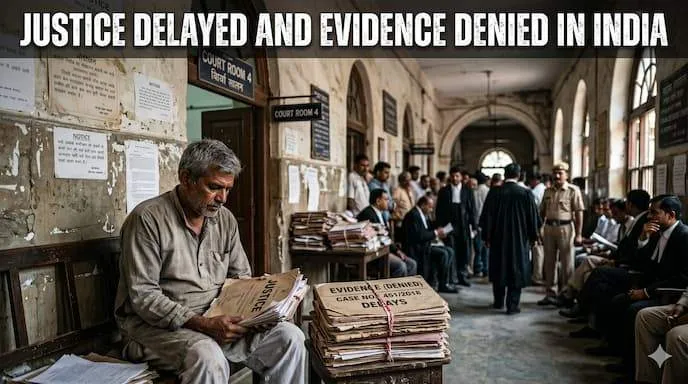
Justice delayed, and evidence denied, remains a persistent issue in India, where the legal system often struggles to keep pace with the growing complexity of cases. Many individuals find themselves entangled in protracted legal battles that can last for years, eroding trust in the judicial process. The strain on resources, coupled with a backlog of cases, hampers timely justice, leaving victims without resolution and perpetrators unpunished. Furthermore, the denial of crucial evidence can significantly skew trials, raising questions about fairness and integrity. As calls for reform intensify, it becomes imperative to examine and address the systemic challenges underlying this critical issue.
Key Takeaways
- Justice Delayed and Evidence Denied highlights the slow judicial process in India, where protracted legal battles erode trust.
- The case of Mahima Maurya illustrates administrative corruption and the suppression of crucial evidence in legal proceedings.
- Medical authorities and police allegedly colluded to downplay the severity of injuries, affecting the investigation.
- The Allahabad High Court intervened, emphasizing the need for transparency and accountability in handling the case.
- Mahima Maurya represents citizens demanding justice and highlights systemic issues that perpetuate delays and evidence denial.
Justice Delayed and Evidence Denied: The Case of Mahima Maurya vs Administrative Apathy
Justice in India often feels like a maze. Vulnerable people become trapped by bureaucratic technicalities and face the outright suppression of facts.For example, the case of Ms Mahima Maurya, a resident of Village Gorsar Sarpati in Mirzapur, clearly illustrates that “Justice Delayed and Evidence Denied” go hand in hand. In her case, administrative corruption and medical collusion sidelined scientific evidence. As a result, justice delayed is indeed justice denied.
At the heart of this matter lies a fundamental question: Why do we categorize a broken bone as a minor injury?
The Incident and the Scientific Disconnect
On September 14, 2024, an incident occurred leading to the registration of NCR No. 104/2024 at P.S. Vindhyachal. On the very same day, the Community Health Centre (CHC) Vindhyachal recorded a Contused Lacerated Wound (CLW) on the “thenar”—the muscular base of the thumb.
Six days later, doctors at the prestigious Tej Bahadur Sapru Hospital in Prayagraj conducted a digital X-ray. It provided undeniable scientific proof: a “Fracture at the base of the 1st metacarpal bone.” According to Indian criminal jurisprudence, a bone fracture falls under “Grievous Hurt.” Nevertheless, the Investigating Officer (IO) ignored this clinical reality. The Investigating Officer (IO) submitted Charge Sheet No. under sections 115(2) and 352 of the Bharatiya Nyaya Sanhita (BNS) instead of charging the accused under sections related to grievous injury. These sections pertain only to “Simple Hurt.”
The Anatomy of Collusion: Medical Board Irregularities
The most troubling aspect of Ms Maurya’s case is the alleged coordination between the police and the medical authorities to erase the severity of her injuries.
Representations sent the Hon’ble Chief Justice of the Allahabad High Court, stating that the Mirzapur Medical Board issued its report on September 15, 2025.
5. It stated that the initial CHC report contained “no mention of any kind of injury” to the thumb.
This differs from existing documentation in the CHC’s records from the day of the incident. (Justice Delayed and Evidence Denied)
The police have stated that they have the Sapru Hospital fracture report. However, they have considered it “inadmissible” because it is marked “Not for medicolegal purposes”. This use of a clerical disclaimer affects the legal classification of the injury.
Administrative Hostility and the “Habitual Applicant” Label
Rather than investigating claims of evidence suppression, the local police hierarchy appears to have adopted a defensive, hostile stance. The Officer (City) has gone as far as labelling a scientifically verified fracture as “concocted” (मनगढ़ंत).
In a classic move of “victim-blaming,” the authorities label Ms. Maurya as a “habitual applicant.” They often use this label to dismiss the persistent efforts of citizens like her, who refuse to let their cases be buried under piles of indifferent paperwork. This raises a critical concern: Does the state now consider seeking justice through legal channels a nuisance?
The High Court’s Intervention and the RTI Trail
Recognising the gravity of the matter, the High Court of Judicature at Allahabad took notice of Ms Maurya’s email representation dated April 14, 2026. On April 24, 2026, the Registrar (RTI) / Central Public Information Officer of the High Court issued a formal directive. This directive was sent to the local authorities in Mirzapur.
The High Court transferred the matter under Section 6(3) of the RTI Act, 2005—which allows the transfer of Right to Information applications to relevant authorities if the initial recipient does not have the information—to three key officials: The Public Information Officer, District Court, Mirzapur.
- The Chief Medical Officer (CMO), Mirzapur.
- The Superintendent of Police, Mirzapur.
The High Court instructed: “Kindly dispose the instant matter at your end.” The department must issue a clear, reasoned order regarding the suppression of evidence.nt Status: Seeking Transparency
As of early May 2026, Ms. Maurya has intensified her legal battle by filing formal RTI requests. She aims to track the “Processing Identity” of the staff handling her case. Ms. Maurya is seeking the names and designations of every clerk and officer who has “entertained” the High Court’s communication. This strategy is designed to prevent her file from disappearing into the “black hole” of administrative delay.
Her prayers to the Court remain focused on three pillars of transparency: (Justice Delayed and Evidence Denied)
- Disclosure: Obtaining the full Medical Board report and Charge Sheet.
- Accountability: An inquiry into the professional conduct of the CHC doctor and the Medical Board.
- Correction: Please request a supplementary charge sheet. This request is made under Section 173(8) of the Bharatiya Nagarik Suraksha Sanhita (BNSS). The supplementary charge sheet should include the fracture evidence.
Justice Delayed and Evidence Denied: The Road Ahead
Mahima Maurya’s case reveals not just a broken bone, but a broken system. In this system, justice delayed and evidence denied have become routine. Police call scientific evidence “concocted.” Medical Boards ignore their own records. Consequently, they undermine the rule of law and show how delays in justice and denial of evidence perpetuate injustice.
The Allahabad High Court is now watching the District Court, the CMO, and the SP of Mirzapur. Their 30-day RTI response deadline will show if these institutions value truth. It will also reveal whether they continue to shield those who manipulate the legal process. For Ms Maurya, the fight continues. She is not a “habitual applicant.” Instead, she is a citizen demanding the right to an honest investigation.
Based on the documents and the filing confirmations provided, here are the identification and contact details for the public authorities involved in your case:
1. High Court of Judicature at Allahabad (Justice Delayed and Evidence Denied)
- Central Public Information Officer: Registrar (RTI).
- Reference Number: R.T.I/812/2026/AHC.
- Official Address: High Court, Allahabad.
- Relevant Emails:
- Chief Justice: cj@allahabadhighcourt.in.
- Registrar General: rg@up.nic.in.
2. Superintendent of Police Office, Mirzapur (Justice Delayed and Evidence Denied)
- RTI Registration Number: SPMZR/R/2026/60209.
- Public Information Officer (PIO): Rajkumar Meena (ASP Operation).
- PIO Mobile Number: 9473567333.
- PIO Email: aspopmzp@gmail.com.
- Nodal Officer Email: addlspopmzr@gmail.com.
- Internal Case Reference: NCR No. 104/2024 (P.S. Vindhyachal).
3. Chief Medical Officer (CMO), Mirzapur (Justice Delayed and Evidence Denied)
- RTI Registration Number: DIRMH/R/2026/63852.
- Public Information Officer (PIO): CMO Mirzapur.
- PIO Phone Number: 9454455171.
- PIO Email: cmomzp@gmail.com.
- Nodal Officer (Medical & Health Directorate): 9451679475 / dgmhsrti@gmail.com.
4. District & Sessions Court, Mirzapur
- First Appellate Authority: District & Sessions Judge, Mirzapur.
- Official Email: dcmir@allahabadhighcourt.in.
- Subject Matter: RTI First Appeal No. 17 of 2026.
5. Web Links and Digital Access
- Uttar Pradesh RTI Online Portal: https://rtionline.up.gov.in/ (Used for filing and tracking your applications).
- Evidence Review Links (from Gmail data):
Summary Table for Quick Reference (Justice Delayed and Evidence Denied)
| Authority | Application ID / Ref | Primary Contact | |
| High Court | R.T.I/812/2026/AHC | Registrar (RTI) | rg@up.nic.in |
| Police (SP) | SPMZR/R/2026/60209 | Rajkumar Meena | aspopmzp@gmail.com |
| Medical (CMO) | DIRMH/R/2026/63852 | CMO Mirzapur | cmomzp@gmail.com |
| District Court | Appeal No. 17/2026 | District Judge | dcmir@allahabadhighcourt.in |


Facing a similar challenge? Share the details in the box below, and our team of experts will do their best to help.