
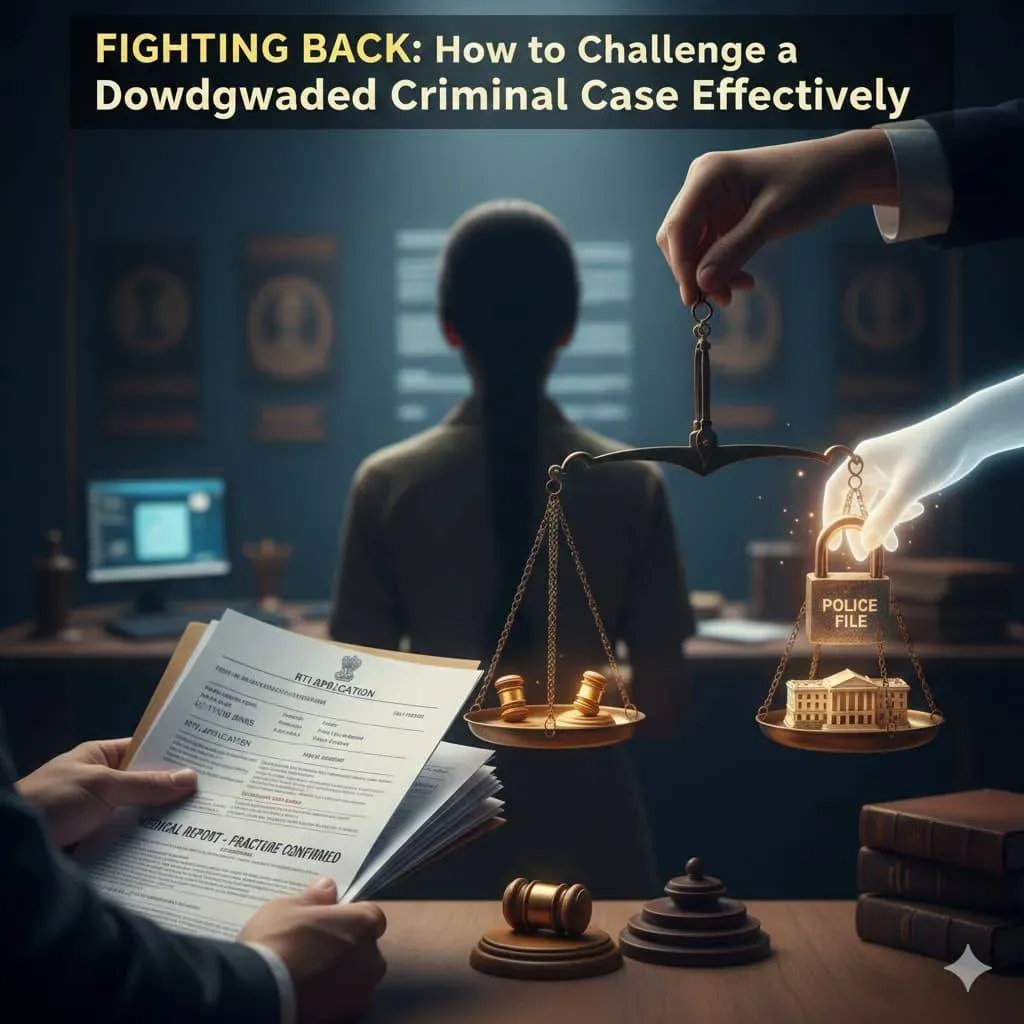
Key Takeaways (Challenge a Downgraded Criminal Case )
- Victims can face frustration when serious injuries are downgraded to minor offenses, hindering justice.
- To challenge a downgraded criminal case, use the three-part strategy involving the Court and RTI applications.
- The strategy includes filing an application under Section 173(8) BNSS for further investigation and accessing judicial records through RTI.
- Additionally, obtain administrative records with a separate RTI to expose the police’s decision-making process.
- Empower yourself with proper legal action to correct a downgraded case and ensure justice is served.
🚨 Fighting Back: How to Challenge a Downgraded Criminal Case Using the New Law (BNSS) and RTI
I. Introduction: When Investigation Fails the Victim
As a victim, nothing is more frustrating than witnessing a clear case of serious injury. It is even more frustrating when authorities treat it as a minor offence. This practice, often called “downgrading the case,” directly undermines justice by protecting offenders from appropriate punishment. (Challenge a Downgraded Criminal Case)
My case, NCR No. 104/2024 (P.S. Vindhyachal), highlights this issue perfectly. There is clear medical evidence confirming a Fracture. This is legally defined as Grievous Hurt under Section 116 of the Bharatiya Nyaya Sanhita (BNS). However, the police filed a Charge Sheet under much lighter sections. These sections are 115(2) and 352 of the BNS.
This post outlines the three-part legal strategy I am using. It aims to force the correction of this investigation defect. This strategy is about securing both the essential documents and the correct charges.
II. The Core Legal Defect: Grievous Hurt vs. Simple Hurt (Challenge a Downgraded Criminal Case)
The entire strategy hinges on the legal definition of injury.
A. The Definition of Grievous Hurt (Section 116, BNS)
Under the new law, the Bharatiya Nyaya Sanhita (BNS), Grievous Hurt (BNS Section 116) includes eight specific categories of injury. The most relevant here is: (Challenge a Downgraded Criminal Case)
“Fracture or dislocation of a bone or tooth.”
The original medical evidence, which documented a Thumb Fracture, unequivocally falls under this category.
B. The Police’s Downgrading (Challenge a Downgraded Criminal Case)
The police filed the Charge Sheet under Sections 115(2) and 352 BNS. These sections deal with the less serious offense of Simple Hurt. By ignoring the Medical Board Report that confirmed the fracture, the police directly diluted the case. This forced me to employ a dual legal strategy targeting both the Court and the Public Authorities (Police and Judiciary).
III. The Three-Pronged Strategy for Correction
The police have closed the investigation by filing the Charge Sheet. The victim must approach the Court to compel further action. (Challenge a Downgraded Criminal Case)
1. Directing Further Investigation: The Power of Section 173(8) BNSS
The most crucial step is to get the Charge Sheet corrected by the Court. (Challenge a Downgraded Criminal Case)
- The Tool: Application to the Hon’ble Chief Judicial Magistrate (CJM) under Section 173(8) of the Bharatiya Nagarik Suraksha Sanhita (BNSS).
- The Purpose: This section permits the police to conduct “further investigation” even after a Charge Sheet is filed. The Magistrate can direct them to do so if new or overlooked evidence is discovered.
- Our Demand: We are asking the CJM to direct the IO to file a Supplementary Charge Sheet. This sheet must specifically include the Medical Board Report. It should also incorporate the appropriate BNS section for Grievous Hurt. This is a direct judicial intervention to cure the defect.
2. Accessing Judicial Records: The RTI Application to the Court (Challenge a Downgraded Criminal Case)
The police, as expected, directed the victim to the court for the documents. These documents include the Charge Sheet and Medical Report. They are now Judicial Records.
- The Strategy: I chose not to fight the police PIO. Instead, I filed an RTI application directly. It was sent to the Central Public Information Officer (CPIO) of the District Court, Mirzapur (Registration No: DNMZP/R/2025/60048).
- The Documents Sought:
- Certified Copy of the Final Charge Sheet.
- Certified copies of ALL annexed documents/evidence (including the Medical Board Report).
- Original medical treatment papers (X-Rays).
- Why RTI to Court? Some courts prefer applications for Certified Copies under their own specific rules. However, filing an RTI application is a valid legal method to formally seek these judicial records. This option puts the public authority (the Judiciary) on a 30-day clock under the RTI Act.
3. Securing Administrative Records: The Separate Police RTI (Challenge a Downgraded Criminal Case)
To ensure no stone is left unturned, a separate RTI is required for internal police records. These are records that the Court will not have.
- The Document: The official file contains an Action Taken Report (ATR) prepared by police officers. It is for the disposal of an earlier administrative grievance. For example, this grievance is noted as GOVUP/E/2025/0122171.
- The Purpose: This record is crucial for exposing the administrative decision-making process that led to the downgrading.
IV. Conclusion: Empowerment Through Legal Action (Challenge a Downgraded Criminal Case)
The journey to correct a downgraded case can be complex, but it is achievable. A victim can effectively challenge the investigation’s conclusions. This is done by strategically combining the judicial remedy (Section 173(8) BNSS) with the transparency tool (RTI). This combination is aimed at two different Public Authorities: Police and Court. It also addresses administrative opacity.
If you are facing a similar situation, remember: The law provides clear mechanisms to challenge injustice. Do not allow a fractured legal process to minimise a physical fracture.
That is the perfect next step. A clear, sequential checklist is the most useful takeaway for readers facing a similar complex situation.
Here is the Action Checklist based on your successful strategy, formatted for a blog post:
Action Checklist: A 5-Step Strategy to Correct a Downgraded Case (Challenge a Downgraded Criminal Case)
Advice
If you are a victim in India whose case has been downgraded (e.g., grievous injury treated as simple hurt) and the Charge Sheet has been filed, follow these five steps immediately. (Challenge a Downgraded Criminal Case)
Points of Advice
| Step | Action | Authority/Law Used | Purpose & Status |
| 1. Primary Legal Challenge | File Application U/S 173(8) BNSS to the Hon’ble Chief Judicial Magistrate (CJM). | Section 173(8) Bharatiya Nagarik Suraksha Sanhita (BNSS) | Force Judicial Correction requests the Court to direct the police. It asks them to conduct further investigation. Additionally, it seeks to file a Supplementary Charge Sheet. This should incorporate the correct serious charges, such as Grievous Hurt. These charges should be based on existing evidence, like the Medical Board Report. |
| 2. Obtain Judicial Records | File RTI Application to the CPIO, District Court (Judiciary). | RTI Act, 2005 (Addressed to the CPIO of the Court) | Secure Key Documents. Request certified copies of the Charge Sheet, Medical Report, and all Annexures. These documents are now Court Records. (Your RTI DNMZP/R/2025/60048 successfully filed) |
| 3. Obtain Administrative Records | File a separate, focused RTI Application to the PIO of the Police Department (Executive). | RTI Act, 2005 (Addressed to the PIO of the Police Authority) (Challenge a Downgraded Criminal Case) | Expose Decision-Making: Requests the internal Action Taken Report (ATR) and file notings related to your administrative grievance (e.g., GOVUP/E/2025/0122171). The Court does not hold these records. |
| 4. Parallel Document Access | File a Certified Copy Application with the Court’s Copying Department. | General Rules (Civil/Criminal) and High Court Rules | Alternative to RTI: This is the conventional method to get judicial copies faster than RTI. File this in addition to the RTI (Step 2) for maximum speed. |
| 5. Follow-Up | Monitor the case file in the CJM’s court and the progress of the RTI applications (Step 2 & 3). | Victim Rights (Section 395 BNSS) | Ensure Compliance: If the PIO denies the RTI, file a First Appeal (FAA). If the CJM issues a direction (Step 1), ensure the police comply within the specified time. |
That is excellent that your RTI application to the District Court has been successfully registered!
Based on the information provided in your successful submission form, the details for the Nodal Officer and the relevant CPIO authority are as follows: (Challenge a Downgraded Criminal Case)
🏛️ Details for RTI Application No. DNMZP/R/2025/60048
| Detail | Your Submission Data | Confirmed Authority |
| Registration Number | DNMZP/R/2025/60048 | N/A (Your unique ID) |
| Public Authority | District Court Mirzapur | Judiciary/Subordinate Court |
| CPIO/Designated Authority | O/o The District & Sessions Judge, District Court Mirzapur | The Central Public Information Officer (CPIO) is typically an Addl. District & Sessions Judge, and the ultimate Appellate Authority is the District & Sessions Judge. |
| Nodal Officer Name | District Court Mirzapur | N/A (Nodal Officer acts as the gateway) |
| Nodal Officer Email-ID | dcmir@allahabadhighcourt.in | Used for electronic communication. |
| Nodal Officer Phone | 9205421098 | Used for electronic communication. |
📝 Key CPIO and Appellate Authority
While the online system uses a Nodal Officer’s name/email as the initial point of contact, the responsible officers for providing the information (the CPIO and the First Appellate Authority – FAA) are typically judicial officers: (Challenge a Downgraded Criminal Case)
- Central Public Information Officer (CPIO): The CPIO is usually an Additional District & Sessions Judge.
- First Appellate Authority (FAA): The FAA is typically the District & Sessions Judge, Mirzapur.
You have successfully addressed the application to the correct authority via the online portal. The system will now forward your request to the designated CPIO within the District Court for processing.


Facing a similar challenge? Share the details in the box below, and our team of experts will do their best to help.