
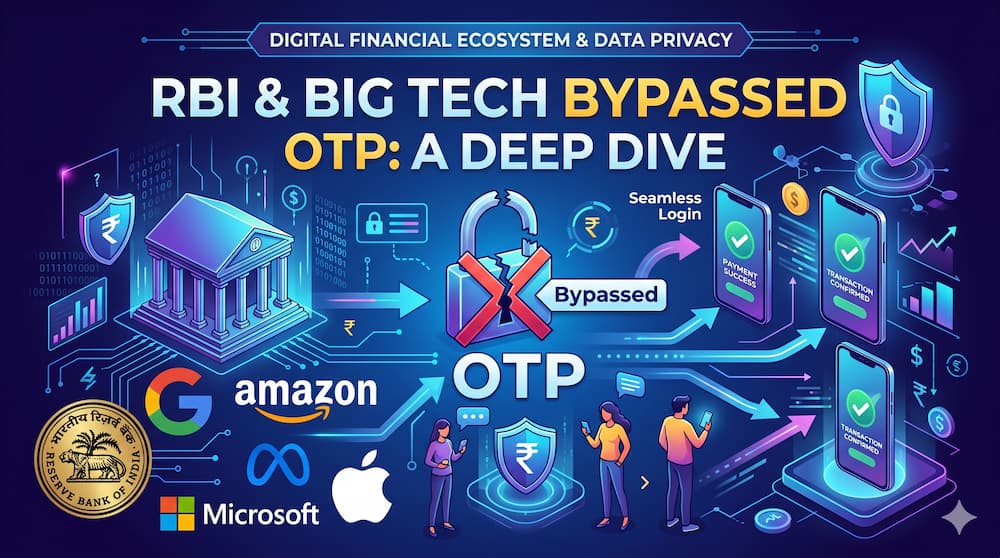
The Reserve Bank of India (RBI) has taken significant steps to enhance digital security in banking transactions. Recently, however, RBI & Big Tech Bypassed OTP through a new collaboration, finding a way to bypass One-Time Password (OTP) verification. This move aims to streamline user experiences. It also makes financial transactions faster and more efficient for consumers. Users have long relied on OTPs as a cornerstone of secure online banking. Yet this collaboration with big tech now leverages advanced authentication technologies instead. As a result, the shift raises real questions. How should regulators balance convenience and security for online banking users?
Most importantly, the system claims to protect transactions on one side of the screen. On the other side, though, it allows transactions that enable companies to donate to political parties and corrupt bureaucrats without an OTP check. Companies still charge for their services and set the prices of their goods. However, they can now do so through automated transactions instead of requiring direct account authorization. In some cases, companies do not even allow consumers to switch off subscriptions. When that happens, RBI staff say the matter falls outside their jurisdiction.
Key Takeaways
- RBI & Big Tech bypassed OTP to streamline digital banking, raising concerns over security and consumer consent.
- New regulations allow transactions without OTPs via contactless payments, pre-authorised mandates, and digital wallets.
- The elimination of OTPs can lead to increased fraud risks, as highlighted by a significant number of complaints regarding unauthorised transactions.
- Transparency issues arise as consumers struggle to access information about the decision-making processes behind OTP bypasses.
- The need for accountability is evident, with calls for greater scrutiny and protection for consumers against the vulnerabilities introduced by bypassing OTP.
The Illusion of Consent: How the RBI and Big Tech Bypassed Your OTP for “Convenience”
In the digital age, your bank account is protected by a thin digital wall: the One-Time Password (OTP). Moreover, cybersecurity experts refer to this as Multi-Factor Authentication (MFA). The system, fundamentally, rests on a simple premise: a transaction requires both something you know (your password) and something you have (your registered mobile phone). However, as policies have evolved, the RBI and Big Tech have, notably, discovered ways around this. Consequently, they now enable payments that entirely bypass traditional OTP requirements.
Still, a silent regulatory shift has taken place beneath this framework. The Reserve Bank of India (RBI) has systematically carved out pathways for millions of transactions. These transactions now occur completely without an OTP. Regulators pitch these pathways under banners like “frictionless payments” and “user convenience.” But a deeper look into the regulatory machinery reveals a troubling reality: authorities are trading consumer security to fuel corporate transaction volumes. In effect, the RBI and certain Big Tech actors introduced these paths together. Together, they created loopholes that let companies bypass OTP protection.
1. The Mechanics of “No-OTP” Transactions
The latest Reserve Bank of India (Authentication Mechanisms for Digital Payment Transactions) Directions, 2025, mandate two-factor authentication for most digital transactions. However, the regulator also permits specific exceptions; consequently, these exceptions allow automated technical factors to substitute for the dynamic OTP. Notably, as a result, RBI and Big Tech have therefore discovered several innovative ways to bypass the OTP step altogether.
These exemptions primarily fall into three categories:
- Contactless Card Payments (Tap-and-Pay): With just a simple tap of a physical credit or debit card at a retail terminal, consumers can conveniently skip the OTP or ATM PIN entirely. Obviously, this innovative approach applies to transactions up to ₹5,000. Here, notably, the physical proximity of the card chip serves as the sole authentication factor. In short, this exemplifies how RBI and Big Tech effectively bypass OTP mechanisms for low-value transactions.
- Pre-Authorised E-Mandates: Recurring automatic debits for utility bills, insurance premiums, and OTT subscriptions do not trigger an OTP at the time of the debit. Instead, a one-time OTP verification during initial setup establishes consent for every future debit.
- UPI Lite and Digital Wallets: Specifically designed for rapid micro-payments, these systems seamlessly utilize local “on-device” hardware binding. Consequently, this enables them to bypass PIN entry entirely for low-value daily vendor transactions.
2. Frictionless Profit vs. Consumer Vulnerability
Commercial pressure drives the push to remove the OTP layer. In fact, payment aggregators, credit card networks, and tech conglomerates view every extra security step as “transaction friction.” This notion includes waiting for an SMS, copying a code, or typing a PIN. Statistically, such friction leads to abandoned carts and incomplete checkouts. Consequently, by eliminating the OTP, corporations achieve lightning-fast payment processing. As a result, this directly translates into higher transaction volumes and maximised corporate revenue. In short, this collaboration between Big Tech and RBI ultimately serves one goal: reducing friction for profit.
That convenience, however, creates an immediate security trade-off. Authentication now shifts from active consumer consent, like manually entering an OTP, to passive background verification. As a result, the burden of vigilance shifts squarely onto the citizen. If someone loses a physical card, or a merchant runs an unauthorised recurring debit, the consumer must spot the theft only after the money has already left the account. Consequently, RBI and Big Tech’s move away from OTP introduces new vulnerabilities for bank users.
3. The Shadow of Fraud: What the Data Shows
Regulatory bodies often defend these “No-OTP” channels. They claim the financial risk stays low because of single-transaction monetary caps. Yet actual grievance data tells a radically different story. Indeed, further scrutiny reveals that RBI and Big Tech’s OTP bypass protocols have, in some cases, opened the door to fraud.
According to official figures the RBI’s Integrated Ombudsman disclosed, citizens formally registered a staggering 4,786 complaints within a single year. That period ran from April 1, 2025, to March 26, 2026. All of these fell under one specific subcategory: “Cardless transactions carried out without OTP/PIN.”
This high volume of disputes proves a simple point: people are actively exploiting “No-OTP” exemptions. As a result, thousands of everyday banking consumers vulnerable to automated gaps and systemic leaks now face real risk. Ultimately, this data shows the real-world impact of RBI and Big Tech’s decision to bypass OTP protection.
4. The Bureaucratic Wall: Transparency Denied
When citizens try to find out how these policies are formed, they run into a wall of bureaucratic evasion. In fact, a recent Right to Information (RTI) application filed against the RBI exposed a deliberate lack of transparency. Overall, RBI and Big Tech have frequently bypassed proper OTP systems. They have done so without providing enough transparency to the procedures behind them.
- Missing Deliberations: Citizens asked for the Minutes of Meetings of the Board for Regulation and Supervision of Payment and Settlement Systems (BPSS). These are the meetings where officials approved the “No-OTP” limit increases. In response, the RBI flatly claimed it “does not have any information in this regard.”
- Suppressed Risk Appraisals: Similarly, the regulator failed to provide copies of internal studies. These “Impact Assessment Reports” would map out the security risks account holders face when OTPs are bypassed.
- Broken Accessibility: To further complicate public access, official responses directed citizens to broken web links. Citizens could not use these links to access copies of the master guidelines.
A central banking authority, though, cannot legally alter national financial security frameworks — such as expanding contactless transaction limits — without real process. That process requires internal board debates, stakeholder representations, and risk analysis. By denying the existence of these records, the RBI shields its relationship with private financial lobbies from public scrutiny. In this way, the RBI and Big Tech bypassed OTP mandates with minimal public input.
5. The Path to Accountability
Corporate-bureaucratic convenience should never override absolute consumer sovereignty over personal funds. When regulatory bodies issue blanket denials regarding their policy-making processes, they violate the core spirit of institutional accountability. Therefore, it remains crucial to hold the RBI and Big Tech responsible. They must answer for bypassing OTP controls without adequate safeguards.
Thousands of unauthorised transaction complaints sit on record. Given that, disclosing internal risk files and board minutes becomes a matter of vital public interest. Consumers and transparency advocates must therefore keep using statutory legal frameworks, first appeals, and the Central Information Commission (CIC). Only that pressure can compel public institutions to disclose their records. Ultimately, true financial inclusion cannot exist without absolute financial security. And that includes closing the vulnerabilities that RBI and Big Tech’s OTP bypasses have opened.
Here is the structured directory of all the application IDs, official email addresses, mobile numbers, and web link details extracted from the documents related to your case.
🆔 Application & Appeal Tracking IDs (RBI & Big Tech Bypassed OTP)
- Original RTI Request Registration Number:
RBIND/R/E/26/02138 - Consolidated Nodal Department Sub-ID:
RBIND/R/E/26/02138/1 - Forwarded Sub-ID (CEPD):
RBIND/R/E/26/02138/2 - First Appeal Registration Number:
RBIND/A/E/26/01148
📧 Official Contact Directory (Reserve Bank of India) (RBI & Big Tech Bypassed OTP)
| Department / Role | Name of Official | Telephone Number | Official Email ID |
|---|---|---|---|
| Nodal RTI Officer (RBI) | Details not provided | 022-22642678 | cpiorbi@rbi.org.in |
| Nodal CPIO: Dept. of Payment and Settlement Systems (DPSS) | Smt. Mathala Gayatri | 022-22222557 | cpiodpss@rbi.org.in |
| CPIO: Department of Regulation (DOR) | Shri Manoj Mathur | 022-22705672 | cpiodor@rbi.org.in |
| CPIO: Consumer Education and Protection Dept. (CEPD) | Shri Gopala Jashwantha Raju | 022-22222559 | cpiocepd@rbi.org.in |
| First Appellate Authority (DPSS) | Shri Gunveer Singh (Chief General Manager-in-Charge) | (Use Nodal Phone) | Address appeals physically to DPSS Central Office, Mumbai |
📱 Applicant Contact Profile (As Recorded) (RBI & Big Tech Bypassed OTP)
- Name: Yogi M P Singh
- Mobile Number:
+91-7379105911 - Email ID:
yogimpsingh@gmail.com - Address: Surekapuram Colony, Shri Laxmi Narayan Baikunth Ma, Jabalpur Road, Mirzapur City, Uttar Pradesh – 231001
🌐 Web Links Mentioned in the Case (RBI & Big Tech Bypassed OTP)
1. The Official RBI Notification Portal Link
This is the base master directory link referenced by the CPIO regarding the “Authentication Mechanisms for Digital Payment Transactions Directions, 2025”:
- Official Base URL: https://rbi.org.in
- The CPIO’s Truncated / Broken Web Link:
https://rbi.org.in/scripts/FS_Notification.aspx?Id=12898&fn=9&Mode=0(Note: As noted in your appeal, this link was printed in a broken format in the response letter, obstructing direct access.)
2. RTI Filing & Tracking Portal (RBI & Big Tech Bypassed OTP)
To track the status of your live First Appeal (RBIND/A/E/26/01148), use the central government monitoring system:
- RTI Online Portal: https://rtionline.gov.in


Facing a similar challenge? Share the details in the box below, and our team of experts will do their best to help.