
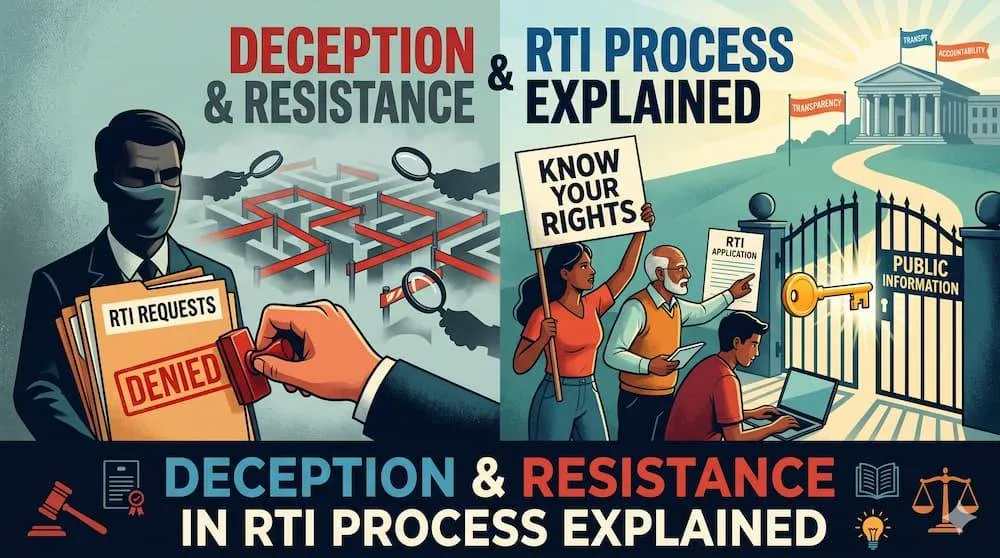
Deception & Resistance in RTI Process: The Battle for Accountability in Mahima Maurya vs. PIO, SP Office Mirzapur
Deception & Resistance in RTI Process Explained: The Right to Information (RTI) process is essential for promoting transparency and accountability in governance. However, it often encounters significant challenges due to deception and resistance from various stakeholders. Deception can manifest in the form of misleading information, obfuscation of facts, and even outright refusal to provide information. Resistance may arise from bureaucratic inertia, fear of exposure, or potential repercussions for those involved. To combat these issues, it is crucial for citizens to remain vigilant, well-informed, and empowered to utilize RTI effectively, ensuring that their right to access information is upheld and protected.
A case study on how public authorities can obstruct transparency—and how appellants can respond within the RTI framework.
The Right to Information (RTI) Act, 2005 promises transparency. It aims to bridge the gap between the governed and the governors. However, many applicants face Deception & Resistance in RTI Process through delays, omissions, and conflicting official narratives. In this context, the case of Mahima Maurya vs. PIO, Office of the Superintendent of Police, Mirzapur is instructive. The matter is under appeal before the Uttar Pradesh Information Commission (Appeal No: S02/A/1784/2025). It shows how officials can obstruct truthful disclosure. It also shows why applicants often must persist to seek accountability.
1. Contradictory Injury Narratives: “Too Injured” to Sign, “Not Injured” for Verification
In this case, the police used contradictory logic about the victim’s physical condition. First, they filed the Non-Cognizable Report (NCR) without the victim’s signature. Instead, they took the signature of her husband, Pramod Kumar Kushwaha. They said Mahima Maurya was “injured/hurt” (मजरूब चोटिल थी) and could not give a statement or sign.(Deception & Resistance in RTI Process)
However, when the applicant asked for an X-ray to confirm a suspected fracture, the Public Information Officer (PIO) refused. In the RTI reply, the PIO said the injuries were not serious enough to require diagnostic testing. As a result, the record creates a paradox. The victim appears “too injured” to participate in the process. Yet the same record treats her as “not injured enough” to justify medical verification.
2. Omission of Court and Commission Interventions: Sanitizing the Record
The RTI Act requires public authorities to explain their administrative decisions. Here, the PIO claimed that the police did not conduct any follow-up medical verification. The PIO also said the initial health centre did not “recommend” it.
Yet the RTI reply omitted a key point. The authorities eventually conducted a re-medical examination. They did so only after the Chief Judicial Magistrate (CJM) Court ordered it, and the Women’s Commission intervened. By leaving out these facts, the PIO presented a sanitised version of events. Consequently, the reply suggested routine compliance. In reality, the record indicates resistance to a court-mandated investigation.
3. The “Non‑Medico‑Legal” Shield: Discrediting Independent Evidence
The police repeatedly tried to discredit outside evidence. The applicant submitted medical records from a government hospital in Prayagraj. Those records confirmed her injuries. Nevertheless, the police labelled the documents as “non-medico-legal purposes.” (Deception & Resistance in RTI Process)
Moreover, the authorities did not arrange a police-ordered medical test early in the inquiry. That decision created a predictable outcome. The victim then had to obtain evidence on her own. Later, officials could dismiss that evidence as procedurally invalid. Therefore, the tactic traps the victim in a cycle. Only the evidence the police choose to collect becomes “valid.” In this case, they kept that collection intentionally limited.
4. Alleged Coercion and Missing Records: Why GD Entries Matter
The appellant also challenged the “written complaint” used to register the case. She alleged that police obtained her husband’s signature under illegal detention and duress. She also stated that the victim remained in police presence at the time. (Deception & Resistance in RTI Process)
In addition, the appellant asked for the General Diary (GD) entries. These entries can show who visited the station, when they came, and under what circumstances. Even so, the PIO did not provide them. This suppression raises a serious red flag in RTI disputes. Often, GD entries provide the only way to verify whether a “voluntary” statement was actually obtained through coercion.
5. Branding the Appellant a “Habitual Complainant”: Penalizing Persistence
The police also adopted a damaging line of defence. They described the applicant as “accustomed to giving applications again and again.” They treated the volume of her representations—nearly two dozen—as proof of “false allegations.”
In effect, this narrative flips the script. Instead of acknowledging police inaction, the authorities framed the 24 representations as a nuisance. However, later developments weaken that defence. A subsequent investigation, initiated by the Court, reportedly found the victim’s allegations TRUE. Therefore, the record supports a different conclusion. The victim did not behave like a “habitual” complainant. She acted like a persistent truth-seeker confronting an uncooperative system.
Conclusion: Section 20 Sanctions to Deter Deception & Resistance in RTI Process
This case, now before the Uttar Pradesh Information Commission (Diary No: D-290420260010), involves more than a dispute over a medical report. It tests whether the RTI Act can restrain a powerful public authority when applicants allege Deception & Resistance in RTI Process. In particular, it raises concern when officials minimise, omit, or reframe material facts. These facts include court-ordered actions and follow-up examinations.
For these reasons, the appellant seeks the maximum penalty under Section 20(1) of the RTI Act. When a PIO labels substantiated allegations as “false,” the PIO weakens the Act. When the same reply omits court-ordered context to justify procedural lapses, it does more damage. Therefore, the Commission should focus on the essentials as the matter proceeds in Hearing Room S-2. These include accurate medical diagnosis, protection from coercion, and preservation of primary records, including GD entries. Above all, RTI replies must remain honest and complete.
Based on the provided documents and the latest updates from the State Information Commission, here are the identification, contact, and web details for the concerned public authorities:
Case & Application Identifiers (Deception & Resistance in RTI Process)
- Second Appeal File Number: S02/A/1784/2025 [cite: 6—]
- Commission Diary Number: D-290420260010 (Recorded on 29/04/2026)
- Commission Registration Number: A-20251000764
- Original RTI Registration Number: SPMZR/R/2025/60128
- Previous RTI Reference Number: SPMZR/R/2024/60221
- Police Correspondence Number: ज) सू)ऑनलाइन-120/2026/SPMZR/R/2025/60128
- Investigation Report Reference: 60000240216787 and 60000240226069
Official Email Addresses (Deception & Resistance in RTI Process)
- Information Commission (Hearing Room S-2):
hearingcourts2.upic@up.gov.in - Mirzapur Police RTI Cell:
jansuchanacellmzr@gmail.com - Superintendent of Police (SP) Mirzapur:
spmzp-up@nic.inorspmzr-up@nic.in - Applicant’s Registered Email:
mahimamauryagonasar@gmail.com
Mobile & Contact Numbers (Deception & Resistance in RTI Process)
- Applicant’s Mobile Number: +91-9198010433
- UP State Information Commission (General Inquiry): 0522-2724930
Web Links & Digital Access (Deception & Resistance in RTI Process)
- Uttar Pradesh Information Commission (UPIC) Portal: http://upsic.up.gov.in
- UP RTI Online Portal: https://rtionline.up.gov.in
- Case Status Link (General): https://upsic.gov.in/citizen_appeals_status
- Direct Access to Appeal Details: The documents indicate that the appeal is managed through the “All Second Appeal Application List” on the UPIC portal under Hearing Room S-2. [cite: 6—]
Concerned Authority Details (Deception & Resistance in RTI Process)
- Public Information Officer (PIO): Om Prakash Singh, Office of the Superintendent of Police, Mirzapur, Pin Code: 231001.
- Concerned Police Station: Thana Vindhyachal, Janpad Mirzapur.
- Commission Hearing Location: RTI Bhavan, Vibhuti Khand, Gomti Nagar, Lucknow.


Facing a similar challenge? Share the details in the box below, and our team of experts will do their best to help.