
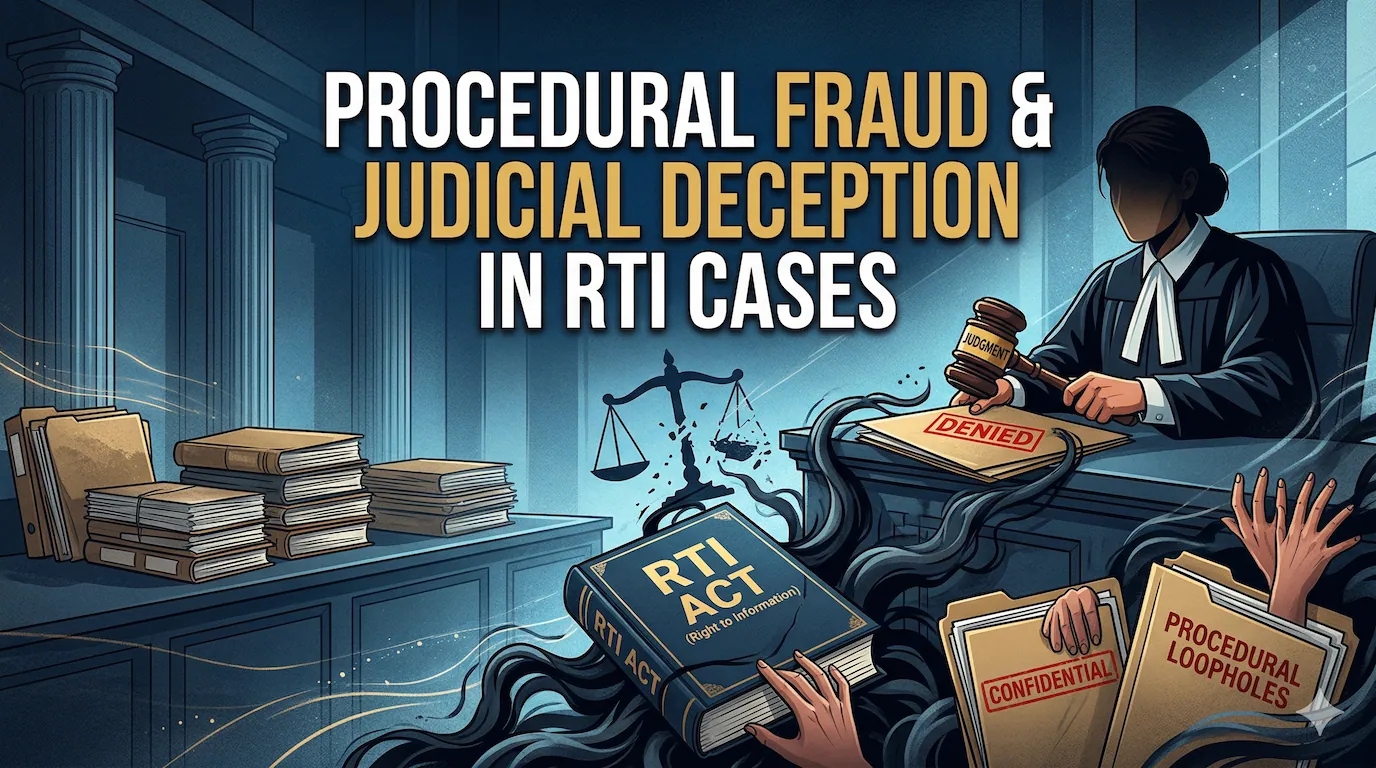
Key Takeaways (Procedural Fraud & Judicial Deception)
- The RTI Act of 2005 aimed to empower citizens but is now challenged by a case in Mirzapur involving procedural fraud & judicial deception.
- Sadhana Tiwari claims officials manipulated her inheritance rights through forgery, blocking her from justice.
- Officials used tactics like procedural fraud and jurisdictional redirection to mislead the Information Commission.
- The Appellant demands criminal prosecution, highlighting systemic misconduct in handling her case and RTI requests.
- The upcoming hearing questions the integrity of the RTI Act and the accountability of public authorities in the face of corruption.
Procedural Fraud & Judicial Deception: The RTI Smokescreen Exposed
Parliament enacted the Right to Information (RTI) Act of 2005 to empower citizens and hold public authorities accountable. Yet a developing case in Mirzapur, Uttar Pradesh, now challenges that vision directly. Sadhana Tiwari (the Appellant) and the Tehsil Lalganj Revenue Department stand at the centre of a sophisticated pattern of procedural fraud and judicial deception. At its core, the dispute traces back to an inheritance claim from 2006, which the Appellant alleges officials manipulated through forgery and corruption. As the matter now comes before the Uttar Pradesh Information Commission, the battle has moved well beyond simple data retrieval. Today, it exposes a deliberate smokescreen of procedural fraud and judicial deception that bureaucrats constructed to block the path of justice.
Background: A Legacy of Exclusion and Procedural Fraud
The conflict began when Shambhu Sharan died in 2005 and left behind an inheritance dispute. At that time, Sadhana Tiwari was a minor and held the status of a Class-I heir through her deceased father, Shiyakant. Nevertheless, revenue officials recorded the property exclusively in the names of her surviving uncles and her grandmother, entirely bypassing her legal claim.
For years, the Appellant has demanded an inquiry into how the then-Lekhpal, Revenue Inspector, and Tehsildar engineered her exclusion. What started as a grievance on the public portal has since escalated into a high-stakes legal battle. Today, it spans the Information Commission, the Human Rights Commission, and the Revenue Courts.
Judicial Deception in Action: The “Concocted Narrative” of February 3rd
On February 3, 2026, the Tehsildar of Lalganj submitted a formal report (Letter No. 2310) to the Information Commission. However, the Appellant firmly contends that this document does not address her RTI demands at all. Instead, she argues, the Tehsildar crafted a “concocted narrative” specifically to mislead the quasi-judicial body.
Tactic 1 — Procedural Fraud: The “Deceased Officials” Defence
The PIO deployed a central tactic: the report listed the deaths of the 2006 officials — Lekhpal Shiv Prasad Yadav, RI Surendra Agrahari, and Tehsildar Santosh Dubey — in elaborate detail.
- The Diversion: Crucially, the Appellant argues she never once requested the mortality status of past staff.
- The Legal Reality: Furthermore, under the RTI Act, information belongs to the Public Authority — not to individual employees. Therefore, the death of a staff member does not extinguish the government’s duty to produce records currently in its custody.
Tactic 2 — Judicial Deception: Jurisdictional Redirection. The Appellant asked which legal provisions allow revenue officials to adjudicate grievances that demand a criminal First Information Report (FIR). In response, the PIO cited Sections 33(1) and 34 of the U.P. Revenue Code, 2006. 2006.
- The Fraud: Those provisions, however, are civil codes governing land mutation — nothing more.
- The Ulterior Motive: By citing civil laws to answer criminal procedure queries, the PIO attempted to legitimise a lack of jurisdiction and shield the department from a corruption inquiry.
Procedural Fraud in the Courts: The Mystery of Case No. 2498/2025
Among the most alarming revelations in this dispute is Case No. 2498/2025 (Sadhana Tiwari vs Ramdeiya), which was heard by the Naib Tehsildar, Haliya.
- Unsanctioned Litigation: In a blatant act of procedural fraud, the Appellant states clearly that she never initiated this case. Moreover, she has no knowledge of who filed it in her name.
- Procedural Obstruction: Initially, the department invited her to carry out inheritance procedures. Then, without warning, officials denied her the opportunity. After a full year of deliberate delays, they pointed to this “ghost” case and instructed her to pursue it instead.
- The Strategic Goal: This appears to be a move to label the matter as sub-judice, creating an aRTIficial legal barrier against the disclosure of records through RTI.
Judicial Deception Through Violations of Natural Justice
The Appellant has consistently challenged the practice of “Self-Investigation.” Specifically, the department forwarded her grievances against Tehsil Lalganj officials to those very same accused officials for investigation.
- Nemo Judex In Causa Sua: This practice directly violates the fundamental legal principle that “no one should be a judge in their own cause.
- Concealment of Identity: The PIO refuses to provide the name and designation of the official who forwarded the complaint to the accused. The PIO claims the information is “not accessible.” Yet no exemption clause under Section 8 of the RTI Act supports this denial.
Procedural Fraud & Judicial Deception: Denying the “Right to Reason” Under Section 4(1)(d)
A cornerstone of this appeal is the Right to Reason. Under Section 4(1)(d) of the RTI Act, public authorities must provide the reasoning behind their administrative or quasi-judicial decisions to all affected persons.
- The PIO’s Denial: The PIO formally stated that this information is “not payable” because it requires the “creation of information.
- The Counter-Argument: The Appellant firmly rejects this position. She asserts that the reasoning behind excluding a Class-I heir from state-sanctioned inheritance already exists in the Case Diary and Order Sheets. Consequently, the authority must disclose it.
Consequences of Procedural Fraud & Judicial Deception: The Demand for Criminal Prosecution
Given the systematic nature of these evasions, the Appellant no longer merely seeks data. Instead, she now demands criminal prosecution.
- Fabrication of Records: The Appellant argues that the PIO submitted a “bogus” report to a Court of Record (the Commission). She contends this act constitutes an offence under Sections 227 to 230 of the BNS (formerly IPC 192, 193).
- Digital Fraud: Additionally, officials marked RTI applications as “Disposed” on the digital portal while providing non-compliant responses. This deliberate act constitutes direct manipulation of state systems.
- Recommended Action: Accordingly, the Appellant urges the Commission to take two immediate steps. First, impound the record dated February 3rd. Second, recommend registration of an FIR against the PIO and the concerned clerical staff for criminal conspiracy and for misleading a public servant.
Conclusion: A Test of Justice Against Procedural Fraud & Judicial Deception
The hearing on April 9, 2026 now places the Uttar Pradesh Information Commission before a critical test. The question is no longer simply about land records from 2006. Rather, it asks whether a Public Information Officer can successfully deploy procedural fraud and judicial deception to shield a corrupt bureaucracy. If the Commission accepts the PIO’s “concocted story” about deceased officials as a valid response, it risks sending a clear signal: the RTI Act’s protections are hollow. Ultimately, the Appellant’s fight demands that the Commission exercise its full quasi-judicial power. Only then can the rule of law prevail and ensure that transparency is not buried beneath a calculated strategy of procedural fraud and judicial deception.
Based on the provided documents, here are the application identifiers, contact details, and web links related to the concerned public authorities and the ongoing proceedings:
Application & Case Identifiers
- RTI Registration Number: A-20250200996.
- UPIC File Number: S09/A/0456/2025.
- UPIC Diary Number (Latest): D-090420260014.
- Revenue Court Case Number (RCCMS): 1202516530202498 (Local No. 2498/2025).
- PIO Notice Number: 202512S09N300388.
- Tehsil Dispatch Number: 2310/RC/Jan-Suchna-Ayog/2025.
Public Authority Contact Details (Procedural Fraud & Judicial Deception)
- Hearing Court S-9 (Shakuntala Gautam): hearingcourts9.upic@up.gov.in.
- Tehsildar Lalganj (Tarun Pratap Singh): teh-lalganj.mi@up.gov.in.
- Sub-Divisional Magistrate (SDM) Lalganj: sdm-Lalganj.mi@up.gov.in.
- District Magistrate (DM) Mirzapur: dm-mir@nic.in.
- Appellant (Sadhana Tiwari): sadhanamishramzp@gmail.com | Mobile: 6387233091.
Official Web Links (Procedural Fraud & Judicial Deception)
- UP Information Commission Portal: https://upsic.up.gov.in/.
- Revenue Court Management System (RCCMS): https://vaad.up.nic.in/ (implied for Case No. 1202516530202498).
- India Post Tracking: https://www.indiapost.gov.in/track-result/article-tracking/….
- UP Public Grievance Portal: IGRS portal (referenced in Point 1 of RTI).


Facing a similar challenge? Share the details in the box below, and our team of experts will do their best to help.