
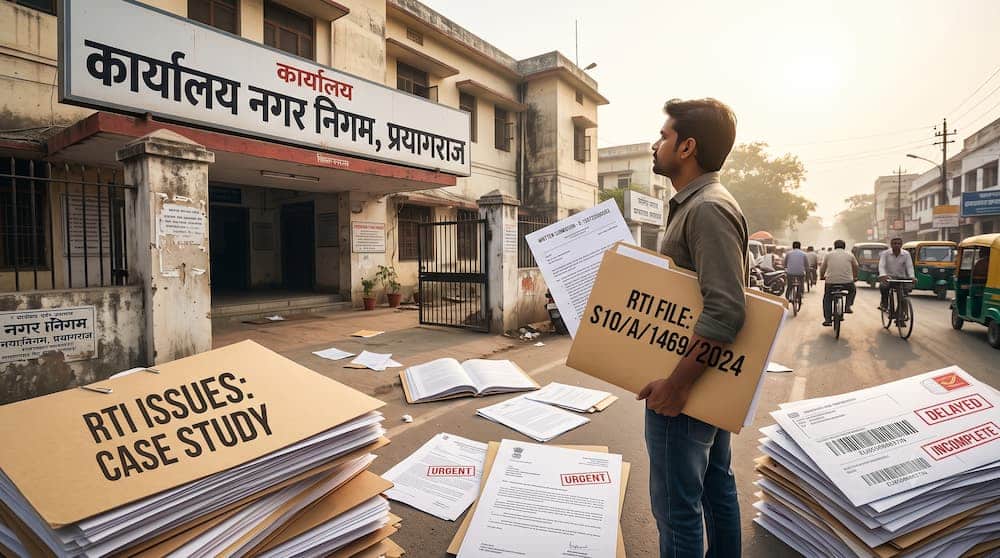
The Case Study of Nagar Nigam Prayagraj outlines the proceedings of the second appeal presented at the State Information Commission. It highlights the persistent issues surrounding the Public Information Officer (PIO), who appears to be continuously overlooking the repeated notices issued by the State Commission. This situation raises critical questions about accountability and transparency within the local government framework. The PIO’s apparent disregard for these communications not only undermines the principles of the Right to Information Act but also reflects a broader challenge in the governance structure. The case serves as a reminder of the importance of compliance with information requests and the need for effective enforcement mechanisms to ensure that citizens’ rights to access information are upheld, fostering a culture of openness and responsiveness in public administration.
Key Takeaways
- The Case Study of Nagar Nigam Prayagraj highlights the ongoing issues with the Public Information Officer’s negligence towards compliance with the RTI Act.
- The appellant requested information about an employee’s appointment, but the PIO withheld crucial details, leading to a prolonged appeal process.
- Differing tactics included concealing posting details and misidentifying verifying authorities, which obscured accountability.
- The case illustrates broader problems of administrative evasion within public departments, undermining transparency and citizens’ rights.
- The State Information Commission must enforce penalties to ensure adherence to the RTI Act and promote better governance practices.
RTI and Administrative Inertia: A Case Study of Nagar Nigam Prayagraj
The Right to Information (RTI) Act, 2005, is undoubtedly a powerful tool for Indian citizens. Indeed, it helps everyday people enforce transparency and administrative accountability across all levels of government. However, the actual process of using this statutory right is often deeply frustrating. Consequently, citizens must frequently navigate bureaucratic delays, evasive replies, and outright administrative stonewalling.
An ongoing dispute before the Uttar Pradesh Information Commission perfectly illustrates this struggle. In fact, it serves as an ideal Case Study of Nagar Nigam Prayagraj. This particular case involves Appeal Registration Number A-20241001256 and File Number S10/A/1469/2024. Specifically, the unfolding details reveal how public authorities deploy clever tactics to shield internal operations. Furthermore, it highlights why the Commission must strictly enforce compliance to protect public faith in the system.
The Core Dispute: Demanding Accountability in Public Appointments
The conflict originally began when the appellant, Indradev Yadav, filed an online application. In particular, he sought to inspect the appointment and service records of Umesh Kumar Singh. This employee works as a Safai Karmachari at the Prayagraj Municipal Corporation. As a result of this application, the department was forced to look into their old records.
Subsequently, the department confirmed some basic details of the hire. For instance, they officially stated that the appointment date was 31 July 2008. In addition, they noted the joining date as 18 August 2008. However, they consistently withheld crucial operational details that would verify the legality of the posting. Naturally, this selective disclosure triggered a prolonged and tiring appeal process. Consequently, the case became a classic Case Study of Nagar Nigam Prayagraj and its rigid, opaque reporting structure.
Point-Wise Breakdown of Key Omissions
Our ongoing Case Study of Nagar Nigam Prayagraj reveals two critical problem areas. In these areas, the Public Information Officer (PIO) provided incomplete or highly misleading information. Evidently, the officer did this to block public scrutiny and protect internal interests.
1. Concealing the Original Posting Details (Ward and Zone)
Under Point 2 of the application, the appellant requested the employee’s first posting details. In response, the PIO merely provided the basic designation of “Safai Karmachari”. thereby, they failed to specify any physical location or department branch.
- The Tactic: A job designation does not reveal an actual, physical workspace. Therefore, by withholding the specific 2008 Ward and Zone, the department effectively hides primary deployment records.
- The Impact: Tracking the exact ward of initial deployment is vital in municipal corporations. Consequently, withholding this information prevents the public from verifying whether the individual actually reported to duty or existed merely on paper. Thus, the absence of these records raises major red flags.
2. Misidentifying the Verifying Authority
Under Point 4 of the inquiry, the appellant sought the name of the administrative clerk who verified the candidate’s certificates. Specifically, this referred to the verification process in the Establishment Department in August 2008. However, the PIO surprisingly named the Municipal Commissioner (Nagar Ayukt) as the verifying authority.
- The Tactic: The Municipal Commissioner acts as the Appointing Authority. Naturally, the Commissioner monitors and signs off on appointments based on files processed by subordinates. In other words, he does not physically verify certificates at the ground level.
- The Impact: By naming the highest office holder, the PIO successfully obscures the identity of the actual handling clerk. Moreover, this shift of responsibility shields lower-level administrative staff from accountability if anyone ever uncovers discrepancies in the verification trail.
Digital Neglect and Communication Delays
This Case Study of Nagar Nigam Prayagraj also exposes a systemic failure to adopt modern e-governance practices. Instead, the department relies heavily on slow, physical mail to delay proceedings as much as possible.
Ignoring the Registered Email Channel (Case Study of Nagar Nigam Prayagraj)
The appellant registered the email address yadavindramzp9118@gmail.com on the state’s portal. Surprisingly, the PIO completely ignored this digital channel. Indeed, they failed to send any notices, compliance reports, or updates electronically. As a consequence, the appellant had to log in constantly to check for updates.
Relying on Delayed Postal Services (Case Study of Nagar Nigam Prayagraj)
Instead of sending instant emails, the department relied on physical post. As a result, they often dispatched letters so late that they arrived after scheduled hearing dates. For instance, one critical communication arrived via Speed Post only on 20 February 2026. Furthermore, this arrival occurred long after the scheduled commission deadlines. Similarly, for the current hearing, the PIO has provided no information to either address. Consequently, the appellant remains completely in the dark on the eve of the trial.
Procedural Timeline and Commission Record
The table below outlines the key registration details and the current status of the dispute: (Case Study of Nagar Nigam Prayagraj)
| Case Parameter | Registered Information |
| Appellant Name | Indradev Yadav |
| Respondent Authority | PIO, Nagar Nigam Prayagraj |
| Appeal Registration Number | A-20241001256 |
| File Number | S10/A/1469/2024 |
| Hearing Room | S-10 |
| Submission Diary Number | D-150720260093 (Registered on 15 July 2026) |
| Current Status | Listed for further hearing |
Seeking Redress Under the RTI Act (Case Study of Nagar Nigam Prayagraj)
In his latest formal written submission, the appellant requested decisive action. This submission is registered under Diary Number D-150720260093. Specifically, he asks the Commission to resolve this matter using the following measures: (Case Study of Nagar Nigam Prayagraj)
- Explicit Directives: The Commission should direct the PIO to provide the exact 2008 Ward and Zone. In addition, they must name the specific clerk who verified the certificates.
- Financial Penalties: The Commission should impose a daily penalty on the PIO under Section 20(1) of the RTI Act. Indeed, this is necessary because the PIO delayed and withheld information without reasonable cause.
- Disciplinary Action: Finally, the Commission should recommend disciplinary proceedings under Section 20(2) for persistent administrative negligence.
Analyzing the Broader Implications of Administrative Evasion
This Case Study of Nagar Nigam Prayagraj is not an isolated incident. On the contrary, it represents a widespread strategy used by various public departments across India. Typically, when an inquiry threatens to expose internal nepotism or procedural lapses, officials respond with structured silence. First, they provide incomplete details to buy time. Next, they miss scheduled hearings under the guise of administrative busyness. Finally, they supply misleading facts to close the file.
Because of these tactics, the role of the State Information Commission becomes absolutely vital. If the Commission acts merely as a post office, the RTI Act will lose its teeth. Conversely, if the Commission enforces strict penalties, it sends a clear message to all public offices. Therefore, the outcome of this case will have a lasting impact on how municipal bodies handle public inquiries.
Conclusion
This Case Study of Nagar Nigam Prayagraj highlights the steep hills citizens must climb to enforce public accountability. Clearly, the department actively undermines the RTI Act. Specifically, they do this by hiding deployment areas, shielding processing clerks, and bypassing registered digital channels.
Therefore, State Information Commissions must strictly penalise these practices to keep the RTI framework effective. Only through consistent enforcement can we compel public authorities to operate with true transparency. true transparency.
Based on the provided records, here is the structured compilation of the application identifiers, contact emails, mobile numbers, and web link details of the concerned public authorities:
🆔 Application & Case Identifiers (Case Study of Nagar Nigam Prayagraj)
- Portal Welcome ID:
UPICR20240008831 - Appeal Registration Number:
A-20241001256 - File Number:
S10/A/1469/2024 - Diary Numbers:
D-291220240006(Date: 29/12/2024)D-200220260053(Date: 20/02/2026)D-150720260093(Date: 15/07/2026)
📧 Email Addresses of the Concerned Authorities (Case Study of Nagar Nigam Prayagraj)
The documents list several active electronic mailing addresses for the UP Information Commission and the Prayagraj Municipal Corporation (Nagar Nigam):
- State Information Commission (Hearing Room S-10):
hearingcourts10.upic@up.gov.in - Prayagraj Nagar Nigam (Office Superintendent):
osnagarnigam@rediffmail.com - Prayagraj Nagar Nigam (Alternative Admin Email):
nsa.nagarnigam@gmail.com - Appellant’s Email Address:
yadavindramzp9118@gmail.com
📱 Mobile Numbers (Case Study of Nagar Nigam Prayagraj)
- Appellant (Indradev Yadav) Contact Number:
9118208936 - Secondary Contact Number (on postal dispatch notice):
7985254986
🌐 Web Link Details (Case Study of Nagar Nigam Prayagraj)
Uttar Pradesh Information Commission (UPIC): * Official Web Portal: https://upsic.up.gov.in
- General Information Website: http://upic.gov.in
Nagar Nigam Prayagraj (Prayagraj Municipal Corporation): * Official Website: https://allahabadmc.gov.in


Facing a similar challenge? Share the details in the box below, and our team of experts will do their best to help.