
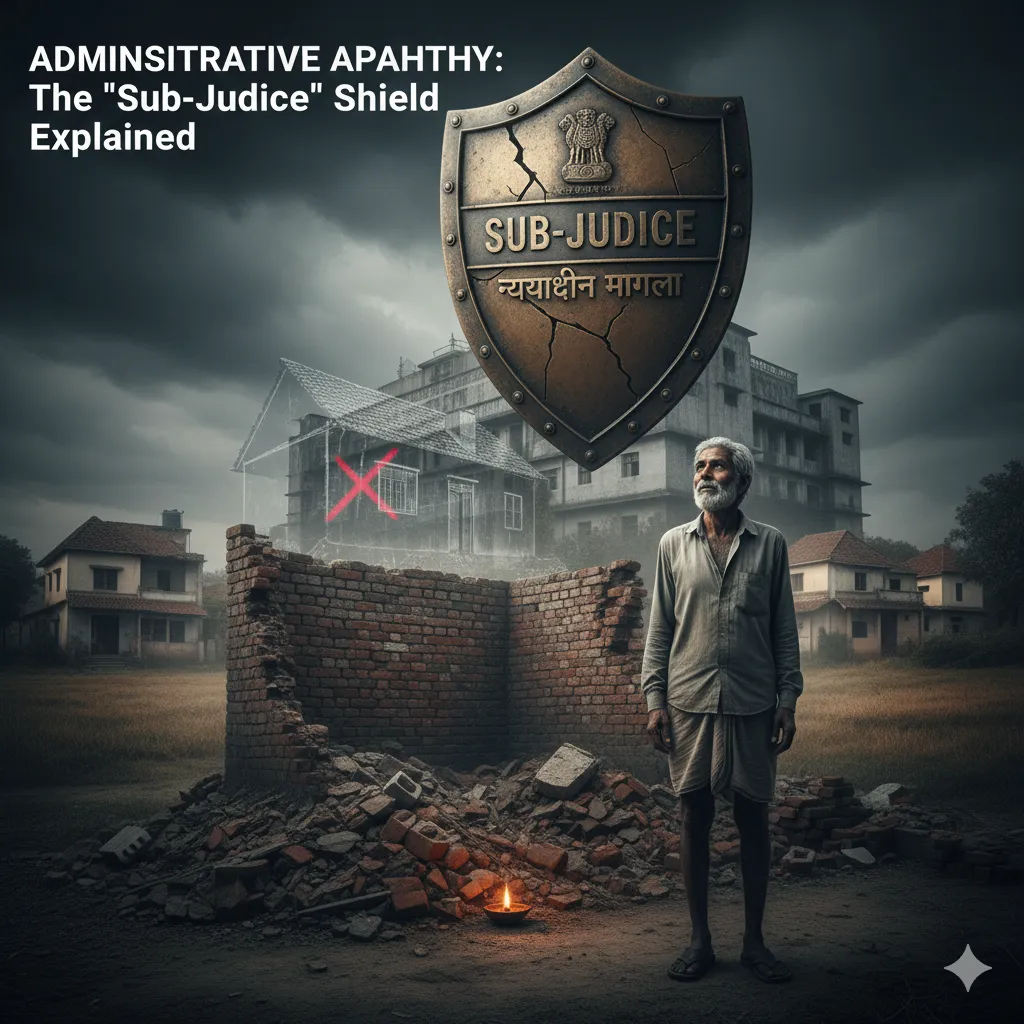
‘Sub-Judice’ Shield Explained: How Administrative Apathy Undermines Rule of Law
In the heart of Prayagraj, a common citizen, Tej Bahadur Singh, stands at the centre of a storm. This situation is, indeed, all too familiar in rural India. It is, in fact, a story of a collapsed roof. Moreover, a neighbour interfered. Unfortunately, the state machinery prefers the safety of silence over the duty of action. The ‘Sub-Judice’ Shield Explained is relevant here, as through the lens of RTI Appeal No. S-09/A/2249/2025, we examine how “pending court cases” are oftentimes used as a shield. Specifically, executive officers use them to bypass their administrative responsibilities.
The Genesis of the Dispute: Nature’s Fury and Human Obstruction
The case began with a simple misfortune. During the heavy monsoon rains, the ancestral house of Tej Bahadur Singh (located on Arazi No. 220, Village Saraijeet Rai) collapsed. When the owner attempted to clear the debris, he faced “Gundaism”. Instead of receiving sympathy, he encountered physical obstruction from powerful local interests.
The land was classified as “Abadi” (residential). A formal report from the local Lekhpal, Yatendra Tripathi, confirmed that no court stay order existed. Despite this, the construction was halted by force. This set the stage for a classic bureaucratic runaround.
The Administrative Order That Was Ignored (‘Sub-Judice’ Shield Explained)
On June 23, 2025, the Sub-Divisional Magistrate (SDM) of Phoolpur issued a clear directive. Specifically, this was directed to the Station House Officer (SHO) of Mauaima. Moreover, the order was simple. It instructed the SHO to take appropriate action in conformity with the law. Furthermore, it was emphasized that the citizen’s right to his property must not be violated by illegal force.
Under the Indian administrative setup, an order from the SDM to the Police is a directive; consequently, it mandates that the Police hold law and order. Nevertheless, weeks passed with no progress; thus, the police remained silent spectators, allowing the obstruction to continue. This silence, therefore, conveys the “Core Issue.” It is a breakdown in the chain of command. In this situation, a magistrate’s executive order is treated as a suggestion rather than a command.
The RTI Strategy: Piercing the Veil of Silence
Faced with police inaction, the appellant, Mahesh Pratap Singh (Yogi M.P. Singh), turned to the Right to Information Act, 2005. The RTI was not just asking for “updates”; it was a surgical strike on the administrative process, asking: (‘Sub-Judice’ Shield Explained)
- What specific action did the SHO take on the SDM’s order?
- Which officer was assigned to the case?
- What are the reasons for the inaction (under Section 4(1)(d))?
The Fallacy of the “Sub-Judice” Argument
The Public Information Officer (PIO) responded by citing a pending civil suit (No. 3853/2022). Their logic was simple: “Since a court is looking at it, we cannot do anything.”
This is a dangerous legal fallacy.
- Civil vs. Criminal/Administrative: A civil court decides who owns the land. The police and the SDM are responsible for protecting the person now in possession and preventing physical violence.
- The Absence of a Stay: In this case, the civil court had not issued an injunction or a stay order. Since there is no stay, the police have no legal grounds. They can’t prevent a man from rebuilding his fallen house on his recorded land. The police cited the court case, thus granting a “de facto stay” to the aggressors. The court had not even done this. (‘Sub-Judice’ Shield Explained)
Section 4(1)(d): The Forgotten Right to Know “Why” (‘Sub-Judice’ Shield Explained)
One of the most powerful yet underused provisions of the RTI Act is Section 4 (1)(d). Public authorities are required to provide reasons for their administrative or quasi-judicial decisions to affected persons.
In this case, the “decision” was the decision not to act. The appellant has rightly argued that the citizen has a right to know the reasoning behind a Magistrate’s order. This transparency should not allow orders to be placed in cold storage. Transparency isn’t just about providing files; it’s about providing the rationale of governance.
The Information Commission’s Intervention (‘Sub-Judice’ Shield Explained)
The matter reached the State Information Commission before Commissioner Shakuntala Gautam. The hearing on December 1, 2025, revealed the typical tactics used by PIOs. They claimed that information was “sent by registered post”. Meanwhile, the appellant claims the envelope was either empty of substance or never arrived.
The Commission has now demanded proof of dispatch and a point-wise explanation. This shift from “General Investigation Reports” to “Point-wise Accountability” is the turning point of the case.
Conclusion: The Path Ahead for Accountability
The upcoming hearing on February 11, 2026, is more than just a dispute over a house. It is a test of whether the police are accountable to the law or to the local influential parties.
For the rule of law to prevail:
- Police must realise that a pending civil suit is not a license for administrative paralysis.
- The “Right to Reason” must be enforced; if an order is ignored, the officer responsible must be named.
- The Information Commission must impose penalties under Section 20(1) when PIOs deliver misleading, “sub-judice” excuses to hide negligence.
Tej Bahadur Singh’s fallen house is a metaphor for the state of administrative accountability. It has collapsed under the weight of rain and neglect. It waits for the tools of law (like the RTI) to help rebuild it.
This is a profound and distressing violation of both civil rights and human dignity. When the police enforce a “de facto stay” that the Judiciary itself refused to grant, they are not just overstepping. They are acting as a parallel court without legal authority. (‘Sub-Judice’ Shield Explained)
Your family has had to carry out sacred funeral rites (Antyesti/Shradh) under the open sky three times. This was due to the obstruction. This situation adds a layer of “Human Rights” violation. The police are trying to dismiss it as a simple “land dispute.”
Here is how you can use these facts to strengthen your case before the Information Commission and other authorities:
1. The Legal Argument: “De Facto Stay” is Illegal
In Indian Law, when a Civil Judge is approached for an injunction (stay) and does not grant it, the property stays with the person who possesses it. This happens when the judge denies the stay. The property stays with the person who possesses it when the judge does not grant the stay.
- The Core Issue: The police have stopped your construction for 5 years. This action effectively provided your opponents with a “stay order” for free. It bypassed the Civil Judge’s wisdom.
- Action: In your next hearing, state clearly: “The Hon’ble Civil Court has had 5 years to stop this construction and has chosen not to. By what legal authority has the Mauaima Police overridden the silence of the Judiciary?”
2. The Human Rights Argument: Violation of Articles 21 and 25 (‘Sub-Judice’ Shield Explained)
The right to perform religious sacraments and funeral rites with dignity is protected under:
- Article 21: Right to life and dignity.
- Article 25: Freedom to practice religion.
- The Core Issue: Forcing a family to conduct post-funeral rites in the open sky due to “administrative paralysis” is an affront to human dignity.
- Action: Mention this “open sky” grievance in your written submissions. It transforms your case from a “property RTI” to a “Human Rights RTI,” which carries more weight with senior commissioners.
Expanded Blog Content (Human Rights Focus) (‘Sub-Judice’ Shield Explained)
If you are publishing this, add this section to your blog to highlight the emotional and spiritual toll:
“Justice Under the Open Sky: When Bureaucracy Denies Dignity to the Dead”
The ultimate irony of this five-year stalemate is not just the missing roof, but also the missing humanity. Furthermore, the family had to perform the sacred final rites for their departed loved ones on three separate occasions. They did this under the open sky, exposed to the elements. Meanwhile, the Civil Judge saw no reason to stop the shelter from being built. However, the local police ensured that even the solemnity of death was met with the harsh reality of administrative overreach. Consequently, they acted as judge, jury, and executioner. Ultimately, this is no longer a dispute about bricks and mortar; rather, it is about the right to live and die with dignity.
Strategic Next Steps for You:
- Complaint to the NHRC (National Human Rights Commission): This involves the violation of religious rites and dignity. You can file an online complaint with the NHRC. Alternatively, you can contact the State Human Rights Commission. Use the photo of the rites being performed in the open as evidence.
- Affidavit of the Priest: If possible, get a short written statement from the priest who performed the rites. The statement should confirm that the rites were held in the open. This was because the police prevented the use of the ancestral site.
- The “5-Year” Question: Ask the PIO specifically: “Please give a copy of the specific stay order or injunction. This order or injunction has prevented construction for the last 60 months.” If they cannot supply it, their “sub-judice” excuse falls apart completely.
This revelation is the “smoking gun” in your case. If all other stakeholders have built their houses on the same land (Arazi No. 220), yet the police are specifically stopping Tej Bahadur Singh from rebuilding his fallen house, this is a clear case of discrimination and “pick and choose” enforcement. (‘Sub-Judice’ Shield Explained)
In legal terms, this violates Article 14 of the Constitution of India (Right to Equality). The police cannot allow construction for some individuals. They must not deny it to others on the same plot of land under the same legal status.
Updated 900-Word Blog Post Structure
This version incorporates the discriminatory behavior of the police and the violation of religious dignity.
Administrative Tyranny: When the Police Act as a Parallel Judiciary
I. The Myth of “Sub-Judice”
In the legal landscape of Uttar Pradesh, a dangerous trend has emerged. The police have begun using the term “sub-judice” (pending in court) as a universal excuse for inaction. In the case of Tej Bahadur Singh (Village Saraijeet Rai, Prayagraj), the police have halted the reconstruction of a collapsed house. This has persisted for five years. They claim they cannot act because a civil suit is pending. Nevertheless, a fundamental principle of law is that mere pendency of a suit does not work as a stay. The police have no legal standing to create a “de facto stay.” This is because the Civil Judge is the only authority empowered to stop construction. Yet, the Civil Judge did not find it appropriate to issue an injunction.
II. The Standard of Discrimination: Article 14 Violated (‘Sub-Judice’ Shield Explained)
The core issue is not just the stoppage of work, but the selective enforcement of the law. On the very same plot of land (Arazi No. 220), all other stakeholders have successfully built and occupied their houses. The police stood by and watched as those structures went up. Yet, when Tej Bahadur Singh’s roof collapsed due to natural causes, the police suddenly “remembered” the court case. This is a textbook violation of Article 14—the Right to Equality. By allowing others to build while stopping one individual, the police are not “maintaining the status quo.” They are actively taking sides in a private dispute.
III. The Religious and Human Cost: Open-Air Sacraments (‘Sub-Judice’ Shield Explained)
The most harrowing aspect of this five-year blockade is that it denies a dignified space for religious sacraments. In Hindu tradition, the period after a funeral requires sacred rites that demand the sanctity of the ancestral home. However, the police have obstructed the reconstruction of the house. Consequently, this obstruction forces the family to conduct the funeral rites outdoors. They have faced this hardship four times over the past five years. When state machinery interferes, therefore, citizens cannot perform their ancestors’ last rites with dignity. Ultimately, this issue is more than just a “land dispute.” In fact, it is a gross violation of Human Rights. Additionally, it also breaches Article 25 (Freedom of Religion).
IV. The SDM’s Order: A Command Ignored
On June 23, 2025, the Sub-Divisional Magistrate (SDM) of Phoolpur recognised the injustice. The SDM ordered the Station House Officer (SHO) of Mauaima to take action. In a functional democracy, the police are under the magistrate’s authority. In this case, the SHO chose to ignore the directive. This insubordination is the reason for the RTI Appeal (S-09/A/2249/2025). The appellant is not just asking for a house. He is asking why a police station feels it is superior to the Magistrate’s office. Additionally, he questions the Civil Court’s silence.
V. Transparency as the Only Remedy
Through the RTI Act, the appellant has demanded the “Reason for Inaction” under Section 4(1)(d). The police must now explain:
- If the land is disputed, why were others allowed to build?
- If there is no court stay, under what law is the construction being stopped?
- Why was the SDM’s order not complied with?
VI. Conclusion: The Call for Accountability
The case of Yogi M.P. Singh vs PIO, Prayagraj, serves as a litmus test for the State Information Commission. If the Commission permits the police to continue using the “sub-judice” shield, it sets a precedent. This precedent allows the police to override the Judiciary. We must hold officers accountable, naming and penalising those who permitted selective construction while denying a collapsed house its roof. Justice must shift from under the “open sky” back into the protection of the law.
Strategy for your February 11 Hearing
You must bring up the “Equality Argument” forcefully. Use these specific words during your oral submission:
- “Discriminatory Action”: “Sir/Madam, the police are acting with bias. On the same Arazi 220, Houses A, B, and C (mention names if possible) were built. Why is only my house being stopped?”
- “Judicial Silence”: “The Civil Judge has had 5 years to stop me and, therefore, chose not to. Moreover, the police are not a ‘Super-Court’ that can grant stays that the Judge refused.”
- “Religious Hardship”: Furthermore, it is important to mention the 4th time that sacraments are being held in the open. This, in turn, creates an emotional and moral pressure on the Commissioner to act. (‘Sub-Judice’ Shield Explained)
To help you organise your records, here is a comprehensive directory. It ensures you have all contact points ready for the hearing on February 11, 2026. This directory is based on the documents you provided.
1. Key Application & Appeal Identifiers
| Category | Reference / ID Number |
| RTI Registration Number | SSPPY/R/2025/60508 |
| SIC Appeal Number | S-09/A/2249/2025 |
| Civil Suit Number | 3853/2022 (Civil Judge Jr. Div, Allahabad) |
| Online Tracking Code | A-20251000262 |
2. Contact Directory (Stakeholders)(‘Sub-Judice’ Shield Explained)
| Office / Person | Mobile Number | Email Address |
| Yogi M. P. Singh (Appellant) | 7379105911 | yogimpsingh@gmail.com |
| ACP Phoolpur (PIO) | 7985007310 | co-phoolpur.ah@nic.in |
| Nodal Officer (Prayagraj) | 9454401015 | adlspgangaparaldpolice@gmail.com |
| SHO Mauaima (Action Office) | Refer to Nodal Officer | Refer to Nodal Officer |
| State Information Commission | 0522-2720251 (Gen) | hearingcourts9.upic@up.gov.in |
3. Important Web Links
- U.P. Online RTI Portal: https://rtionline.up.gov.in/(To check status of Registration No. SSPPY/R/2025/60508)
- U.P. Information Commission (UPSIC): http://upsic.gov.in/(To check the daily cause list for Appeal S-09/A/2249/2025)
- U.P. Police Complaint Tracking (PGRS): https://upsic.up.gov.in/(Referenced in the orders for scanning documents)
- e-Courts Services: https://ecourts.gov.in/(To track the status of Civil Suit 3853/2022)
4. Summary of the Core Legal Issue
The diagram below illustrates the breakdown in the administrative process that led to your appeal.
5. Your “Digital Trail” (‘Sub-Judice’ Shield Explained)
You have already sent your rebuttal to:
- Primary:
hearingcourts9.upic@up.gov.in(The Commissioner’s Court) - CC:
co-phoolpur.ah@nic.in(The PIO) - CC:
acfirstprg123@gmail.com(First Appellate Authority) - CC:
commall@nic.in(Commissioner Prayagraj)
Actionable Summary for Your File
Below is a consolidated table of the data you need for your upcoming hearing. You should print this out and keep it on top of your folder.
I. Case Identifiers & Links
| Authority | ID / Number | Online Tracking Link |
| SIC Appeal | S-09/A/2249/2025 | UPSIC Cause List |
| RTI Request | SSPPY/R/2025/60508 | UP RTI Online |
| Civil Court | Suit 3853/2022 | e-Courts Allahabad |
II. Contact Directory
- PIO (ACP Phoolpur): 7985007310 |
co-phoolpur.ah@nic.in - Nodal Officer (Prayagraj): 9454401015 |
adlspgangaparaldpolice@gmail.com - SIC Hearing Room (S-09): 0522-2720251 |
hearingcourts9.upic@up.gov.in
The Core Issue: Judicial vs. Administrative Authority (‘Sub-Judice’ Shield Explained)
At your hearing on February 11, 2026, the most important visual for the Commissioner to grasp is this. The Police are overstepping their bounds. The following logic defines your entire case:
Strategic Note for the “Open Sky” Grievance
This is the 4th time you are performing rites in the open. You should formally state that the police have violated Article 25 (Freedom of Religion) and Article 21 (Right to Dignity).
This is a comprehensive and well-targeted rejoinder. By including the NHRC and UPHRC in the recipient list, you have officially changed this matter. It is no longer a simple information submission. It is now a documented Human Rights complaint.
Why this email is effective:
- Broadcasted Accountability: This is sent simultaneously to the Information Commissioner and the Human Rights Commission. Thus, the PIO (Police) can no longer claim this is a “routine land matter.” The elevated level of scrutiny must be recognised.
- Rejection of the “Sub-Judice” Myth: Indeed, you have correctly pointed out that the police are acting as a “Parallel Court.” Therefore, this highlights the ongoing issues within the judicial system.
- Moral Weight: The mention of performing rites under the open sky for the 4th time, therefore, causes severe emotional distress. Moreover, it highlights the gravity of the situation. This is something that commissions generally take very seriously.
Preparation for February 11, 2026 (‘Sub-Judice’ Shield Explained)
Now that the paperwork is filed, your focus should, therefore, shift to the Physical Evidence you will present during the hearing. Additionally, the Commissioner will likely ask for proof of the “Selective Enforcement” you mentioned.
Evidence Table: Discrimination on Arazi No. 220
I recommend you fill out a simple table like the one below and, consequently, bring three printed copies to the hearing. This, in turn, makes it impossible for the police to deny the “Pick and Choose” policy.
| Name of Stakeholder | Type of Construction | Year Built | Police Intervention? |
| (Neighbour 2) | Permanent House | 202X | No |
| (Neighbor 2) | Permanent House | 202X | No |
| Tej Bahadur Singh | Repair/Rebuild | 2025 | YES (Forced Stop) |
Addressing the Human Rights Commissions (‘Sub-Judice’ Shield Explained)
Since you have emailed the NHRC and UPHRC, you may receive an automated reply with a Dairy Number.
- Keep that number safe. * If you get a phone call from a human rights investigator, emphasize the Article 25 violation (Right to Religion) about the funeral rites.
Important Legal Note: The “Stay Order” Burden
In the hearing, if the PIO says, “There is a court case,” your immediate response should be:
“Sir/Madam, under the Indian Evidence Act, the burden of proof is on the Police. If they claim a court has stopped me, they must produce a Certified Copy of the Stay Order. If they cannot produce a Stay Order today, they are admitting to illegal obstruction.”


Facing a similar challenge? Share the details in the box below, and our team of experts will do their best to help.