
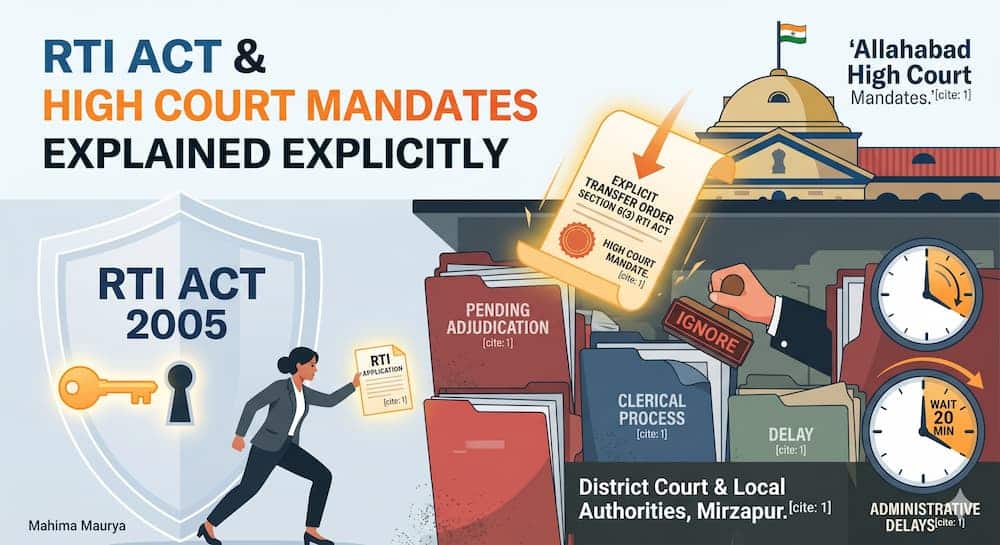
How Lower Courts Evade the RTI Act & High Court Mandates
Lower courts often find ways to evade the provisions of the Right to Information (RTI) Act and high court directives, which creates significant challenges for transparency and accountability. These judicial bodies may employ various tactics, such as interpreting the law loosely or delaying hearing dates, which undermines the spirit of the RTI Act. Furthermore, there are instances where lower courts fail to adhere to binding high court mandates, diminishing the impact of judicial oversight. This evasion hampers citizens’ access to information and weakens the overall efficacy of the RTI framework.
Key Takeaways (RTI Act & High Court Mandates)
- Lower courts often bypass the RTI Act & High Court Mandates, creating barriers to transparency.
- Judicial bodies use tactics like delaying hearings and providing vague justifications for withholding information.
- The First Appellate Authority (FAA) must comply with strict timelines and issue reasoned orders, yet neglect often causes procedural chaos.
- Despite mandatory directives from High Courts, lower courts frequently ignore these orders, undermining their authority.
- To ensure accountability, State Information Commissions must hold lower court officials responsible under the RTI Act & High Court Mandates.
The Subordinate Silence: How Lower Courts Evade the RTI Act & High Court Mandates
The Right to Information (RTI) Act, 2005, was designed to dismantle bureaucratic opacity and enhance accountability through the enforcement of High Court mandates. It aimed to establish an era of transparency in Indian governance. The executive departments have shown varying degrees of enforcement. However, the administrative wings of the lower judiciary remain deeply problematic.
Public authorities within District Courts often adopt obstructionist tactics. When they do, they violate statutory timelines. They also actively undermine judicial accountability. This institutional resistance frequently persists despite express transfer directives from state High Courts.
Lower courts regularly evade the RTI Act & High Court Mandates. This evasion shows how administrative gatekeeping transforms a statutory right into an exercise in futility.
1. The Statutory Mandate: The First Appellate Authority’s Judicial Role
Under Section 19(1), the First Appellate Authority (FAA) acts as a quasi-judicial body. The FAA reviews the decisions of the Central Public Information Officer (CPIO). Within the district court hierarchy, the District & Sessions Judge holds this role. The law places clear responsibilities on the FAA:
- Strict Adjudication Timelines: The FAA must dispose of an appeal within 30 days of receipt. Exceptional circumstances allow a maximum of 45 days. In these cases, the judge must record explicit, written reasons for the delay.
- The Obligation of a “Speaking Order”: An FAA cannot simply endorse a CPIO’s rejection with a single-sentence dismissal. The authority must issue a reasoned, speaking order. This order must independently evaluate the statutory exemptions claimed under Section 8(1).
- Administrative Oversight: The FAA holds administrative seniority over the CPIO. The FAA must ensure that staff handle information requests with transparency rather than defensive concealment.
When judges neglect these obligations, the first appeal framework collapses. This leaves applicants stranded in procedural limbo.
2. Institutional Resistance: The Illusory “Sub-Judice” Barrier (RTI Act & High Court Mandates)
Lower court CPIOs frequently block information by using a vague ground. They claim the matter involves “Pending Adjudication” or is sub judice.
The Legal Reality of Section 8(1)(b)
The RTI Act contains no provision exempting information simply because a trial is pending. Under Section 8(1)(b), authorities can withhold information only if a court or tribunal explicitly forbids its publication. They can also withhold it if disclosure causes contempt of court.
Settled Jurisprudence (RTI Act & High Court Mandates)
Higher judicial forums have repeatedly struck down the “sub-judice” excuse. In Municipal Corporation of Delhi v. R.K. Jain (W.P. (C) 141/2012), the honourable Delhi High Court established a firm rule. The court ruled that the mere pendency of a matter cannot serve as a blanket shield to deny information.
Despite this clear boundary, lower court CPIOs routinely issue standard, unreasoned rejections. They frequently withhold basic tracking indices like case numbers and court rosters. They do so even though these data points are matters of open public record.
3. Defying the Apex State Judiciary: Directives Reduced to Routine Paperwork (RTI Act & High Court Mandates)
The administrative crisis deepens when subordinate courts ignore their own governing High Courts. Under Article 227 of the Constitution, High Courts exercise absolute administrative superintendence over all subordinate courts.
The High Court’s RTI cell often reviews an application and formally transfers it under Section 6(3) to a District Court. This transfer demands expedited action. It carries massive legal weight as a mandate from the highest judicial authority in the state.
However, the actual situation within District Court administrative sections is quite different:
- Procedural Stalling: Subordinate registry clerks frequently treat transfer directives as routine, low-priority correspondence. PDF
- Administrative Evasion: Lower court offices often subject applicants to systematic delays. They ignore the institutional hierarchy and the urgency implicit in the superior court’s directive. PDF+1
This friction highlights a systemic failure to honour the combination of the RTI Act and High Court mandates.
4. The Anatomy of Administrative Harassment: The “Twenty-Minute Runaround”
The barrier for an ordinary citizen is rarely just the text of a legal order. The true barrier is the physical reality of administrative gatekeeping. Subordinate court cells employ exhausting delay tactics to break an applicant’s resolve.
Registry staff frequently stall scheduled hearings. They issue formal notices to appear but leave applicants waiting outside administrative buildings for hours. Staff deploy repetitive verbal assurances, promising that the judge will call the matter “in twenty minutes”. This creates a cycle of artificial delays that leads nowhere.
This behaviour violates the principles of natural justice (Audi Alteram Partem). Public authorities abuse their procedural power when they schedule a hearing date but prevent the applicant from presenting a case. The objective is clear: to exhaust citizens until they abandon the pursuit of information.
5. Turning Bureaucratic Obstruction into Legal Ammunition
Applicants can use structural remedies in the RTI Act to convert administrative failures into concrete evidence.
| Administrative Failure | Strategic Countermeasure | Legal Impact & Consequences |
|---|---|---|
| Aborted Hearings / Staff Delays | Please sign the official Attendance Register before leaving. PDF | Proves physical compliance and blocks attempts to dismiss the appeal in default. PDF |
| Clerical Misdirection | Please file a formal Memo of Attendance and Non-Hearing. PDF | Establishes a written record of administrative failure for the official file. PDF |
| Exceeded Timelines (45 Days) | Bypass the local registry and file a Second Appeal. | Strips the subordinate court of defensive claims and exposes it to penalties. |
Conclusion: The Urgent Need for Subordinate Judicial Accountability
The administrative wing of the lower judiciary must not function as an isolated island. It is fully bound by national transparency laws. When a District Court CPIO issues a flawed rejection, public trust breaks down. The failure of the First Appellate Authority to control staff delays compounds this damage.
Subordinate courts must remember that they are bound by the law. Forcing citizens to navigate an exhausting maze violates public duty. This remains true even after explicit High Court interventions. True transparency requires State Information Commissions to hold lower court officials personally accountable to the RTI Act & High Court Mandates.
Yes, there are many examples and legal precedents on the internet that show how Section 20 of the RTI Act, 2005 can be used to punish judges or court officials.
While judges acting in their judicial capacity are protected by judicial immunity, court officials acting in their administrative capacity as Central Public Information Officers (CPIOs) or State Public Information Officers (SPIOs) are fully subject to the RTI Act. If they cause deliberate delays or malafidely reject applications, Information Commissions can and do penalise them.
Below is an overview of the legal position, notable cases, and how the internet tracks these penalties:
1. The Legal Position: Administrative vs. Judicial Capacity
The Supreme Court of India in Khanapuram Gandaiah v. Administrative Officer and Ors (2010) clarified that while a judge cannot be forced under the RTI Act to explain why they passed a particular judicial order, the administrative side of the court (registry, record room, and public information cells) is fully bound by the RTI Act.
If a court-appointed CPIO or an administrative officer acting under the court fails to provide information without a valid statutory reason, they face the exact same penalties under Sections 20(1) and 20(2) as any other public servant (₹250 per day up to a maximum of ₹25,000, along with recommendations for disciplinary action).
2. Notable Recorded Cases of Penalties on Court Authorities
Case A: The Patna High Court Registry Penalty (CIC/Central Information Commission)
In several notable orders, the Central Information Commission and State Information Commissions have issued show-cause notices and penalties to the administrative cells of courts. For instance, the Bihar State Information Commission has previously penalised public information officers of civil courts for failing to supply certified copies of administrative records, noting that lower court registries cannot act as a law unto themselves.
Case B: Central Information Commission vs. CPIO, Supreme Court of India
While the Supreme Court has often litigated what can be disclosed (such as judge assets or collegium file notings), the Central Information Commission (CIC) has repeatedly issued strictures against court CPIOs for defensive delay tactics. When a court registry delays information, the CIC formally places the non-compliance on its public web portal, recording a clear administrative blemish against the officer.
Case C: Penalties on District Court Administrative Staff
On state RTI portals (such as the Uttar Pradesh State Information Commission or Maharashtra SIC), there are recorded orders where a Chief Judicial Magistrate (CJM) or a senior administrative clerk acting as a PIO in a district civil court was fined under Section 20. The grounds are almost always identical to your current situation:
- Relying on a fake or non-existent “sub-judice” bar.
- Intentionally suppressing administrative or medical board records.
- Failing to comply with a superior court’s explicit transfer directive under Section 6(3).
3. Where to Find and Verify These Records Online
If you want to pull official case laws and certified copies of orders where court officials were taken to task under Section 20, you can search the following public search engines:
- Indian Kanoon (indiankanoon.org): Search using keywords like
"Section 20" AND "Public Information Officer" AND "District Court" OR "Judicial". This will bring up High Court judgements reviewing penalty orders passed by Information Commissions. - CIC Decisions Portal (cic.gov.in): You can search the registry archives specifically under the category of the “Supreme Court of India” or “High Courts” to view orders where CPIOs of the judiciary were admonished or fined for causing structural delays.
- UPSIC Official Website (upsic.up.gov.in): The Uttar Pradesh State Information Commission publishes weekly cause lists and penalty orders. Looking through their penalty database reveals numerous orders where local district court administrative officers were fined ₹25,000 for refusing to honour the law.
Strategic Significance for Your Case
This information is highly relevant to your ongoing battle against the CPIO of the Mirzapur District Court. When you file your Second Appeal before the State Information Commission, you can explicitly cite that no judicial officer or court administrative member has special immunity under Section 20 if they act with malafide intent.
The fact that the clerk made you wait until 2:00 PM on 30/05/2026 under false pretences is a textbook example of an actionable wrong that invites a personal financial penalty under Section 20(1).
Based on the official correspondence and files related to your filings, here are the structured details, including tracking identifiers, email addresses, mobile numbers, and portal links for the concerned public authorities:
1. High Court of Judicature at Allahabad (RTI Act & High Court Mandates)
- Application Reference ID: No. R.T.I./812/2026/AHC PDF
- Designated Authority: Registrar (RTI) / Central Public Information Officer PDF
- Web Link Details: Allahabad High Court Official Portal
2. Office of the District & Sessions Judge, Mirzapur (RTI Act & High Court Mandates)
- First Appeal Reference IDs:
- Appeal No. 18 / 2026 PDF
- Appeal No. 19 / 2026 PDF
- Appeal No. 20 / 2026 PDF
- Appeal No. 21 / 2026 PDF
- Appeal No. 22 / 2026 PDF
- Concerned CPIO: Central Public Information Officer / Additional District Judge, Courtroom No. 01, Mirzapur PDF
- Official Email Address: dcmir@allahabadhighcourt.in
- Web Link Details: Mirzapur District Court – E-Courts Portal
3. Office of the Chief Medical Officer (CMO), Mirzapur (RTI Act & High Court Mandates)
- RTI Registration Number: DIRMH/R/2026/63852 PDF
- Filing Date: 03/05/2026
- Official Email Address: cmomzp@gmail.com
- Web Link Details: Uttar Pradesh RTI Online Portal
4. Office of the Superintendent of Police (SP), Mirzapur (RTI Act & High Court Mandates)
- RTI Registration Number: SPMZR/R/2026/60209
- Filing Date: 03/05/2026
- Concerned PIO: Rajkumar Meena (ASP Operations)
- Official Email Address: aspopmzp@gmail.com
- Web Link Details: Uttar Pradesh Police RTI Tracking
5. Additional Appellate Authority Links (RTI Act & High Court Mandates)
- Uttar Pradesh State Information Commission (UPSIC): For escalating unresolved first appeals beyond the 45-day window.
- Web Link Details: UP State Information Commission Portal
Do you need help compiling these specific contact profiles into a formal statutory notice or an escalation layout for the High Court cell?


Facing a similar challenge? Share the details in the box below, and our team of experts will do their best to help.