
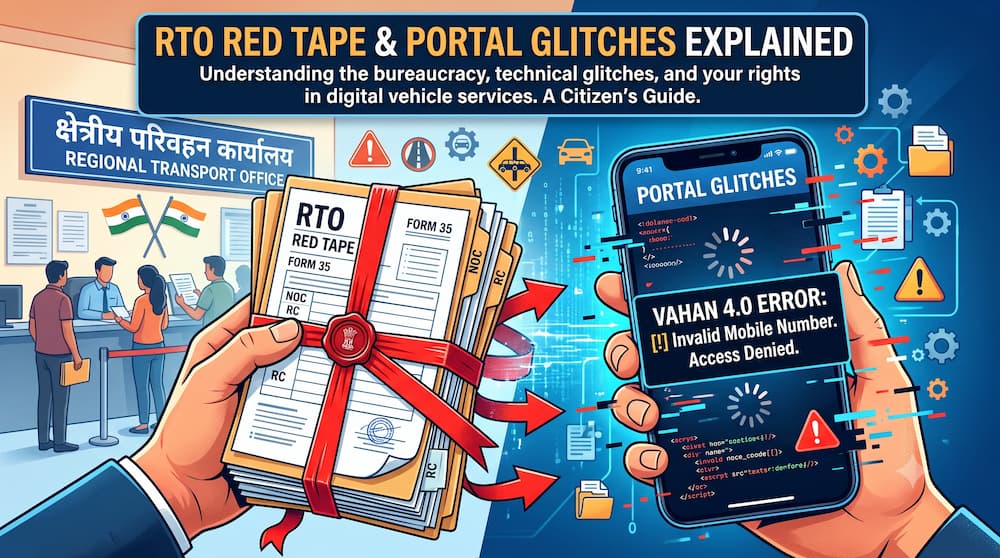
RTO Red Tape & Portal Glitches represent a significant hurdle in completing the hypothecation process, primarily due to the pervasive issue of corruption. This bureaucratic delay not only frustrates individuals and businesses seeking to use their assets for loans or financing but also exacerbates the overall inefficiency within the system. Each step in this convoluted process often becomes mired in excessive paperwork and uncalled-for regulations that seem to serve as barriers rather than facilitators. Furthermore, the reliance on outdated technology and poorly maintained portals causes additional frustration, leading to frequent system crashes and lost applications. The culmination of these factors conspires to create a landscape where procrastination thrives, leaving many individuals feeling helpless as they navigate a maze of red tape instead of progressing smoothly through necessary procedures.
Key Takeaways
- RTO Red Tape & Portal Glitches hinder the hypothecation process, causing frustration for individuals and businesses.
- Digital governance aims to streamline tasks, yet citizens face inefficiencies due to discrepancies between automation and manual processes.
- Miscommunication between banks and local authorities complicates the hypothecation termination, hampering efficient vehicle ownership transfer.
- Technical issues on the VAHAN portal further obstruct users, leading to bureaucratic delays and the need for RTI interventions.
- The case highlights the need for system integration, robust support structures, and strict enforcement of service delivery timelines to address RTO Red Tape & Portal Glitches.
RTO Red Tape & Portal Glitches: The Friction in Digital Governance
Digital governance initiatives aim to eliminate bureaucratic bottlenecks. Furthermore, they remove intermediaries and establish a seamless workflow between public administration, corporate sectors, and citizens. In India, the centralized VAHAN portal represents a significant milestone towards automating vehicle-related services. However, a significant gap still remains between policy design and ground-level execution. Consequently, citizens often find themselves caught between RTO Red Tape & Portal Glitches.
For instance, a recent Right to Information (RTI) application significantly highlights this systemic issue. Specifically, the applicant filed this request against the Assistant Regional Transport Officer (ARTO) in Mirzapur. Moreover, the case involves vehicle number UP63BC3789. Ultimately, it further reveals how administrative contradictions and system errors can effectively trap an ordinary citizen in a bureaucratic loop. Furthermore, this loop persists even after the citizen has fulfilled all legal and financial obligations.
The Core Dispute: Auto-Termination vs Manual Mandates
The conflict begins with the vehicle Hypothecation Termination (HPA) process; consequently, this situation serves as a classic example of where administrative systems suffer from RTO Red Tape & Portal Glitches. Specifically, hypothecation binds a vehicle as collateral to a financing bank. Thus, removing this clause from the Registration Certificate (RC) is essential to establish absolute legal ownership after a loan repayment.
The Digital Workflow Claim
On 7 May 2026, Axis Bank Limited officially closed the auto loan account XX9087 linked to the vehicle. Meanwhile, the bank issued an automated confirmation regarding the system. The bank stated that they fully digitalised the hypothecation removal process. According to the bank, they successfully transmitted the relevant no-dues data to the VAHAN database to trigger an automatic termination of the lien.
The Administrative Contradiction
In stark contrast to this automated system, the office of the ARTO Mirzapur had previously issued a formal letter on 7 April 2026. This letter responded to an integrated public grievance under reference number 600000260027375. The local transport authority insisted that the vehicle owner must complete an online application. Additionally, the owner must print out Form 35 and obtain physical bank stamps and signatures. Finally, they must submit the original physical Registration Certificate and ensure the bank sends a manual email to the office.
As a result, this creates a clear structural contradiction where RTO Red Tape & Portal Glitches stall progress:
- The financial institution operates under a fully electronic, API-driven data-sharing architecture.
- Conversely, the local registration authority still relies on traditional paper verification and physical record handling.
Technical Glitches on the VAHAN Portal
When citizens attempt to bridge this administrative gap, they access online options through the VAHAN Citizen Services portal. However, they frequently encounter severe system failures. This case perfectly illustrates how RTO Red Tape & Portal Glitches work together to block public access.
The Registered Mobile Number Alert
To initiate any modification on the VAHAN platform, the portal requires authentication. The user must use a Registered Mobile Number (RMN) to generate a One-Time Password (OTP). In this specific case, the user entered the valid, registered mobile number (9794089100). Nevertheless, the portal continuously blocks progress with a generic alert: “Please enter valid mobile number.”
[ VAHAN CITIZEN SERVICES PORTAL ] ├── Registration No: UP63BC3789 ├── Input Mobile No: 9794089100 └── SYSTEM ALERT: "Please enter valid mobile number." (Access Blocked)
Thus, this error creates a critical technical barrier. Because the database fails to parse or validate a verified mobile number, the citizen cannot pay the required fees. Furthermore, they cannot upload supporting documents or track the real-time status of their asset registration.
Bureaucratic Non-Responsiveness and the RTI Intervention
Faced with a technical error on one side and a manual paperwork demand on the other, the applicant consequently turned to the Right to Information Act, 2005. He subsequently filed a formal request on 9 May 2026 under Registration Number CTRNS/R/2026/60776. He did this specifically to effectively bypass the ongoing RTO Red Tape & Portal Glitches.
                ┌────────────────────────────────────────┐
                │ Original RTI Filed: 09 May 2026         │
                └───────────────────┬────────────────────┘
                                    │
                         (30-Day Statutory Limit)
                                    │
                ┌───────────────────▼────────────────────┐
                │ Deemed Refusal Reached: 08 June 2026  │
                └───────────────────┬────────────────────┘
                                    │
                          (First Appeal Action)
                                    │
                ┌───────────────────▼────────────────────┐
                │ Appeal Registered: CTRNS/A/2026/60377 │
                │ Date of Filing: 09 July 2026           │
                └────────────────────────────────────────┘
The application sought five specific points of clarification; notably, these points ranged from the current hypothecation status within the internal database to, furthermore, the maximum turnaround time defined in the official Citizen Charter.
The Statutory Failure of the PIO
Under Section 7(1) of the RTI Act, a Public Information Officer (PIO) must either provide the requested information or reject the application with valid reasons within 30 days. In this case, the statutory limit expired on 8 June 2026. However, since the PIO, ARTO (Admin) Mirzapur, completely ignored the timeline and failed to respond, he consequently triggered a provision under Section 7(2) known as “Deemed Refusal.”
This silence demonstrates a common issue. Public offices often use non-responsiveness to delay accountability on operational or technical inefficiencies. Consequently, this behavior compounds the impact of RTO Red Tape & Portal Glitches.
The Escalation to First Appeal
Because the primary transparency channel yielded no results, the applicant escalated the matter on 9 July 2026. He filed a First Appeal under Section 19(1) of the Act, which the portal registered under number CTRNS/A/2026/60377.
The First Appellate Authority (FAA)—headed by the Regional Transport Officer (RTO) of Mirzapur—now holds the legal responsibility to review the case. Therefore, the appeal seeks specific remedies to clear the hurdles of RTO Red Tape & Portal Glitches:
- Enforcing Free Information Provision: Under Section 7(6) of the RTI Act, when a public authority fails to comply with the 30-day limit, they must provide all relevant information to the appellant entirely free of cost.
- System Resolution Order: The FAA must clarify why a discrepancy exists between Axis Bank’s electronic notification and the RTO’s insistence on manual document verification.
- Technical Error Correction: The RTO must coordinate with technical teams to address the VAHAN database glitch that blocks user access via the mobile verification error.
Broader Implications for Digital India (RTO Red Tape & Portal Glitches)
This case highlights a broader challenge for public administration reform in India. Specifically, the combination of RTO Red Tape & Portal Glitches threatens to slow down national digitisation goals:
1. The Need for End-to-End System Integration
True digitization requires all participating systems to integrate fully. If a financial institution transmits a digital loan-closure notification via an API, the receiving government database should update automatically. It should not require physical document cross-checks, manual emails, or paper forms like Form 35.
2. Robust Technical Support Structures (RTO Red Tape & Portal Glitches)
When a major public platform like VAHAN errors out during a standard user login, engineers must provide clear troubleshooting paths. Without automated error reporting or dedicated support desks, users have no option but to file formal administrative grievances or RTI requests to fix simple database bugs.
3. Strict Enforcement of Citizen Charters (RTO Red Tape & Portal Glitches)
Authorities must closely monitor public service delivery timelines. A service should have an explicit, enforceable processing limit once a bank submits data electronically. This step ensures accountability for processing delays.
Conclusion
The ongoing appeal process under reference CTRNS/A/2026/60377 will serve as an indicator of local administrative accountability. It shows that deploying digital portals is only the first step. True administrative modernization requires regular system maintenance, clear internal workflows, and compliance with statutory timelines. Until authorities close these technical and administrative gaps, citizens will continue to rely on transparency laws to resolve routine vehicle registration updates slowed down by RTO Red Tape & Portal Glitches.
Here is the structured list of all application tracking IDs, email addresses, mobile numbers, and public authority web links extracted from your documentation:
1. Application tracking IDs (RTO Red Tape & Portal Glitches)
- Original RTI Registration Number: CTRNS/R/2026/60776 PDF
- First Appeal Registration Number: CTRNS/A/2026/60377 PDF
- Prior IGRS Public Grievance Reference Number: 600000260027375 PDF
- Axis Bank Auto Loan Account Number: XX9087 PDF
2. Email Addresses (RTO Red Tape & Portal Glitches)
- ARTO (Admin) Mirzapur (PIO Office): artomi-up@nic.in PDF
- Nodal Officer (Jan Suchna Adhikari): rti.tco@up.gov.in PDF
- Appellant Email: yogimpsingh@gmail.com PDF
- Vehicle Owner Email: jagadgurukeshav@gmail.com PDF
- Axis Bank Alerts: alerts@axis.bank.in PDF
3. Mobile & Phone Numbers (RTO Red Tape & Portal Glitches)
- Shri Santosh Kumar Singh, ARTO Admin (PIO): 9452708276 PDF
- Shri Vivek Shukla, Jan Suchna Adhikari (Nodal Officer): 6386017575 PDF
- Mirzapur Appellate Authority (FAA / RTO): 8005441122 PDF
- Yogi M P Singh (Appellant): 7379105911 PDF
- Keshav Pratap Singh (Vehicle Owner Contact): 9794089100 PDF
- Axis Bank Customer Care: 18604195555 / 18605005555 / 18001035577 PDF
4. Web Links of Public Authorities (RTO Red Tape & Portal Glitches)
- Official VAHAN Citizen Services Portal: https://vahan.parivahan.gov.in PDF
- Online RTI Portal (Filing & Tracking): https://rtionline.gov.in (Inferred from portal interface context)


Facing a similar challenge? Share the details in the box below, and our team of experts will do their best to help.