
Parallel Activation Trap & Telecom Giants tells us if we want to protect our rights, then struggle long. In an era of rapid technological advancement and increasing corporate influence, it becomes imperative for individuals to recognize the need for vigilance and resilience. The fight for our rights is not an easy path; it demands awareness, engagement, and often, a unified front against powerful entities. We must educate ourselves about the implications of telecom practices and establish a framework that emphasizes accountability and fairness. As consumers, it is our responsibility to voice our concerns and advocate for transparency, ultimately driving the change needed to ensure our rights are not merely theoretical but actively upheld. Through persistent efforts, we can forge a future where our rights are respected and safeguarded from exploitation by powerful telecom giants.
Key Takeaways
- The article discusses the Parallel Activation Trap & Telecom Giants, highlighting how telecom companies activate overlapping plans, leading to consumer loss.
- Consumers must confront corporate practices that undermine their rights, demanding transparency and accountability.
- By utilizing evidence-based public grievances, users can reclaim lost funds from the Parallel Activation Trap.
- Regulatory reform is needed to prevent these practices and ensure fair treatment for consumers against telecom giants.
- Persuasive documentation and escalation can effectively pressure companies to comply with consumer rights.
Parallel Activation Trap &Telecom Giants: How Telecom Giants Force Overlapping Plans and How to Fight Back
For years, prepaid mobile connections in India offered unmatched flexibility. Consumers could purchase recharges in advance. They did so secure in the knowledge that a newly bought pack would sit safely in a digital queue. Consequently, it waited to activate the precise second the current plan expired.
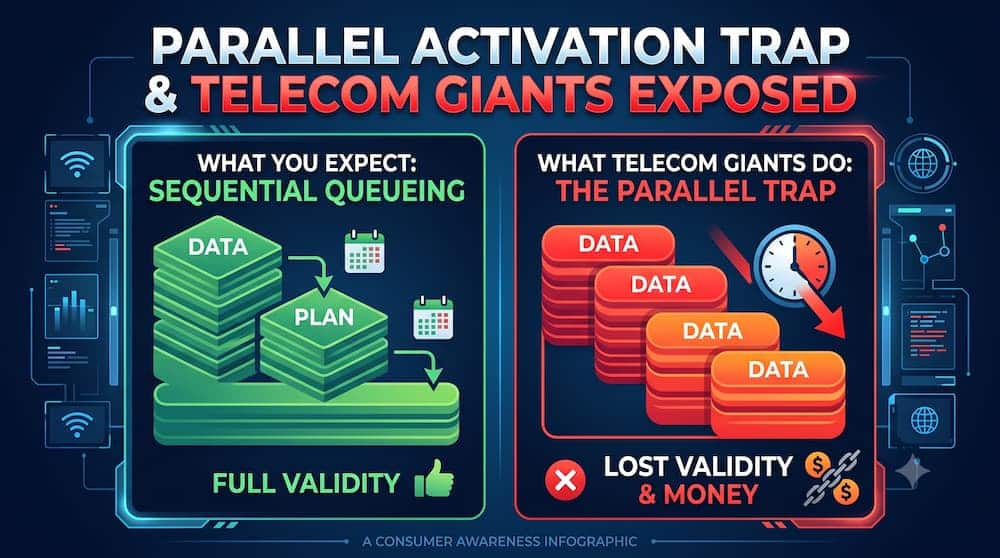
However, a highly controversial shift in telecom billing practices has trapped thousands of unsuspecting users. Known as the Parallel Activation Trap, this practice occurs when telecom giants activate a newly purchased recharge immediately. As a result, they force it to run concurrently with an existing active plan. Therefore, instead of lengthening service validity, the two plans overlap. This overlapping causes data, talk-time, and hard-earned money to melt away simultaneously.
While telecom giants frequently blame this on system limitations, persistent resistance proves these corporations can reverse these unfair charges. Indeed, when caught in the Parallel Activation Trap, consumers can successfully force refunds. However, they must launch structured, evidence-based public grievances to do so.
Anatomy of the Parallel Activation Trap
The mechanics of this trap are simple. Yet, they are devastatingly effective for boosting corporate Average Revenue Per User (ARPU).
Imagine you possess an active annual plan that provides unlimited calling and daily data. Naturally, you might want to secure uninterrupted service. Alternatively, you might want to lock in a tariff rate before an upcoming price hike. For this reason, you purchase another high-value plan, such as an annual ₹2,249 pack from one of the major telecom giants. In a fair, consumer-centric system, the second plan remains dormant. It waits until day 365 of your first plan concludes.
Under the Parallel Activation Trap model, however, the operator activates both plans on the exact same day. Your single mobile device now runs two identical, overlapping subscriptions. Obviously, you cannot consume double the daily data. Furthermore, you cannot make two phone calls at once. This means the entire value of the second recharge is systematically stolen by design.
[Fair Queueing System]|---- Plan A (Active: 365 Days) ----| |---- Plan B (Queued: 365 Days) ----|[The Parallel Activation Trap]|---- Plan A (Active: 365 Days) ----||---- Plan B (Overlapping Active) --| <-- Stolen Value Area
The Corporate Smoke Screen: “Technical Inability”
When consumers discover the overlap, they naturally confront customer care. However, they quickly encounter a highly coordinated wall of resistance. Frontline support agents deployed by telecom giants typically offer a standard response. They claim: “Our billing system activates recharges automatically based on denomination categories. Therefore, we lack the technical capability to queue distinct plans or issue manual refunds.”
In reality, this defense is entirely deceptive. Modern telecom billing architectures rely on advanced Online Charging Systems (OCS). These systems are fully capable of real-time rating, custom bundling, and precise policy management. For example, they handle complex data throttling, international roaming attachments, and promotional tokens effortlessly.
Consequently, to claim that telecom giants cannot establish a simple digital queue for prepaid vouchers is a calculated falsehood. The “technical inability” is not a flaw in the system. Instead, it is a deliberate administrative choice to protect the profitable Parallel Activation Trap.
The CPGRAMS Illusion: Deceptive Closures on Public Portals
When standard customer care channels fail, informed consumers escalate their complaints. They usually turn to the Centralised Public Grievance Redress and Monitoring System (CPGRAMS) under the Department of Telecommunications (DoT). Unfortunately, telecom giants have learned to game this government portal to safeguard their metrics.
Specifically, a common corporate tactic involves the premature closure of grievance tickets. Corporate nodal officers working for these telecom giants frequently mark a dispute as “Case Closed” or “Disposed Of. However, they do this after inputting mere forward-looking assurances. For instance, they upload final remarks stating that the issue “has been forwarded to the relevant team”. Additionally, they promise it “will be resolved within 24 to 48 hours.”
Marking a public grievance closed based on a promise of future action directly violates standard administrative protocols. Furthermore, it allows telecom giants to artificially inflate their resolution rates on paper. Meanwhile, they leave the consumer with a zero balance on the ground. Therefore, without definitive, transactional proof like a specific reference ID, a forward-looking statement remains completely meaningless.
Turning the Tide: Forcing Corporate Compliance Through Evidence
Despite the systemic barriers, telecom giants are not completely untouchable. They operate under strict regulatory frameworks. Thus, when confronted with unassailable digital evidence, their legal and compliance departments must capitulate. Eventually, they are forced to undo the Parallel Activation Trap.
To force a refund, the consumer relies entirely on comprehensive documentation:
- Live Carrier Logs: First, consumers must pull live network status logs from their devices. For example, running a standard Unstructured Supplementary Service Data (USSD) balance check explicitly reveals the live talk-time status. Consequently, capturing timestamped screenshots of a “0.0 Balance” directly disproves any corporate claim of automated resolution.
- Persistent Escalation: Second, if a nodal officer closes a case prematurely, the user must act immediately. They should utilize the CPGRAMS appeal mechanism, select options like “Harassment by Official”, and detail the false reporting.
- The Power of “Under Protest” Acceptance: Finally, telecom giants often attempt to resolve a massive dispute by offering a minor token adjustment, such as a ₹349 credit. In response, consumers can accept the token strictly under protest. This legal stance ensures that partial acceptance does not mean agreeing to the Parallel Activation Trap. Thus, it preserves the user’s right to pursue the remaining balance via consumer courts.
The Ultimate Success: Proof that Systemic Pushback Works
The efficacy of systematic escalation is proven when telecom giants finally buckle under regulatory pressure. For example, after facing a succession of formal complaints, they inevitably yield. This happens because of detailed appeals and the threat of legal action via the e-Daakhil portal or the National Consumer Helpline (NCH).
In multiple documented instances, operators have been forced to back down from their stance. Subsequently, they post the promised credit adjustments directly to the user’s main talk-time balance. Furthermore, they formally notify the DoT appellate authorities of compliance.
Therefore, this success proves a vital point for consumer rights. The policies of telecom giants are never set in stone. When an individual stands firm, leverages public portals correctly, and refuses to let deceptive remarks slide, the corporation will choose to refund the money. They do this simply to avoid formal penalties for misleading a government platform.
The Path Forward: The Urgent Need for TRAI Regulation
While individual victories are empowering, ensuring justice through numerous complaints is exhausting. It remains an inefficient burden for the average citizen to fight telecom giants alone. Therefore, the Telecom Regulatory Authority of India (TRAI) must intervene to banish the Parallel Activation Trap permanently.
| Needed Regulatory Reform | Corporate Impact | Consumer Benefit |
|---|---|---|
| Mandatory Voucher Queueing | Eliminates forced overlapping plan activations by telecom giants. | Ensures consumers get 100% of the validity they pay for. |
| Cryptographic Transaction Proof | Prevents operators from making unverified resolution claims on CPGRAMS. | Stops deceptive portal closures. |
| Automated Financial Penalties | Penalizes telecom giants who mislead government portals with fake disposal claims. | Enforces corporate honesty in grievance handling. |
Until TRAI enacts these structural protections, consumers must remain vigilant. Thus, treat every advanced recharge with caution. Also, remember to document every interaction. In short, when telecom giants steal your validity through the Parallel Activation Trap, you possess the administrative tools to fight back, escalate, and reclaim your money.
Based on your records and official public grievance listings for the Department of Telecommunications (DoT) and Bharti Airtel Ltd, here are the structured contact details and web links for the concerned authorities:
1. Nodal & Appellate Authorities (Bharti Airtel Ltd) (Parallel Activation Trap &Telecom Giants)
These authorities handle escalations arising from unresolved consumer complaints and premature closures on government portals.
- Appellate Authority / Head of Customer Complaints:
- Name: Ms. Esma Siddiqui
- Email Address:
airtel.dotcomplaints@airtel.com - Contact Number:
9818122843 - Office Address: M/s. Bharti Airtel Ltd., Plot Number 16, 2nd Floor, Udyog Vihar, Phase-IV, Gurgaon, Haryana.
- Nodal Officer Team:
- Email Address:
nitin.grover@airtel.com - Contact Number:
0124-4222222
- Email Address:
- Circle Jurisdiction: Uttar Pradesh (East)
2. Public Grievance Portals & Redressal Platforms (Parallel Activation Trap &Telecom Giants)
If you need to log fresh disputes, track appeals, or escalate unresolved complaints, use these official portals.
Centralised Public Grievance Redress and Monitoring System (CPGRAMS) (Parallel Activation Trap &Telecom Giants)
- Concerned Ministry: Department of Telecommunications (DoT), Government of India
- Core Utility: Used to file grievances against telecom service providers regarding billing, parallel activations, and fraudulent closures.
- Web Link: https://pgportal.gov.in
National Consumer Helpline (NCH) (Parallel Activation Trap &Telecom Giants)
- Concerned Ministry: Department of Consumer Affairs, Government of India
- Core Utility: Provides a primary mediation platform for unfair trade practices, deficient customer service, and misleading portal updates.
- National Toll-Free Number:
1915 - Web Link: https://consumerhelpline.gov.in
e-Daakhil Portal (Parallel Activation Trap &Telecom Giants)
- Concerned Authority: National Consumer Disputes Redressal Commission (NCDRC)
- Core Utility: Enables consumers to digitally file formal cases in the District Consumer Forum without requiring physical travel or mandatory lawyer representation.
- Web Link: https://edaakhil.nic.in
3. Case Identifiers for Reference (Parallel Activation Trap &Telecom Giants)
Keep these numbers on hand when referencing this specific dispute in any future correspondence with the NCH or Consumer Forum:
- Grievance Registration Number:
DOTEL/E/2026/0031893 - Appellate Reference Number:
DOTEL/E/A/26/0007689 - Complainant Registered Mobile:
7379105911


Facing a similar challenge? Share the details in the box below, and our team of experts will do their best to help.