
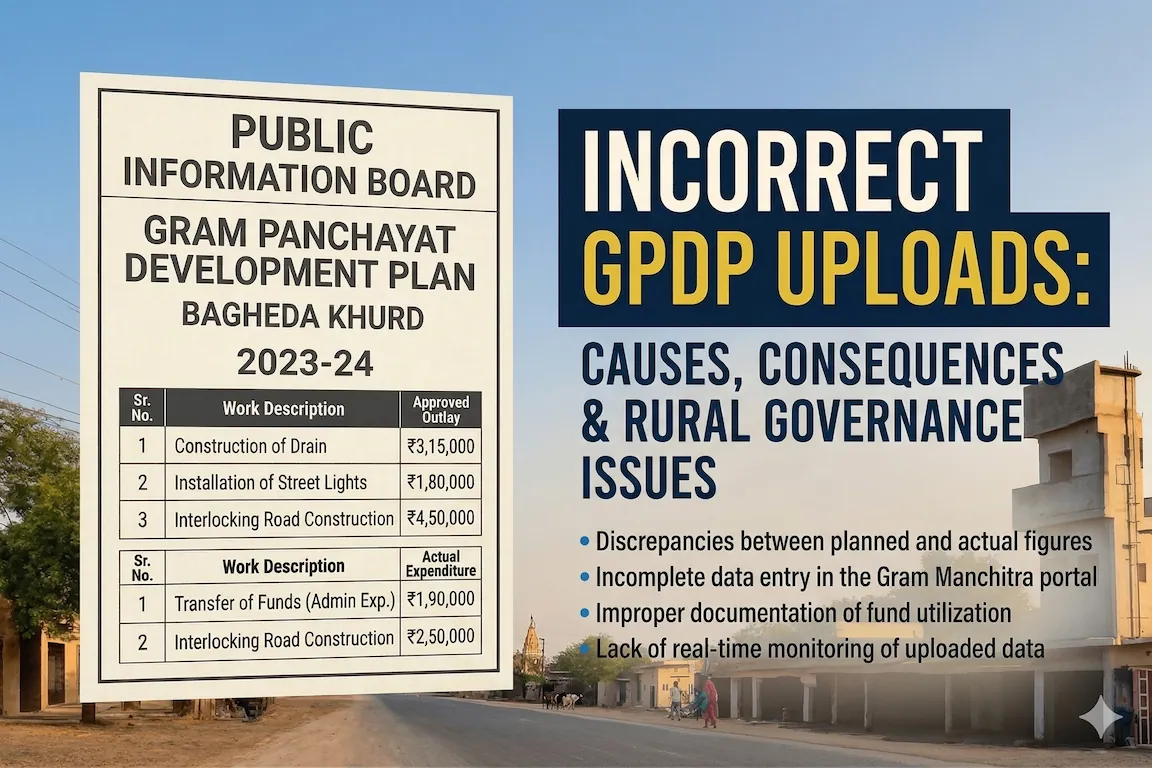
🔑 Key Takeaways (Incorrect GPDP Uploads in Rural Governance)
1. Incorrect GPDP Uploads Can Severely Damage Rural Transparency
Incorrect GPDP Uploads in Rural Governance can have serious consequences. When the GPDP portal displays wrong information—such as a PIB from another village—it disrupts public trust, blocks citizen oversight, and distorts the village’s official development record.
2. GPDP Portal Contains Approved Plans, Not Proposals (Incorrect GPDP Uploads in Rural Governance)
The GPDP system showcases final, approved Gram Panchayat Development Plans, not draft proposals. Therefore, officials cannot justify mistakes by calling them “only proposals.”
3. Public Information Boards (PIBs) Carry Official Weight
PIBs are created after the Gram Sabha approves the development plan. Because they act as public disclosures, uploading the wrong PIB represents a serious administrative lapse.
4. Wrong Uploads Disrupt Planning, Auditing, and Fund Allocation
Incorrect GPDP uploads confuse residents, misalign budgets, and undermine social audits. As a result, development monitoring becomes unreliable. (Incorrect GPDP Uploads in Rural Governance)
5. Misleading Explanations Undermine Accountability
Dismissing a wrong upload as a “proposal” misleads citizens and hides administrative negligence. Officials must provide accurate and transparent information.
6. The Incident Reveals Systemic Weaknesses
The case highlights: (Incorrect GPDP Uploads in Rural Governance)
- Lack of verification before upload
- Poor data‑management practices
- Weak supervision at Panchayat and block levels
- Inadequate RTI responses
These weaknesses weaken the effectiveness of digital governance.
7. Incorrect Uploads Harm Citizen Rights
Villagers lose access to accurate development records, which limits their ability to:
- Track approved works
- File meaningful RTI applications
- Participate effectively in governance
8. Authorities Must Act Quickly and Responsibly (Incorrect GPDP Uploads in Rural Governance)
To fix such errors, authorities should:
- Replace incorrect uploads immediately
- Upload corrected PIBs
- Identify and hold the responsible officers accountable
- Introduce stronger verification and audit mechanisms
9. Long‑Term Reforms Are Essential
To prevent future errors, government offices need:
- Better training for Panchayat staff
- Mandatory cross‑checks before uploads
- Automated validation systems
- Regular GPDP data audits
10. Digital Governance Works Only When Data Is Accurate (Incorrect GPDP Uploads in Rural Governance)
Ultimately, digital governance must reflect the truth. Villagers depend on the GPDP portal for transparency, oversight, and accountability for development. Therefore, accuracy is not optional—it is essential.
Incorrect GPDP Uploads in Rural Governance: Why a Digital Error Can Disrupt Entire Villages
The spread of digital governance tools across India has promised citizens greater transparency, smoother access to information, and a more accountable local administration. However, when these systems contain errors, the effects ripple through the community. A recent incident involving incorrect GPDP uploads in rural governance—specifically, the wrong Public Information Board (PIB) appearing under Bihasara Khurd’s GPDP page—reveals how a seemingly small digital mistake can undermine public trust, distort planning, and weaken transparency.
This blog explores the serious consequences of such incorrect uploads and highlights why accurate data matters more than ever in rural development.
Understanding the GPDP Portal and Its Critical Role
GPDP Represents an Approved Action Plan, Not a Draft
The Gram Panchayat Development Plan (GPDP) is the backbone of rural development. Through a structured process, the Gram Sabha identifies needs, prioritizes works, and approves the final list of development activities. Because of this structured process, the GPDP portal showcases approved plans, not preliminary proposals.
Furthermore, every entry on the GPDP portal reflects community‑endorsed decisions, administrative approval, and budgetary intent. Therefore, any incorrect upload directly affects the integrity of the planning system.
Why Accuracy on the GPDP Portal Matters
A properly uploaded GPDP ensures that residents can verify:
- Which works the Panchayat approved
- How funds will be allocated
- Which tasks require urgent completion
- Whether authorities follow the planned priorities
When the digital record is wrong, residents lose the ability to monitor progress effectively. Consequently, accountability weakens across multiple layers of the governance chain.
The Importance of Public Information Boards (PIBs)
PIBs Are Public Declarations of Finalised Decisions
The Public Information Board plays a crucial role in conveying development decisions to villagers. After the Gram Sabha approves the GPDP, officials create PIBs to publicly display:
- Approved works
- Sanctioned amounts
- Department-wise responsibilities
- Campaign-year verification
- Implementation timelines
Since people rely on PIBs to understand what has been authorised, accuracy becomes vital for public confidence.
Why PIBs Cannot Be Considered Proposals
PIBs reflect finalised decisions. They are displayed publicly and uploaded digitally only after approval. Because they represent sanctioned actions, they cannot be labelled as proposals under any circumstance. Therefore, claiming that an incorrect PIB upload is “just a proposal” shows a serious misunderstanding of the governance process.
Incorrect GPDP Uploads in Rural Governance: The Case of Bihasara Khurd
What Went Wrong?
The GPDP portal for Bihasara Khurd displayed the PIB of Bagheda Khurd, an entirely different village. As a result:
- The listed works did not match Bihasara Khurd’s needs
- Dates and entries belonged to a separate Panchayat
- Residents could not trace their own development activities
This mismatch highlights a significant example of incorrect GPDP uploads in rural governance, showing how a digital mistake can easily distort official records.
Why This Is a Serious Issue
Although the error may seem clerical, it has far-reaching implications:
- Residents cannot verify sanctioned works
- Social audit becomes difficult or impossible
- RTI queries receive misleading responses
- Higher authorities receive wrong planning data
- Public trust declines sharply
Because GPDP data influences fund allocation and monitoring, a wrong upload disrupts every stage of the governance process.
The Problem With Dismissing Errors as “Only a Proposal”
This Explanation Undermines Accountability
When concerned citizens raised questions, some local officials responded by saying the PIB was “only a proposal.” However, this explanation is incorrect. Moreover, it prevents meaningful corrective actions and limits transparency.
Why the Explanation Is Incorrect
The claim is flawed for several reasons:
- Proposals never reach the PIB stage
- GPDP uploads reflect only approved documents
- PIBs contain official dates, signatures, and verification
- The portal does not support draft or tentative uploads
Consequently, dismissing an incorrect GPDP upload in rural governance by calling it a proposal misleads the community and hides administrative lapses.
Administrative Weaknesses Highlighted by the Wrong Upload
Lack of Verification
The incident shows that responsible officials failed to verify the uploaded document. Multiple layers—Panchayat Secretary, VDO, ADO Panchayat—should check every record before uploading. Their oversight allows errors to slip through unnoticed.
Inadequate Digital Management
Incorrect uploads also reveal gaps in:
- Data validation
- Upload authentication
- Administrative monitoring
- Technical supervision
As a result, rural governance becomes vulnerable to misinformation.
Failure to Provide Accurate RTI Responses
When villagers filed RTI queries, they received vague or incorrect answers. Instead of correcting the mistake, officials pushed misleading explanations, weakening the RTI framework itself.
How Incorrect GPDP Uploads in Rural Governance Affect Communities
Impact on Development Planning
Wrong uploads create chaos in:
- Planning future works
- Reviewing old projects
- Matching expenditures to plans
- Conducting audits
Therefore, incorrect GPDP uploads disrupt every layer of development governance.
Impact on Citizens’ Rights (Incorrect GPDP Uploads in Rural Governance)
Villagers lose their right to verify planned works, track budgets, and hold officials accountable. Additionally, they cannot assess whether funds have been used properly.
Impact on Governance Reputation
Repeated mistakes weaken citizens’ trust in digital systems designed to empower them. Ultimately, digital governance loses credibility when the information it displays remains unreliable.
How Authorities Can Prevent Future Errors
Immediate Steps (Incorrect GPDP Uploads in Rural Governance)
Authorities should:
- Remove the incorrect upload quickly
- Upload the correct PIB
- Identify the responsible staff
- Inform villagers once corrections are made
A quick response can rebuild trust and maintain transparency.
Long-Term Improvements
To strengthen governance systems, officials should adopt:
- Better verification workflows
- Training programs for Panchayat staff
- Automated checks for village-name mismatches
- Regular audits of GPDP entries
These measures will reduce errors and improve reliability across the platform.
Conclusion: Digital Governance Requires Accuracy and Integrity (Incorrect GPDP Uploads in Rural Governance)
Incorrect GPDP uploads in rural governance may appear minor, yet they produce significant downstream effects. When a village discovers that its official development plan belongs to another Panchayat, trust erodes instantly. Because digital platforms shape modern rural administration, they must display accurate, verified, and responsible data. Only then will digital governance truly support villagers, strengthen transparency, and promote accountable development.
### DPRO Mirzapur (District Panchayat Raj Officer, Mirzapur) (Incorrect GPDP Uploads in Rural Governance)
Official Email
dpromi-up@nic.in
(Email of the PIO for Mirzapur)
Official Phone Number
05442-252883
(Phone number of the officer handling RTI transferred to DPRO Mirzapur) [gpdp.nic.in]
Official District Website
https://mirzapur.nic.in/
(District Mirzapur official portal providing department directories)
[panchayatsetu.in]
✅ FINAL SUMMARY (Only Required Authorities) (Incorrect GPDP Uploads in Rural Governance)
| Authority | Mobile / Phone | Website URL | |
|---|---|---|---|
| DPRO Mirzapur | dpromi-up@nic.in | 05442‑252883 | https://mirzapur.nic.in/ |
| BDO Chhanbey | (No official email published) | RTI-confirmed authority; block contacts available via Secretaries: 8957262198, 8707752909, 9454100568 | https://mirzapur.nic.in/block/ |
| UPIC (Uttar Pradesh Information Commission) | webmaster-upic@up.gov.in | 0522‑2724930 / 0522‑2288949 | https://upic.gov.in/ and https://upsic.up.gov.in/ |


Facing a similar challenge? Share the details in the box below, and our team of experts will do their best to help.