
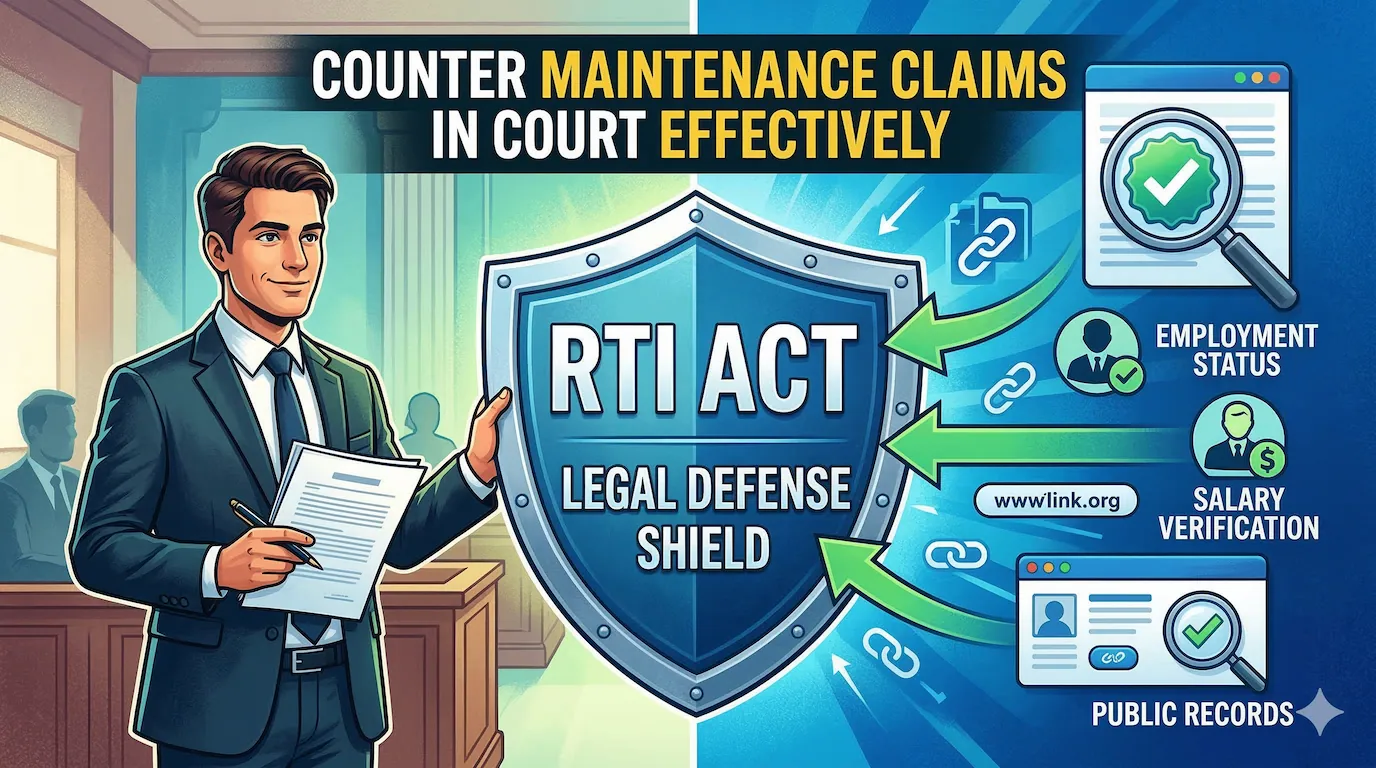
⚖️ Counter Maintenance Claims in Court: How to Use Public Information to Fight a Maintenance Suit
Key Takeaways (Counter Maintenance Claims in Court)
- The RTI Act can serve as a legal shield in maintenance suits by providing verified public information about employment status.
- Individuals can submit an RTI application to confirm or deny claims made by a spouse regarding their financial capacity.
- The case of Indradev Yadav illustrates how using RTI effectively can challenge false employment allegations in court.
- Critical information includes identity confirmation, date of joining, and current service status to support the legal defense.
- A formal RTI response grounds court decisions in authenticated departmental facts, enhancing the chances of a just outcome.
Counter Maintenance Claims in Court: When Personal Disputes Meet Public Records
In India, personal legal battles often concern matrimonial maintenance. These cases typically fall under laws like the Code of Criminal Procedure (CrPC) Section 125. Sometimes, they involve parties seeking to Counter Maintenance Claims in Court. The outcomes often hinge on the financial capacity of the parties involved. They also depend on the employment status of the individuals.
Allegations regarding a spouse’s employment, salary, and position can be easily made in court. However, proving or disproving these claims requires concrete, authoritative evidence.
This is the point where the Right to Information (RTI) Act, 2005, transforms. It changes from a tool for transparency into a powerful shield for legal defense. For individuals facing maintenance demands based on unverified employment claims, an RTI application can compel the concerned government department. They can officially confirm or deny the alleged employment status. This provides irrefutable proof for the family court.
The case of Indradev Yadav (RTI Registration No. DIRMH/R/2025/67269) against the Medical and Health Department, Mirzapur, serves as a textbook example of this strategic legal maneuver.
🧐 The Legal Context: Disputing Employment Status
The foundational premise of a maintenance suit is the petitioner’s inability to maintain herself. The respondent has the financial ability to provide for her. A petitioner may claim that the respondent is employed in a high-paying government job. In that case, the court will typically rely on this claim. This reliance stands unless contradicted by strong evidence.
In this specific scenario, Mr. Yadav’s wife has instituted a maintenance suit, seeking a substantial sum of Rs. 20,000 per month, based on the assertion that he is working in the Department of Medical and Health, Mirzapur.
The challenge for the respondent, Mr Yadav, is to obtain an official declaration from the public authority. This authority is the Chief Medical Officer (CMO), Mirzapur. The declaration should state that he is either not an employee or that no staff member matches his identity. A simple affidavit from the respondent denying employment may not carry the same weight. A formal document’s significance.
🎯 The Strategic Use of the RTI Application
Mr. Yadav’s RTI application was filed under Section 6(1) of the RTI Act. It is meticulously crafted to elicit three pieces of information. These pieces directly address the court’s requirement for evidence. The application correctly identifies the Chief Medical Officer (CMO), Mirzapur, as the PIO and clearly lists the questions: (Counter Maintenance Claims in Court)
1. Identity Confirmation (The Core Question) (Counter Maintenance Claims in Court)
The most critical question asks whether any staff member currently works in the Department of Medical and Health, Mirzapur. Does any of them have the same identity as the information seeker, Indradev Yadav? This is determined by documents like his Aadhar card, mark sheets, and photographs.
This is a request for a clear Yes or No confirmation. The department cannot evade this by citing privacy. The information sought is limited to the existence of an employee matching the applicant’s public identity details. It does not include their sensitive service record unless the applicant is identified as that employee.
2. Date of Joining
If the department confirms a match, the next logical question seeks the date of joining. This provides the necessary timeline for the court to assess the validity of the employment claim.
3. Current Service Status (Counter Maintenance Claims in Court)
Requesting the current service status is important. This includes statuses such as Active, Suspended, or Retired. It ensures the court receives the most up-to-date information. This information pertains to the individual’s employment at the time of litigation.
📝 Procedural Precision: Ensuring Compliance
The success of a legal defense RTI often depends on strict adherence to the PIO’s application requirements. Mr. Yadav’s application demonstrates awareness of key procedural requirements:
- PIO Identification: Correctly addressing the application to the PIO (CMO Mirzapur) as the custodian of the records.
- Documentation: Attaching supporting documents (Aadhar, mark sheets) ensures the department has the necessary data to perform the identity search. Crucially, attaching pages from the maintenance suit paper book provides the context and establishes the relevance of the information sought.
Why the Character Constraint Matters
The highly restrictive character requirement of many Indian government portals, as seen in this case, imposes brevity on the applicant. This requirement forces a direct, telegraphic style. While challenging, this often results in a clear and unambiguous request, which minimizes the PIO’s scope for rejection or misinterpretation. Every punctuation mark and word must be justified, leading to highly focused questions. (Counter Maintenance Claims in Court)
🏛️ The Impact in Court
Once the PIO responds to this RTI application, the resulting document becomes a public record under the RTI Act.
- If the CMO denies the match: The PIO’s formal denial letter is powerful evidence for the Family Court. It directly contradicts the petitioner’s claim of employment in that specific department. This can significantly reduce or eliminate the maintenance claim based on the alleged high income.
- If the CMO confirms the match: The PIO’s response will officially establish the employment details. The petitioner can then use these details. At least the facts are clear and based on departmental records.
In either scenario, the RTI response eliminates speculation. It grounds the court’s decision in authenticated departmental facts. This makes it an invaluable tool in procedural law. By utilizing the RTI Act, individuals like Mr. Yadav transform a personal allegation into a matter of public record, securing factual clarity necessary for a just legal resolution.


Facing a similar challenge? Share the details in the box below, and our team of experts will do their best to help.