
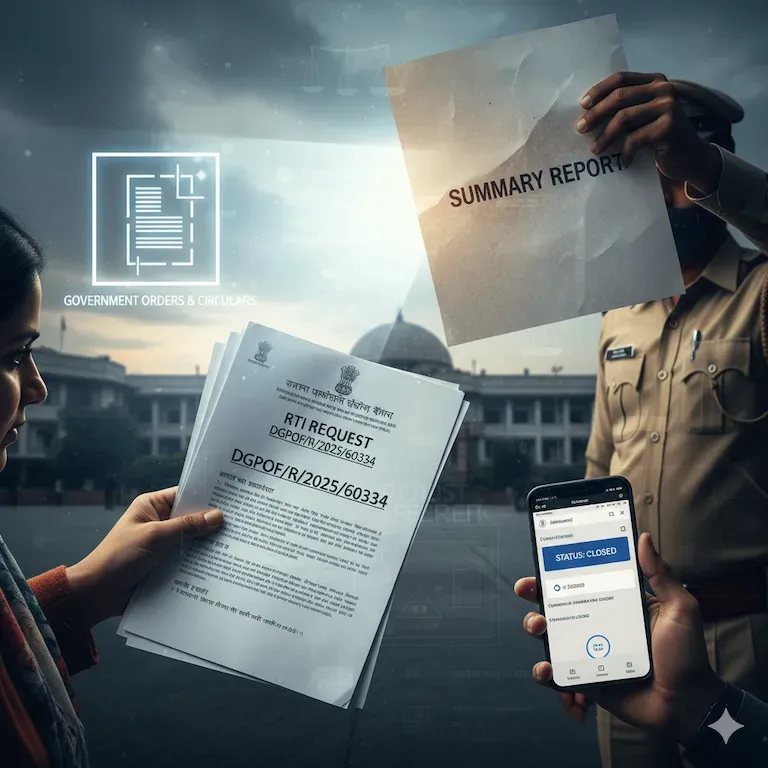
Uttar Pradesh Police Accountability in RTI Requests is a crucial aspect of ensuring transparency and accountability within law enforcement agencies. The Right to Information (RTI) Act empowers citizens to seek information regarding the functioning and activities of the police force. By granting access to records, statements, and operational procedures, the RTI mechanism serves as a tool for holding the police accountable for their actions. Citizens can inquire about police practices, filing of FIRs, and handling of complaints, thereby fostering a culture of openness and diligence. Improved accountability through RTI requests can lead to enhanced public trust and a more responsive policing system.
Key takeaways from the blog post
Here are the key takeaways from the analysis of Mahima Maurya’s struggle with the Mirzapur police administration and the RTI process—an example of why Uttar Pradesh Police Accountability in RTI Requests matters in practice:
1. “Information” vs. “Justification”
The Public Information Officer (PIO) failed first. The PIO provided a summary report (opinion), not the specific records (Government Orders/Circulars) requested. Under the RTI Act, the PIO must provide existing documents. The PIO must not replace them with a subordinate officer’s justification.
2. Violation of Mandatory FIR Norms
However, the police claim they were “powerless” to act. That claim contradicts the Supreme Court’s mandate in the Lalita Kumari case. The applicant provided a government medical certificate that showed a bone fracture (a cognizable offence). Therefore, the police must register an FIR. They should not direct the victim to approach a court first.
3. Misuse of Administrative Portals
Meanwhile, officials use the Jansunwai (IGRS) system as a paper-forwarding exercise. The accused station (Vindhyachal) writes its own “clearance report.” Then higher officials rubber-stamp it. As a result, the grievance redressal mechanism loses objective oversight.
4. The “Deemed Refusal” Gap
In addition, the PIO (Additional SP Dinesh Kumar Dwivedi) did not provide the actual legal documents that supposedly “allow” an SHO to ignore a victim’s name or injuries. Therefore, the response amounts to a legal “deemed refusal” or misleading information. This is consistent with a broader pattern: the DGP office provided misleading information to Mahima Maurya on a separate occasion as well.
5. Contradiction in Police Protocol
Finally, the post exposes a critical flaw. If the police treated the matter as non-actionable or “minor,” they had no reason to order a formal medical test at a Community Health Centre. By conducting the test, they acknowledged a possible crime. Yet they refused to file an FIR. In contrast, the victim needs an FIR to access remedies.
Recommended Next Steps
- File a First Appeal: Challenge the PIO’s response because a “summary report” is not the “certified copy of circulars” requested.
- Invoke Section 18: Prepare a complaint to the State Information Commission regarding the deliberate obstruction of information.
Uttar Pradesh Police Accountability in RTI Requests: The RTI Mirage in Mirzapur
The Right to Information (RTI) Act often serves as the last line of defence for ordinary citizens. However, cases like this show why Uttar Pradesh Police Accountability in RTI Requests has become an urgent public concern. The case of Mahima Maurya vs the Police Establishment of Mirzapur highlights a troubling trend. Officials turn a transparency tool into a bureaucratic maze. When a citizen asks for specific government orders, officers respond with a “summary report.” Worse, the report comes from the very officers the complaint targets.
This is not just an administrative lapse; it is a systemic “diagnostic deadlock” that leaves victims of violence powerless.
The Core Issue: RTI Requests vs Justification (and Uttar Pradesh Police Accountability)
Mahima Maurya filed an RTI and asked for five specific points after a brutal assault left her with a bone fracture and head injuries. Instead of the requested circulars, government orders, or office memos, she received a summary report. A Sub-Inspector at the Vindhyachal Police Station wrote that report.
Under the RTI Act, the Public Information Officer (PIO) must provide records. A Sub-Inspector’s justification for not registering an FIR is only a statement. It is not the “information” the applicant sought. Moreover, when officials replace legal documents with personal opinions, they shield the Mirzapur police from accountability.
The “Teethless” Police Station: A Legal Fallacy
The SHO’s claim stands out. The Station House Officer (SHO) said the police were “powerless” to act. The SHO also told the victim to “take shelter in a court of law.” (Uttar Pradesh Police)
This directly contradicts the landmark Supreme Court judgment in Lalita Kumari vs Govt. of U.P., which established clear mandates for the police:
- Mandatory Registration: If a complaint discloses a cognizable offence (like serious physical assault), an FIR must be registered immediately.
- No Discretion: Police do not have the authority to “advise” a victim to go to court instead of filing an FIR when a crime has been committed.
- Medical Evidence: When a government hospital certificate confirms a fracture, the “non-cognizable” (NCR) status is often a deliberate attempt to minimise the gravity of the crime.
The Jansunwai Paradox: Where Complaints Go to Die (Uttar Pradesh Police)
The government designed the Jansunwai (IGRS) portal to bridge the gap between the public and the Chief Minister’s office. However, for Mahima Maurya, it has become a loop. She sees “forwarded” and “disposed” statuses. Yet she gets no real resolution.
Reports suggest the portal tracks the movement of paper. However, it rarely tracks the quality of justice delivered. For example, a Circle Officer or an Additional SP may rely on a subordinate’s report to close a grievance. If that subordinate belongs to the accused station, oversight collapses. As a result, the mechanism defeats its own purpose.
Right to reason is an indispensable part of a sound administrative system.” — This principle from Mahima’s application remains ignored as the police fail to explain why a fracture does not merit a cognizable FIR.
Analysis of the 5 Points Withheld in RTI Requests
The RTI sought to uncover the “why” and “how” of police inaction. Here is a breakdown of the missing transparency: (Uttar Pradesh Police)
| Point No. | Information Requested | Police Response/Status |
| 1 & 2 | Orders allowing an SHO to omit names or remain “powerless.” | Substituted with a Sub-Inspector’s “justification report.” |
| 3 | Legislation prohibiting vulnerable sections from filing FIRs. | No copy of any such (non-existent) legislation provided. |
| 4 | The reason for not registering the FIR. | Vague administrative summary instead of a legal basis. |
| 5 | Why was a medical test done if no FIR was intended? | Left largely unaddressed in the summary. |
The Way Forward: Breaking the Silence
Now the dispute is moving beyond the police station. Mahima Maurya will press the issue before the First Appellate Authority. She may also approach the State Information Commission. When the PIO (Dinesh Kumar Dwivedi, Additional SP) withholds the requested circulars, the law treats it as a “deemed refusal.” (Uttar Pradesh Police)
Steps for Accountability
- First Appeal: Since the information provided was misleading and incomplete, a First Appeal must be filed emphasising that a “Summary Report” is not “Information” under Section 2(f) of the RTI Act.
- Section 18 Complaint: A complaint to the State Information Commission regarding the PIO’s attempt to obstruct information by providing irrelevant documents.
- Judicial Intervention: If the police continue to ignore the medical evidence of “Grievous Hurt,” a petition under Section 156(3) of the CrPC (or the relevant BNS section) is the next legal step to force the registration of an FIR.
Conclusion
Mahima Maurya’s case tests the Uttar Pradesh police’s commitment to women’s safety. When the “protectors” of the law use paperwork to justify inaction, they fail more than one person. They also weaken public trust in the system. Therefore, Uttar Pradesh Police Accountability in RTI Requests must move beyond slogans. It must ensure timely disclosure of records. It must also trigger lawful action on cognizable offences.
In addition, the Director General of Police (DGP) office must recognise a basic point. An RTI is not a request for a “summary of excuses.” Instead, it is a demand for the rule of law.
To assist you with following up on your application, here are the official contact details for the relevant public authorities, based on the documents you provided and official government directories.
1. Primary Public Authority (DGP Office)(Uttar Pradesh Police Accountability in RTI Requests)
Since your RTI was filed with the Director General of Police HQ, this is the main nodal point for your request.
- Public Information Officer (PIO):
- Name: Dinesh Kumar Dwivedi (Additional SP, Public Grievance)
- Mobile: 9454405121 / 9454404917
- Email: rti.dgphq-up@gov.in / digcomplaint-up@nic.in
- Appellate Authority (FAA):
- Designation: Inspector General / DIG (Public Grievance), DGP HQ
- Address: Tower-4, Police Headquarters, Gomti Nagar Extension, Lucknow, UP.
2. District Public Authority (Mirzapur) (Uttar Pradesh Police Accountability in RTI Requests)
Since your request was transferred to the Superintendent of Police (SP) Mirzapur, they are responsible for the specific report from Vindhyachal station.
- Nodal Officer / SP Mirzapur:
- Mobile (CUG): 9454400299
- Landline: 05442-252578
- Email: spmzr-up@nic.in
- Additional SP (City) Mirzapur:
- Mobile: 9454401104
- Email: asp-city.mi@up.gov.in
- Circle Officer (CO) City Mirzapur:
- Mobile: 9454401590
- Email: co-city.mi@up.gov.in
3. Grievance & Web Portals (Uttar Pradesh Police Accountability in RTI Requests)
If the RTI response is unsatisfactory, you can escalate via these official links:
| Portal | Purpose | Web Link |
| RTI Online UP | To file a First Appeal online | rtionline.up.gov.in |
| Jansunwai (IGRS) | To report police inaction to the CM | jansunwai.up.nic.in |
| UP Police Official | To find station-specific emails | uppolice.gov.in |
4. Important Summary of Your RTI Details
- Registration Number: DGPOF/R/2025/60334
- Transferred Number: SPMZR/R/2024/80020
- Previous Reference: DGPOF/R/2024/60974
Next Recommended Step (Uttar Pradesh Police Accountability in RTI Requests)
Since the 30-day period is active and you have received a “summary” instead of the requested “orders/circulars,” you should prepare a First Appeal under Section 19(1) of the RTI Act.
Would you like me to draft a formal “First Appeal” letter for you to send to the Appellate Authority at the DGP Headquarters?


Facing a similar challenge? Share the details in the box below, and our team of experts will do their best to help.