
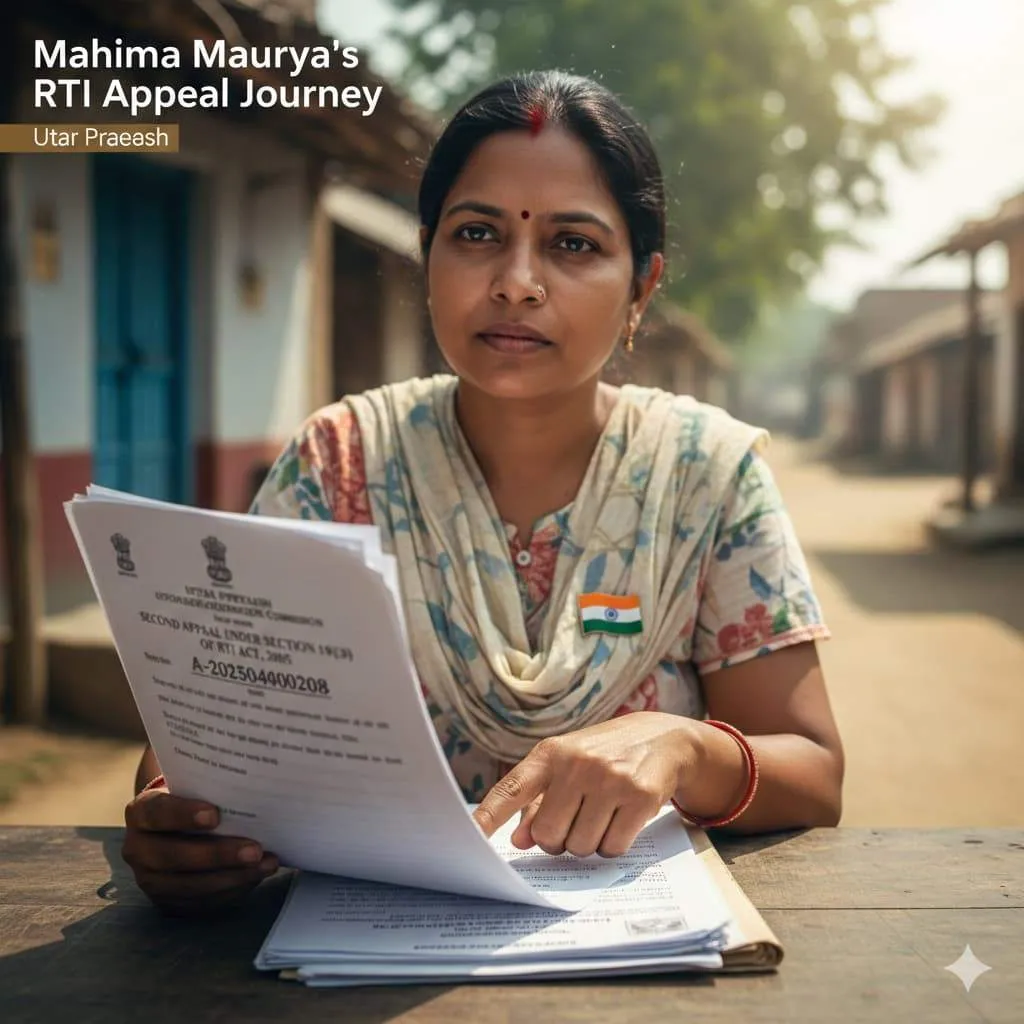
Mahima Maurya’s RTI appeal traces the obstacles she faced while seeking crucial police records from public authorities in Uttar Pradesh. Filing an RTI request can be complex, and her case shows exactly why. Bureaucratic red tape, unresponsive officials, and vague denials repeatedly stalled her request. Meanwhile, incorrect information and long waiting periods added further delay at nearly every stage. Despite this, her persistence highlights why accountability within public institutions matters. As a result, Mahima Maurya’s RTI appeal offers a clear window into the systemic issues many citizens face. In particular, it shows the barriers people encounter when pursuing information critical to civic engagement and government transparency.
Key Takeaways from Mahima Maurya’s RTI Appeal
- Mahima Maurya’s RTI appeal highlights the challenges in obtaining police records, exposing bureaucratic obstacles and unresponsive officials.
- Her struggle emphasizes the need for accountability within public institutions and the complexities of the RTI process.
- The appeal’s core issues include incomplete and misleading information from the Public Information Officer (PIO) and inadequate responses to specific requests.
- The Information Commission’s role is crucial in addressing the deficiencies in provided information and holding officials accountable.
- This case underscores the ongoing battle for transparency in governance and the importance of the RTI Act in empowering citizens.
⚖️ A Citizen’s Struggle for Information: Analyzing the Second Appeal under RTI Act, 2005
The RTI Act, 2005, is a cornerstone of Indian democracy. It empowers citizens to hold public authorities accountable. When this process faces bureaucratic stonewalling or misleading responses, the recourse is often a Second Appeal to the State Information Commission. Accordingly, this post analyzes a recent Second Appeal filed by Mahima Maurya, highlighting the issues raised and the apparent deficiencies in the information provided.
📅 Timeline of Mahima Maurya’s RTI Appeal
The appellant, Mahima Maurya from Mirzapur, Uttar Pradesh, initiated her quest for specific police records related to a complaint she made.
- RTI Application Date (Section 6(1)): November 6, 2024
- Registration No.: SPMZR/R/2024/60200
- PIO Reply Date: December 5, 2024 (Deemed Incomplete/Unsatisfactory)
- First Appeal Date (Section 19(1)): December 18, 2024
- Registration No.: SPMZR/A/2024/60047
- FAA Order Date: January 24, 2025 (Deemed Unsatisfactory/False/Misleading)
- Second Appeal Date (Section 19(3)): April 5, 2025
Overall, the core of the appeal lies in the appellant’s assertion that the Public Information Officer (PIO) provided “incomplete misleading information.” Meanwhile, the First Appellate Authority (FAA) “justified it through arbitrary report of investigation officer,” which the appellant frames as an “insolence to the provisions of RTI.”
🔍 Analysis of Mahima Maurya’s RTI Appeal: Sought Information vs. Provided Replies
Here, Mahima Maurya’s RTI appeal breaks down into five specific requests, each met with a corresponding, often evasive, reply. Notably, a comparative breakdown reveals the nature of the alleged deception:
Request 1: Copy of Complaint Registered based on Medical Report
- Sought Information: She requested a copy of the complaint registered by Vindhyachal police based on her medical examination report.
- Provided Information: A generic statement citing orders on how the main victim’s name is mentioned in the First Information Report or Non-Cognizable Report.
- Appellant’s Submission: The PIO failed to provide the copy requested, offering a non-responsive, misleading statement instead.
Request 2: Copy of the Information Seeker’s (Victim’s) Witness Testimony
- Sought Information: She asked for a copy of her own witness testimony as the main victim.
- Provided Information: The PIO cited an NCR (Non-Cognizable Report) No. 104/24, registered on September 14, 2024, based on the complaint of her husband, Pramod Kumar Kushwaha.
- Appellant’s Submission: Instead, the police did not provide the victim’s (Mahima Maurya’s) testimony, referring only to an NCR filed on her husband’s complaint. So, this suggests the police never recorded her own statement as the primary victim — a crucial piece of information they were asked to provide.
#Request 3: Copy of Any Police Complaint Registered with Information Seeker’s Name
- Sought Information: She sought any complaint registered by the police that mentioned the information seeker’s name.
- Provided Information: “No”
- Appellant’s Submission: However, the PIO gave no reason for the denial, a requirement under Section 4(1)(d) of the RTI Act, 2005.
This pattern of evasive replies recurs throughout Mahima Maurya’s RTI appeal, with each subsequent request met by a similarly incomplete response.
Request 4 in Mahima Maurya’s RTI Appeal: Police Findings Report
- Sought Information: She requested the police findings report based on her complaint, for use in a court of law.
- Provided Information: Again, the PIO cited the NCR 104/24 registered on her husband’s complaint.
- Appellant’s Submission: Consequently, the PIO appears to have conflated the applicant’s complaint with her husband’s, leaving her specific complaint and its findings unaddressed. So the core question remains: is this report actually based on Mahima Maurya’s complaint?
Requests 5 & 6: Circle Officer City’s Report and Report to Chief Minister’s Office
- Sought Information 5: She also sought the Circle Officer City’s report on her complaint.
- Sought Information 6: Additionally, she requested the report submitted to the Chief Minister’s Office based on that investigation.
- Provided Information 5: No such report provided.
- Provided Information 6: PIO did not entertain this request.
- Appellant’s Submission: Altogether, the PIO failed to address two direct requests, further demonstrating a lack of compliance.
🚨 The Information Commission’s Role in Mahima Maurya’s RTI Appeal
The appellant is seeking intervention under Section 19(3) of the RTI Act, alleging an act “tantamount to anarchy in the working of the public authority,” which must be “curbed at the initial stages.”
Therefore, the Uttar Pradesh Information Commission must now determine several key issues:
- Completeness of Information: Did PIO Sri Omprakash Singh fail to provide the copy of the document requested in Point 1?
- Accuracy and Evasion: Was citing her husband’s NCR, instead of her own complaint and testimony, a deliberate evasion of the RTI Act’s intent?
- Compliance with Section 4(1)(d): Was the reply of “No” to a registered complaint deficient, since no reasons for denial were given?
- Role of the FAA: Finally, did FAA Abhinandan Singh fail to rectify the PIO’s shortcomings, thereby rendering the First Appeal ineffective?
If the Commission finds the PIO’s actions deliberately obstructive or misleading, it can impose a penalty of up to Rs. 25,000 under Section 20(1). Furthermore, it can recommend disciplinary action against the PIO under Section 20(2). Ultimately, the Commission can also order the police to provide correct, complete information within a set time frame.
In short, Mahima Maurya’s RTI appeal is a powerful reminder of the ongoing challenge citizens face in securing transparency from public authorities. It underscores the vital, investigative role of the Information Commission in upholding the RTI Act.
Would you like to learn the full text of the NCR 104/24 sections cited (Section 115(2)/352 BNS) to better understand the nature of the complaint registered?


Facing a similar challenge? Share the details in the box below, and our team of experts will do their best to help.