
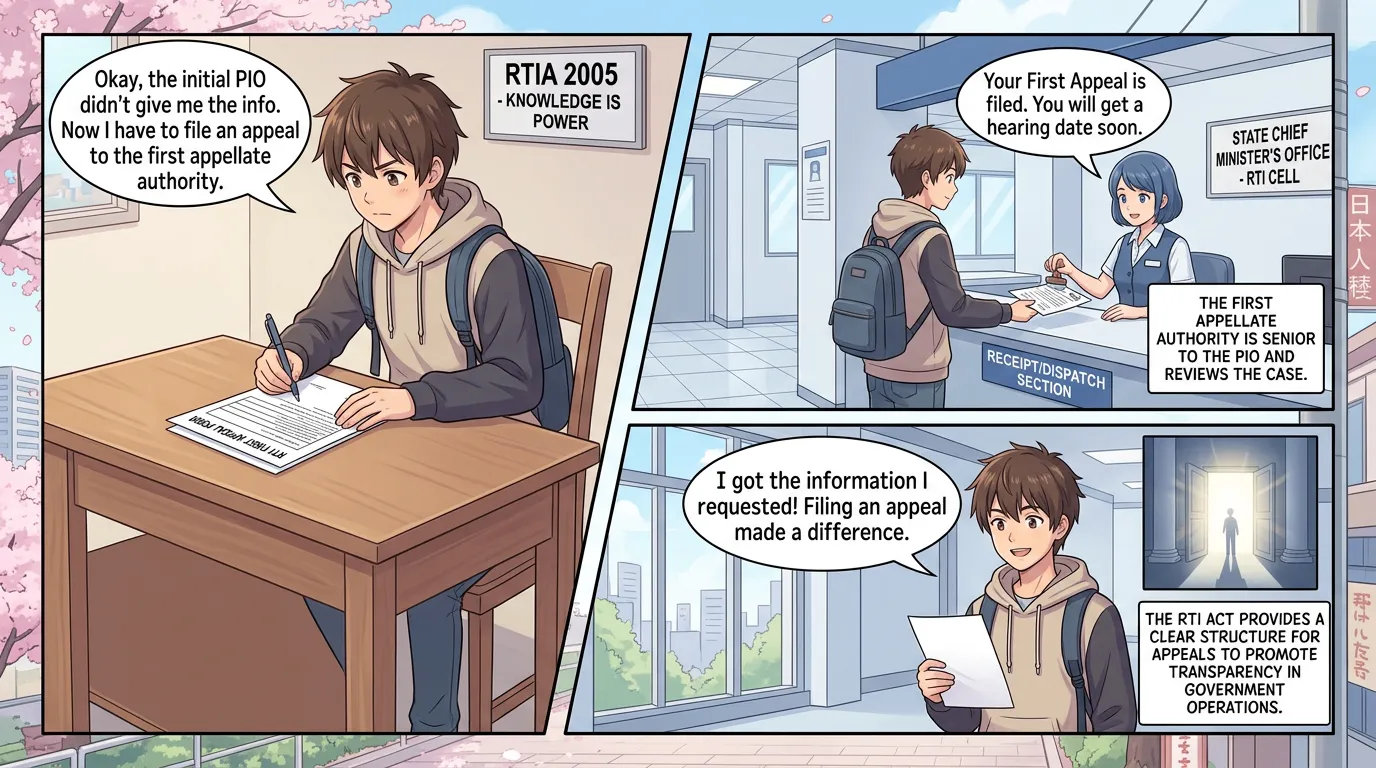
The PIO Chief Minister office did not give any information to the information seeker under the RTI Act 2005, which is designed to promote transparency and accountability in the functioning of public authorities.
Following the initial denial of information, the seeker consequently found it necessary to file an RTI Appeal at the PIO Chief Minister, thereby highlighting the importance of obtaining the relevant details to understand the decision-making processes within the government.
This situation ultimately raises concerns about the compliance of the Chief Minister’s office with the provisions of the RTI Act, as it is essential for citizens to have access to information pertaining to governmental activities in order to ensure that their rights are upheld and that they can hold public officials accountable for their actions.
Key Takeaways
- The Chief Minister’s office failed to provide information under the RTI Act, prompting a citizen to file an appeal.
- Indradev Yadav faced bureaucratic delays and incomplete responses regarding his grievance about the Nagar Nigam.
- Mr. Yadav’s RTI application cited concerns over the misdirection of his grievance to the wrong department.
- He seeks accountability and clearer answers to his specific questions regarding the handling of his grievance.
- The outcome of the appeal could influence transparency and accountability in public governance.
RTI Appeal at PIO Chief Minister for “Incomplete and Misleading” Information
This Right to Information (RTI) appeal at the PIO Chief Minister illustrates how a citizen struggles to obtain clear answers amidst a labyrinth of bureaucratic red tape and opacity. Moreover, authorities allegedly mishandled his public grievance by sending it to the wrong department,
resulting in significant delays and confusion that further exacerbated the citizen’s frustration. The unintended transfer of his request not only wasted precious time but also highlighted the systemic inefficiencies within the public information system,
raising concerns about accountability and transparency in governance. This situation exemplifies the challenges faced by ordinary citizens when they seek to engage with public institutions that are meant to serve them,
often leaving them feeling powerless in their quest for information.
Indradev Yadav is from Mirzapur, Uttar Pradesh. On December 27, 2024, he filed a First Appeal under the RTI Act at the Public Information Officer (PIO) Chief Minister’s Office (CMO). He claims, thus, that the PIO misled him. Furthermore, the officer provided incomplete information in response to his original RTI application. Additionally, the officer also neglected to handle the specific points he raised.
Mr. Yadav seeks accountability and clarification through the RTI Act regarding a public grievance that seemingly misdirected.
Case Overview: Key Details
- Appellant: Indradev Yadav
- Public Authority: Chief Minister’s Office, Uttar Pradesh
- RTI Application Number:
DOCMO/R/2024/61454 - Date of RTI Filing: October 26, 2024
- RTI Appeal Number:
DOCMO/A/2024/60180 - Date of Appeal Filing: December 27, 2024
- Grounds for Appeal: Provided Incomplete, Misleading, or False Information
The Backstory: A Misdirected Grievance
The issue began with a public grievance filed on the Government of India’s IGRS portal, which is designed to streamline the process of addressing citizens’ concerns and complaints regarding various government services. This platform allows individuals to submit their grievances directly to relevant authorities, ensuring that their voices are heard in a transparent manner. However, the case in question highlighted several challenges within this system, as the initial response from the government was delayed and inadequate, prompting further frustration among the affected parties. In light of this, an RTI Appeal was submitted to the Chief Minister’s Public Information Officer (PIO) to seek resolution, further underscoring the need for a more efficient mechanism for resolving issues submitted by the public.
- Grievance Reference Number:
60000240210955 - Grievance Pertained to: The functioning of the Nagar Nigam (Municipal Corporation) of Prayagraj.
- Action Taken by CMO: The CMO forwarded the grievance to the Superintendent of Police, District Mirzapur.
Mr. Yadav found this action inexplicable. As a result, the Superintendent of Police in Mirzapur has no jurisdiction over the Municipal Corporation in Prayagraj. To understand this discrepancy, he thus filed an RTI application with the UP CMO.
The Five Questions in the Original RTI Application
On October 26, 2024, Mr. Yadav sought the following specific information from the PIO of the Chief Minister’s Office:
- Firstly, Legal Provision: Which provision of law empowers the Superintendent of Police, Mirzapur, to handle a grievance? How can the authorities of police redress a grievance related to the Nagar Nigam, Prayagraj?
- Secondly, Accountability: What is the name and designation of the CMO staff member? Who processed and forwarded this grievance to the Mirzapur SP?
- Thirdly, Monitoring Body: Please give the posting details of the staff. They should be responsible for monitoring public grievances from the Government of India’s portal within the UP CMO. Also, supply the date they joined the office. (RTI Appeal at PIO Chief Minister)
- Furthermore, Reason for Action: Why did the authorities send the grievance? The grievance number is
60000240210955. It is about Nagar Nigam, Prayagraj. They forwarded it to the Superintendent of Police, Mirzapur? - Lastly, Rectification: Will the concerned CMO staff rectify this error by forwarding the grievance to the appropriate authority? If not, why?
The PIO’s Response: A Vague Deflection in matter RTI Appeal at PIO Chief Minister
In response, the PIO provided the following information, which Mr. Yadav found to be evasive and irrelevant to his specific questions:
Original Hindi Reply:
आपके पत्र में उल्लिखित भारत सरकार की आईजीआरएस शिकायत संदर्भ संख्या 60000240210955 अनुभाग में ऑनलाइन प्राप्त हुई थी जिसे दिनांक-19.11.2024 द्वारा अपर मुख्य सचिव/प्रमुख सचिव/सचिव, नगर विकास तथा नगरीय रोजगार एवं गरीबी उन्मूलन विभाग, उ0प्र0 शासन को अग्रेसित किया गया है जिसे पोर्टल पर देखा व प्राप्त किया जा सकता है |
English Translation Instrumental to access RTI Appeal at PIO Chief Minister
The IGRS complaint of the Government of India was mentioned in your letter; specifically, its reference number is 60000240210955. Furthermore, it was received online in the section. Additionally, it has been forwarded on 19.11.2024 to the Additional Chief Secretary/Principal Secretary/Secretary, Urban Development and Urban Employment and Poverty Alleviation Department, Govt. of U.P., which can be viewed and received on the portal.
Mr. Yadav says that the reply does not address his five questions. He wants the RTI Appeal at PIO Chief Minister to ensure that his concerns are properly addressed. He believes that transparency is vital for accountability in handling the issues he raised.
The Appeal: A Plea for Point-Wise Answers in RTI Appeal at PIO Chief Minister
In his appeal, Mr. Yadav reiterates his frustration, emphasizing the lack of adequate response he has received regarding his grievance. Specifically, he states, “The public information officer must know that he is not redressing the grievance. Instead, he is giving information that is tangential to my concerns and fails to address the core issues I raised. Therefore, he must supply the information according to the points of information I outlined, as it is not only my right as a citizen but also his duty to ensure that the public is served with clarity and accountability.”
His prayer to the First Appellate Authority (FAA) is to:
- Firstly, Direct the PIO to give clear, point-wise answers to his original five questions.
- Finally, Fix the accountability of the PIO. They showed “insolence to the RTI application”. They also undermined the provisions of the Right to Information Act.
The appeal is now under the purview of the designated First Appellate Authority.
Contact Details of Involved Officials
- First Appellate Authority (FAA):
- Name: Anjna Tripathi (LS-3)
- Designation: Under Secretary
- Phone No:
9454411282 - Email:
anjna.11282@gov.in
- Public Information Officer (PIO) Approached:
- Name: Vinod Sharma (L.S. Sec-3)
- Designation: Section Officer
- Phone No:
9454412736 - Email:
vsls32165@gmail.com
- Nodal Officer:
- Name: Sanjay Chaturvedi
- Email:
sanjay.10972@gov.in
The outcome of this appeal will decide if Mr. Yadav receives the specific information he sought to guarantee transparency and accountability in the handling of public grievances.
Chief Minister Office forwarded grievance about Nagar Nigam Prayagraj to SP Mirzapur


Facing a similar challenge? Share the details in the box below, and our team of experts will do their best to help.