
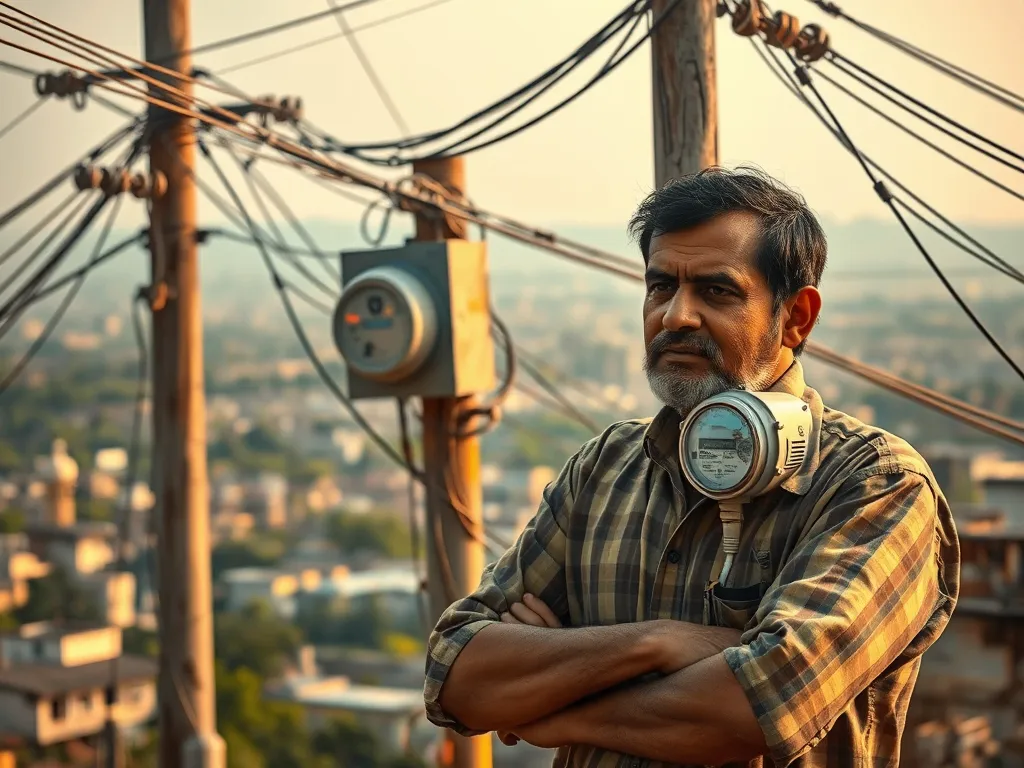
Grievance Regarding Smart Meter Installation in Mirzapur
The recent installation of smart meters in Mirzapur has raised significant concerns among the local residents. Many believe the execution of the process lacked proper consultation, leading to confusion and frustration. There are apprehensions about the accuracy of these meters and their impact on energy bills, with some individuals reporting unexpected spikes in their charges. Community members voice their health concerns about electromagnetic radiation from smart meters. They demand transparency and call for a thorough review of the installation procedures to ensure that decision-makers hear their voices and address their concerns.
Key takeaways
1. The Mandate vs. Reality (The “Cable Scam”)
The most significant takeaway is the technical discrepancy in installation.
- Official Policy: Executive Engineer Manish Kumar Srivastava states that any premises located within 40 meters of the LT line must have a new armoured cable installed free of charge during smart meter installation.
- The Violation: Contractors in Mirzapur (such as in the cases of Mahesh and Keshav Pratap Singh) are reportedly reusing old, un-armoured cables. This forces consumers to either accept a lower safety standard or buy their own cables, despite the government already paying contractors for these materials.
2. The “Blocklisted” Contractor Controversy (Grievance Regarding Smart Meter Installation)
The companies involved in the Uttar Pradesh rollout (notably Genus Power and HPL Electric) have faced significant legal and administrative hurdles elsewhere.
- The Goa Link: These firms were previously barred/blacklisted by the Goa Electricity Department for performance issues.
- UP Award: Despite this history, authorities awarded them multi-crore contracts in UP. Allegations suggest that they proceeded with only a 3% bank guarantee instead of the standard 10%, raising questions about high-level administrative favouritism.
3. Systematic Data and Billing Errors
The “smart” transition suffers from a lack of digital synchronisation. (Grievance Regarding Smart Meter Installation)
- Ghost Arrears: A significant lag in data transfer between the private contractor and the electricity department causes “phantom consumption” or arrears to appear on consumer bills. This happens because personnel often enter old meter readings incorrectly, resulting in discrepancies, such as a 520 kWh difference noted in several cases.
- Payment Lag: Even after a consumer pays, the “smart” meter may not reflect the balance for weeks due to delayed backend data feeding.
4. Lack of Accountability & “Missing” Records (Grievance Regarding Smart Meter Installation)
When questioned via RTI, the Electricity Distribution Division II (EDD-II) Mirzapur provided evasive responses:
- The department claimed it has no office records regarding the total funds paid to contractors or the specific staff assigned to monitor them.
- By labelling the work as “external,” the department effectively creates a “responsibility vacuum,” causing consumers to bounce between the SDO office and the private contractor’s helpdesk.
5. Selective Implementation and Theft (Grievance Regarding Smart Meter Installation)
Complainants allege that the department is targeting honest, bill-paying consumers for smart meter installation while ignoring areas notorious for electricity theft. This suggests that instead of using technology to curb losses, companies are using the system to further squeeze regular consumers who are easier to track.
Next Step: (Grievance Regarding Smart Meter Installation)
In the heart of Mirzapur district, a growing controversy surrounds the transition to smart electricity meters. This issue has reached the highest offices of government. What officials promised as a technological leap toward a “Digital India” has instead unravelled into allegations of contractor negligence. There are also claims of systemic corruption and bureaucratic apathy.
At the center of this battle is Yogi M. P. Singh, a local advocate and human rights defender, whose grievance—PMOPG/E/2025/0058307—filed with the Prime Minister’s Office, exposes the widening gap between departmental policy and ground-level execution.1
Grievance Regarding Smart Meter Installation: The “Armoured Cable” Discrepancy
The crux of the grievance lies in the technical specifications of smart meter installation. According to official guidelines provided by the Executive Engineer of Electricity Distribution Division II (EDD-II), Manish Kumar Srivastava, all premises located within 40 meters of the Low Tension (LT) line must equip themselves with new armoured cables during the smart meter rollout.
Despite this clear mandate, the contractor responsible for the installation in Mirzapur city allegedly bypassed these requirements.3 The specific cases highlighted include:
- Mahesh Pratap Singh (Account No: 2704668219)4
- Keshav Pratap Singh (Account No: 8667726000)5
In both instances, the contractor utilized old, substandard cables instead of the mandated armoured versions.6 This is not merely a technical oversight; it represents a potential misappropriation of government funds allocated for these materials.
RTI Insights: Evasive Responses from EDD-II Mirzapur
Mr. Singh’s pursuit of transparency through the Right to Information (RTI) Act (PUVNL/R/2024/60577) yielded startling revelations. The Executive Engineer’s response admitted that:
- Armoured cables are mandatory for premises within 40 meters of the LT line.7
- The work is being handled by an external agency (contractor) rather than departmental staff.8
- Crucially, the department claimed that details regarding the total funds provided to contractors and the specific staff assigned to monitor the work are “not available in office records.”9
This “lack of records” regarding public expenditure and monitoring has fueled suspicions of a deep-rooted scam.10 If the government is paying for armoured cables that are never installed, where is that money going?
Systemic Failures and Consumer Rights
The grievance doesn’t stop at faulty wiring. It highlights a broader “insensitivity” toward consumer rights in Mirzapur:
1. The Data Transfer Delay
A communication from September 2024 (Letter No. 5921) suggests that the private company is responsible for transferring consumer data.11 Until this transfer is complete, payments made by consumers do not reflect on their smart meters. This lag creates a “ghost billing” scenario where consumers remain in the dark about their actual balance.
2. Monitoring or Lack Thereof
The RTI response confirms that Purvanchal Vidyut Vitaran Nigam Limited (PuVVNL) has outsourced the installation to private players. However, the apparent absence of departmental oversight has allowed contractors to cut corners, pressuring consumers to provide their own cables or settle for old, dangerous wiring.
3. Arbitrary Implementation (Grievance Regarding Smart Meter Installation)
While some residents have had smart meters for months, others have been bypassed entirely without explanation. This inconsistency suggests a lack of a strategic rollout plan and further points toward a “pick and choose” approach by contractors.
Current Status: Under Process in the CM Secretariat
As of early 2026, the grievance remains “Under Process” at the Chief Minister’s Secretariat in Lucknow. The case is currently assigned to Shri Arvind Mohan (Joint Secretary). (Grievance Regarding Smart Meter Installation)
The public demand is clear:
- Replacement of old cables with the mandated armoured versions for all eligible consumers.
- Financial Accountability: Disclosure of payments made to the external agencies and an audit of the materials used.
- Disciplinary Action: Investigation into the Executive Engineer and monitoring staff who allowed these violations to persist.
Conclusion: A Test for Digital Governance (Grievance Regarding Smart Meter Installation)
The Mirzapur smart meter case is more than a local dispute; it is a test case for the accountability of “Digital India.” If high-tech meters are connected with low-grade, corruptly sourced wiring, the system fails both the consumer and the state exchequer.
The residents of Mirzapur, led by advocates like Yogi M. P. Singh, are no longer silent spectators. They are demanding that the “smart” in smart meters applies to the administration as much as the technology.
This new development adds a layer of serious systemic concern to the Mirzapur smart meter case. Evidence and public discourse suggest that the contractor involved—likely Genus Power Infrastructures Limited or HPL Electric & Power Ltd—has been at the centre of a “blocklisting” controversy in Goa, which has now followed them to Uttar Pradesh.
Here is the structured update for your blog post, focusing on the “Blocklisted Status” and its implications for the Mirzapur rollout.
The Goa Connection: A “Blocklisted” Legacy in Mirzapur?
The ongoing Mirzapur smart meter grievance has revealed some explosive information. This pertains to the identity and track record of the service providers. Reports from the Uttar Pradesh Rajya Vidyut Upbhokta Parishad, or State Electricity Consumer Council, indicate that at least two major companies awarded contracts in UP were previously embroiled in blocklisting proceedings. These proceedings were initiated by the Goa Electricity Department. (Grievance Regarding Smart Meter Installation)
Genus Power has publicly claimed that a Goa High Court order quashed the formal blocklisting memo in late 2024. However, the “non-technical blocklisting” status remains a point of heavy contention. The question remains: Why was a company with such a volatile regulatory history entrusted with a multi-crore infrastructure project in Mirzapur?
Chronology of a Failed Rollout (Grievance Regarding Smart Meter Installation)
- Goa, 2024: Internal memos from the Goa Electricity Department barred these companies from tenders due to performance issues.
- Uttar Pradesh, September 2024: Consumer councils raised alarms that “blocklisted” firms were participating in tenders in UP. It was alleged that these companies were required to provide a 10% bank guarantee but were allowed to proceed with only 3%.
- Mirzapur, April 2025: Local residents report that these same contractors are cutting corners by using old cables instead of the mandated armoured cables.
Grievance Regarding Smart Meter Installation: Manipulation and Whistleblower Suppression
The situation in Mirzapur is part of a larger pattern emerging across Purvanchal. In nearby Gorakhpur, a massive controversy erupted involving the Genus portal, where over 8,000 rejected smart meter cases were allegedly approved illegally via backend access.
When departmental engineers discovered this data manipulation and reported it, the response was shocking: the whistleblowers were suspended, while the company faced no immediate action. This suggests a dangerous “nexus” where the contractor’s errors are shielded by administrative apathy.
The Financial Discrepancy (Grievance Regarding Smart Meter Installation)
In your grievance, you specifically asked for the “total fund provided to contractors.” The reluctance of Manish Kumar Srivastav (EE, EDD-II) to provide these figures is telling. If the government is paying for a “premium” installation (new smart meter + armoured cable) and the contractor is delivering a “budget” installation (smart meter + old cable), the difference in cost—multiplied by thousands of connections—represents a massive financial fraud.
What the Goa Precedent Means for Mirzapur
The “Goa Model” of smart meter implementation failed due to a lack of transparency and poor technical execution—the exact issues now surfacing in Mirzapur. The fact that the Chief Minister’s Secretariat (Joint Secretary Arvind Mohan) is now handling this grievance suggests that the state can no longer ignore the “blocklisted” tag. (Grievance Regarding Smart Meter Installation)
Key Questions for the CM Secretariat:
- Vetting Process: Did the department perform a “due diligence” check on the contractor’s performance in Goa before awarding the Mirzapur contract? (Grievance Regarding Smart Meter Installation)
- Safety Compromise: Is the use of old cables with smart meters a fire hazard? (Old cables often lack the insulation required for the increased sensitivity of smart meters).
- Audit of Materials: Will there be a physical audit of the “armoured cables” that were supposedly paid for by the state but never arrived at the consumer’s doorstep?
The Path Forward: Seeking Accountability (Grievance Regarding Smart Meter Installation)
The fight led by Yogi M. P. Singh is not just about a cable; it is about the integrity of public utility. If a company deemed unfit for Goa is being allowed to operate with impunity in Mirzapur, the “Smart” in Smart Metering stands for “Systemic Mismanagement and Arbitrary Routine Tasks.”
Next Step for the Complainant: (Grievance Regarding Smart Meter Installation)
Given that the contractor has a history of legal battles regarding their “blacklisted” status, would you like me to draft a formal letter to the Chairman of UPPCL (Lucknow) specifically citing the Goa High Court’s context and demanding a technical audit of the Mirzapur installations?
To ensure your grievance (PMOPG/E/2025/0058307) is effectively pursued, you should maintain direct communication with the following authorities. These contacts cover the local execution level, the regional management (PuVVNL), and the state-level oversight (CM Office & UPPCL).
1. Local Authority (Mirzapur Execution) (Grievance Regarding Smart Meter Installation)
This is the primary office responsible for the ground-level work of the contractors.
- Executive Engineer (EDD-II), Mirzapur: Manish Kumar Srivastava
- Mobile: 9450963598
- Email: ee.2mirzapur@puvvnl.in
- Superintending Engineer (Mirzapur Division): Ram Das (First Appellate Authority)
- Mobile: 9415304000
- Email: se.mirzapur@puvvnl.in
- Office Address: Electricity Office, Fataha, Mirzapur, Uttar Pradesh – 231001.
2. Regional Management (PuVVNL Varanasi HQ) (Grievance Regarding Smart Meter Installation)
Since Mirzapur falls under the Purvanchal Discom, these officers oversee the external agencies and smart meter budgets.
- Managing Director (PuVVNL): Shambhu Kumar, IAS
- Phone: 0542-2318437 / 0542-2318348
- Email: md@puvvnl.in / mdpurvanchalvvnl@gmail.com
- Director (Technical): Jitendra Kumar Nalwaya
- Phone: 0542-2322585
- Email: dirtech@puvvnl.in
- Director (Commercial): Shishir Singh
- Mobile: 9415755426
- Email: dircom@puvvnl.in
- Nodal Officer (RTI/Grievance): Sandeep Kumar Verma
- Email: rtipuvvnl@gmail.com
3. State Oversight (CM Secretariat & UPPCL Lucknow)(Grievance Regarding Smart Meter Installation)
These authorities handle the higher-level policy and grievance redressal for the entire state.
- Joint Secretary (CM Office): Shri Arvind Mohan (The current officer for your grievance)
- Phone: 0522-2226350 / 0522-2226354
- Email: arvind.12574@gov.in
- Address: Room No. 321, Chief Minister Secretariat, U.P. Secretariat, Lucknow.
- Chairman (UPPCL): Dr. Ashish Kumar Goel, IAS
- Phone: 0522-2287801
- Email: chairman@uppcl.org
- Managing Director (UPPCL): Shri Pankaj Kumar, IAS
- Phone: 0522-2288377
- Email: md@uppcl.org
4. Important Web Links (Grievance Regarding Smart Meter Installation)
- Grievance Tracking: Jansunwai-Samadhan Portal
- UPPCL Official Directory: UPPCL Headquarters Contact
- PuVVNL Official Website: puvvnl.in
Next Step for You:
Would you like me to prepare a formal representation email addressed to the Managing Director of PuVVNL, specifically attaching the evidence of the contractor’s blocklisting in Goa and the failure to use armoured cables in Mirzapur?


Facing a similar challenge? Share the details in the box below, and our team of experts will do their best to help.