
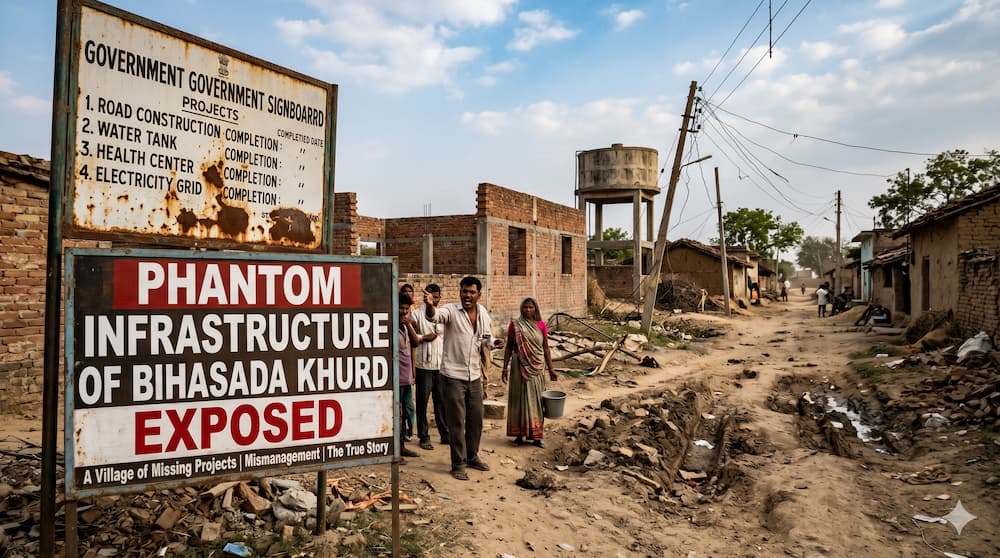
The Phantom Infrastructure of Bihasada Khurd captivates locals and visitors alike with its fascinating yet mysterious presence. Stories and legends shroud this enigmatic structure, describing it as a haunting remnant of a bygone era. It sparks intense curiosity and exploration, though its origins remain unclear. Various theories suggest that it stems from ancient architectural practices or unrecorded events. As one ventures into the heart of Bihasada Khurd, the aura of the Phantom Infrastructure evokes a sense of wonder and prompts inquiries into the stories of the past that linger in its shadows.
Key Takeaways
- The Phantom Infrastructure of Bihasada Khurd highlights issues in rural governance, revealing how local officials manipulate information to misrepresent development projects.
- RTI Act discrepancies expose the stark contrast between publicized infrastructure spending and the actual financial reality in Bihasada Khurd.
- Despite claimed expenditures over ₹9,45,000 on various projects, investigations disclose that many projects are entirely unexecuted.
- Local administrative failures, such as using unrelated data in public reports, obstruct transparency and deny citizens their rights to information.
- To overcome bureaucratic stagnation, citizens must enforce accountability by escalating issues to higher authorities and challenging administrative inaction.
Phantom Infrastructure of Bihasada Khurd: How Data Falsification and Deliberate Delays Stifle Rural RTI Whistleblowers
The Right to Information (RTI) Act of 2005 was heralded as a historic milestone for grass-roots Indian democracy. It promised to empower the common citizen and pierce through decades of bureaucratic opacity. The act aimed to directly expose administrative corruption, as seen in cases like the Phantom Infrastructure of Bihasada Khurd. Yet, twenty-one years after its inception, the implementation of this landmark legislation faces structural roadblocks. These challenges exist within the very institutions designed to protect it.
The ongoing legal struggle of a rural citizen from Gram Panchayat Bihasada Khurd, Vikas Khand Chhanbey, Janpad Mirzapur, highlights a deeply troubling trend. It uncovers how local administrative officers manipulate digital portals like eGramSwaraj to misrepresent developmental spending. Additionally, the State Information Commission’s procedural inefficiencies can unintentionally shield corrupt public officials.
The Illusion of Progress: The Missing Village Infrastructure
At the heart of this specific dispute is the ultimate financial accounting of public development funds allocated for Financial Year 2022–2023. To the casual observer or an auditor looking strictly at the village Public Information Board (PIB), Gram Panchayat Bihasada Khurd appeared to be a model of rural development. The public display board claimed a vibrant array of completed infrastructure projects. It listed over ₹9,45,000. This amount spanned across multiple key works designed to improve village life.
However, a formal point-by-point confrontation through an RTI Second Appeal completely shattered this facade. Under the threat of statutory penalties, the Public Information Officer (PIO) and Gram Panchayat Officer, Dilip Kumar Yadav, submitted a signed written defense on May 10, 2026, revealing an alarming administrative reality. They advertised multiple major infrastructure developments to the entire village as executed realities, but these developments were entirely non-existent on the ground.
The itemized discrepancies reveal a calculated gap between public advertisement and fiscal reality:
- Drain Construction: The Public Information Board prominently displayed an estimated allocation of ₹1,00,000 for local drains. The PIO officially admitted in writing that no ground execution took place and that they never made any payments.
- Soak Pit Construction: The community was informed about a completed ₹70,000 asset, but the PIO later admitted that the project was entirely unexecuted.
- Interlocking Brick Roadworks: They valued multiple interlocking projects on public boards at ₹1,90,000 and ₹1,20,000 respectively. However, the official cash books registered an actual payout of zero rupees.
- Submersible Pump & Water Tank Distribution: This essential clean-water infrastructure project has an estimated cost of ₹50,000 on the village board. However, the project never received any actual disbursement.
Phantom Infrastructure of Bihasada Khurd: The Action Plan Loophole and Digital Falsification
When confronted with these stark contrasts, the PIO resorted to a dual defensive strategy. This strategy exposes structural vulnerabilities in rural data management. First, the administrative officer argued that the presence of these ghost projects on the public board was merely a “reference to the Action Plan.
This defense fundamentally distorts the principles of transparency.
Displaying an unexecuted, unfunded budgetary idea on a physical “Work Done” board misleads the local populace.
It makes them believe development is occurring while masking a total lack of ground implementation.
Second, and far more egregious, was the PIO’s reliance on the “technical error” defense. The PIO admitted in writing that someone mistakenly uploaded the Public Information Board data for an entirely separate village—Gram Panchayat Bagedha Khurd. This error occurred. The official data portal for Bihasada Khurd operated under an entirely separate village Secretary.
This is not a harmless technical mistake. It represents a direct violation of Section 4 of the RTI Act, which mandates honest, voluntary disclosure (Sua Sponte) of correct information to the public. By uploading external, unrelated data, the local administration successfully obscured the actual financial and developmental status of Bihasada Khurd. This action directly stripped its residents of their constitutional right to monitor public expenditure.
Financial Discrepancies in Executed Works
Even where the local administration did execute and disburse funds, massive financial discrepancies persist between the publicly declared estimates and the cash book entries pulled from the eGramSwaraj system.
The Panchayat Bhawan Painting Skim
The physical Public Information Board in the village declared an estimated cost of ₹1,90,000 specifically for the painting and rejuvenation of the local Panchayat Bhawan.
However, a detailed analysis of the consolidated eGramSwaraj Cash Book for March 2023 reveals that the actual payment disbursed under Voucher 5THSFC/2022-23/P/11 on March 10, 2023, was a mere ₹32,750.
This exposes an unexplained budgetary deviation of over ₹1,57,000. The difference lies between what the public was led to believe the project cost and the actual financial reality.
Unnotified Hand Pump Expenditures (Phantom Infrastructure of Bihasada Khurd)
For routine hand pump maintenance and repairs, the public estimate was listed on the board at ₹35,000. Yet, the June 2022 Cash Book logs an actual combined withdrawal of ₹55,202 across separate material and labor vouchers. While the expenditure exceeded the public estimate by over 50%, the PIO continuously failed to provide the necessary verification data, including the exact dates of the repairs and the requested GPS coordinates for the 17 specified locations.
Phantom Infrastructure of Bihasada Khurd: How the Commission Impedes Further Remedies
The ultimate frustration for rural whistleblowers does not always lie with the corrupt practices of a village secretary; it frequently rests on the procedural mechanisms of the State Information Commission. In this case, during a second appeal hearing on May 11, 2026, inside Hearing Room S-9, State Information Commissioner Shakuntala Gautam orally declared the case as “Disposed.
On the public tracking system, the portal accurately notes that a final order was passed and the file was forwarded to the scrutiny division. However, the registry’s subsequent failure to sign, upload, or issue the written final judgment introduces a severe administrative roadblock.
Under the legal framework of the RTI Act, an appellant cannot file a formal application for non-compliance or seek execution of penalties against an erring officer until a certified copy of the written order is officially issued. By orally closing the case while withholding the physical document, the Commission traps the citizen in a state of procedural limbo. This structural delay directly prevents further escalation to higher judicial authorities, such as filing a writ petition in the High Court, and allows the PIO’s recorded misconduct to sit unpunished.
Conclusion: Turning the Bureaucracy Against Itself
The systemic manipulation discovered in Bihasada Khurd proves that digital portals like eGramSwaraj can easily be converted into tools of deception if there is no immediate local validation. When public officials use artificial technical errors to hide the non-disclosure of critical data, they are actively concealing grass-roots corruption.
To counter this institutional stagnation, citizens must adapt by shifting from simple information-seeking to aggressive procedural enforcement. By filing tactical, internal accountability RTIs against the Commission’s own registry, citizens can disrupt bureaucratic delays. They can escalate signed administrative confessions directly to supervisory bodies like the Chief Information Commissioner. The battle for rural transparency cannot be won merely by exposing missing assets on a village map. It is won by forcing the institutional machinery to answer for its own deliberate silence.
Based on your case records, portal status, and recent submissions, here is the organized directory of all relevant application IDs. It includes email addresses, mobile numbers, and official web links for the public authorities involved in your matter.
🆔 1. Application, File, and Registration IDs (Phantom Infrastructure of Bihasada Khurd)
Information Commission Case Identifiers
- Commission File Number:
S09/A/0494/2025 - RTI Appeal Registration Number:
A-20250200829 - Latest Scrutiny Diary Number:
D-220520260032(Dated: 22/05/2026) - Previous Scrutiny Diary Numbers:
D-110520260082,D-110520260035,D-110520260031,D-110520260030,D-031120250036,D-250920250048,D-200820250073 - RTI Commission Commission Notice Number:
2025085098300236(Dated: 07/08/2025) &202604S09N300614(Dated: 30/04/2026) - UPIC Interim Order Numbers:
202603S09AO0385,202602S09AO0238,202511S09AO0958,202510S09AO0595,202509S09AO0401,202506S09AO0999,202506S09AO0304,202505S09AO0427
Internal Registry RTI Identifier (Filed against the Commission) (Phantom Infrastructure of Bihasada Khurd)
- New RTI Registration Number:
UPICM/R/2026/60310 - Online Payment Reference Number:
CPAGTCKBC1
📧 2. Email Directory (Phantom Infrastructure of Bihasada Khurd)
Uttar Pradesh Information Commission (UPIC) Officials
- Chief Information Commissioner Office Registry:
hearingcourts1.upic@up.gov.in - State Information Commissioner (Hearing Court S-9 – Shakuntala Gautam):
hearingcourts9.upic@up.gov.in - Commission Internal Public Information Section (Mumtaz Ahmad):
jansu-section.upic@up.gov.in
Local District Authorities (Mirzapur) (Phantom Infrastructure of Bihasada Khurd)
- District Panchayat Raj Officer (DPRO) Mirzapur – Santosh Kumar:
dpromi-up@nic.in - Block Development Officer (BDO) Chhanbey:
bdo.chhanbey96@rediffmail.com - Gram Panchayat Officer (Secretariat Contact – Dileep Yadav):
dileepline4@gmail.com
📱 3. Mobile and Telephone Contact Numbers (Phantom Infrastructure of Bihasada Khurd)
Uttar Pradesh Information Commission Nodal Contacts
- Nodal Officer Telephone Number:
9415021746 - Internal PIO (Mumtaz Ahmad, Administrative Officer) Phone:
9151804317
Ground Level Respondents (Mirzapur Local Administration) (Phantom Infrastructure of Bihasada Khurd)
- Gram Panchayat Officer / PIO Office (Shri Dilip Kumar Yadav): Provided as masked in public data (
915180XXXX), please use the primary local desk routing through the BDO or DPRO email networks if direct dialing limits occur. - Your Registered Contact (For reference verification):
9619971441
🌐 4. Core Web Link Directory (Phantom Infrastructure of Bihasada Khurd)
- eGramSwaraj Official Expenditure Portal: [suspicious link removed]
- Uttar Pradesh Information Commission Online Portal: Used for checking direct file status codes and tracking current room listings (
https://mail.google.comsecure thread routes verify it operates via the state NIC servers mapped toupic.gov.in). - UP RTI Online Submission System: Portal link utilized to execute
UPICM/R/2026/60310tracking references for accountability testing against internal staff.


Facing a similar challenge? Share the details in the box below, and our team of experts will do their best to help.